
What is Wide Research
Wide Research is a Manus feature launched by the platform that providesbasic buildingcapability, supporting hundreds of general-purpose agents (Agents) working simultaneously through system-level parallel processing mechanisms and agent collaboration protocols, helping users efficiently handle complex, large-scale tasks, such as researching Fortune 500 companies or comparing top MBA programs. Each sub-agent is a fully functional Manus instance, and tasks are not limited by fixed formats or predefined domains, offering extremely high flexibility. Currently, this feature is available to Pro users and will gradually cover more user tiers in the future.
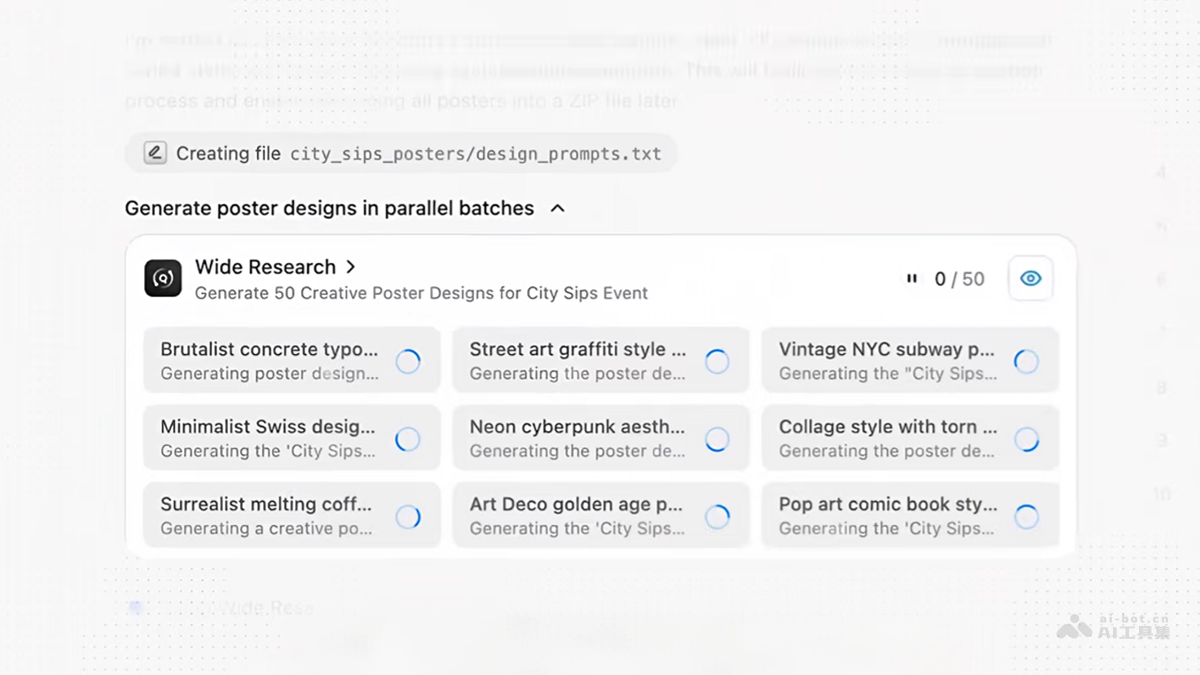
Main features of Wide Research
- Large-scale parallel processing: Supports hundreds of agents working in parallel to efficiently complete complex tasks.
- Complex task handling: Balances depth and breadth, suitable for enterprise research, market analysis, and many other fields.
- Agent collaboration mechanism: Based on a general-purpose agent architecture, agents can collaborate and share information to improve task processing efficiency.
How to use Wide Research
- Register and log in: Visit the Manus official website orManus AI APPregister an account and log in.
- Upgrade user tier: Upgrade to the Pro tier to unlock the Wide Research feature.
- Create a task: Users directly create and describe a task, and the system automatically activates Wide Research based on the task requirements.
- Interact with agents: Refine task requirements through the dialog box and guide the agents' work.
- Monitor progress: View agent work status and task completion in the task management interface.
- View results: After the task is completed, view the summarized results and download reports or data files.
Application scenarios of Wide Research
- Enterprise research: Quickly analyze the financial data, market performance, and strategic direction of Fortune 500 companies.
- Academic research: Assist researchers in collecting and organizing large amounts of literature and conducting interdisciplinary comparative analysis.
- Market analysis: Compare different brands' market share, user feedback, and marketing strategies.
- Technical evaluation: Evaluate the security, performance, and application scenarios of cutting-edge open-source projects.
- Education sector: Help students and teachers organize course materials and compare the advantages of different educational programs.