
What is Whisper-Medusa
Whisper-Medusa is an open-source AI speech recognition model launched by aiOla. It combines OpenAI's Whisper technology with aiOla's innovations. Whisper-Medusa introduces a multi-head attention mechanism, enabling parallel processing and significantly improving inference speed, with an average speedup of 50%. The model is optimized for English and supports more than 100 languages, making it suitable for multiple industries such as translation, finance, and travel. Whisper-Medusa is trained on the LibriSpeech dataset and has excellent performance and accuracy. Through weak supervision methods and training techniques, it reduces reliance on large amounts of manually labeled data. aiOla plans to further expand the model's multi-head attention mechanism to achieve even higher efficiency.

Main features of Whisper-Medusa
- High-speed speech recognition: Through the multi-head attention mechanism, Whisper-Medusa can process speech data in parallel, achieving transcription speeds 50% faster than traditional models.
- High accuracy: Despite the speed improvement, Whisper-Medusa's speech recognition accuracy is comparable to the original Whisper model, maintaining high accuracy.
- Multilingual support: The model supports transcription and translation in more than 100 languages, making it suitable for a variety of language environments.
- Weakly supervised training: Whisper-Medusa uses a weak supervision method for training, reducing reliance on large amounts of manually labeled data.
- Strong adaptability: The model can understand terminology and accents specific to particular industries and is suitable for different acoustic environments.
Technical principles of Whisper-Medusa
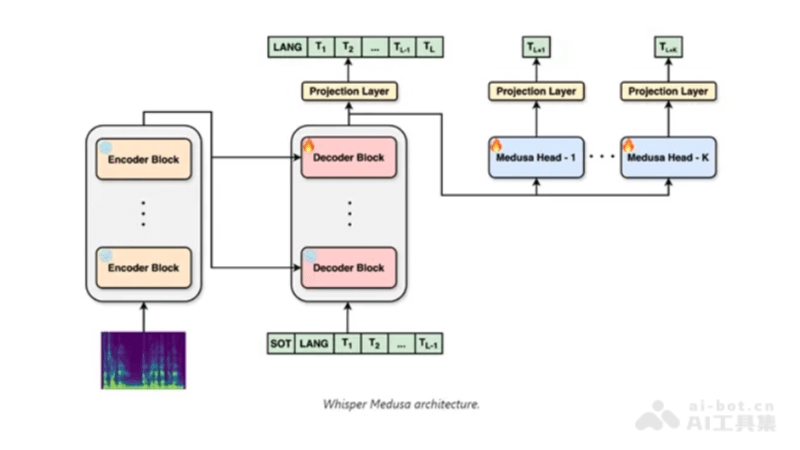
- Multi-head attention mechanism: Unlike traditional Transformer models, Whisper-Medusa uses a multi-head attention mechanism, allowing the model to process multiple data units (tokens) simultaneously. This parallelized processing significantly improves the model's inference speed.
- Weakly supervised training: During training, Whisper-Medusa uses a weak supervision method. This means that in the early stage of training, the main components of the original Whisper model are frozen while additional parameters are trained. Audio transcriptions generated by Whisper are used as pseudo-labels to train Medusa's additional token prediction module.
- Parallel computation: Each "head" of the model can independently compute attention distributions and then process input data in parallel. This parallelization method not only speeds up inference but also increases the model's expressive power, because each head can focus on different parts of the sequence and capture richer contextual information.
- Optimized loss function: During training, the loss function needs to consider both prediction accuracy and efficiency. The model is encouraged to speed up prediction as much as possible while ensuring accuracy.
- Stability and generalization ability: To ensure that the model converges stably during training and avoids overfitting, aiOla adopted various methods such as learning rate scheduling, gradient clipping, and regularization.
Project addresses of Whisper-Medusa
- Project official website:https://aiola.com/blog/introducing-whisper-medusa/
- GitHub repository:https://github.com/aiola-lab/whisper-medusa
- HuggingFace model library:https://huggingface.co/aiola/whisper-medusa-v1
Application scenarios of Whisper-Medusa
- Speech recognition (ASR): Whisper-Medusa can be used to convert speech into text in real time, making it suitable for meeting minutes, lecture transcription, podcast production, and more.
- Multilingual translation: It supports more than 100 languages and can be used for real-time translation services, helping cross-language communication and international conferences.
- Content monitoring and analysis: In broadcasting, television, and online media, Whisper-Medusa can be used to automatically generate subtitles and content summaries, as well as perform content monitoring.
- Customer service: In call centers, Whisper-Medusa can improve customer service efficiency by using automatic speech recognition to quickly respond to customer needs.
- Medical records: In the medical field, it can be used to quickly and accurately transcribe doctors' diagnoses and patients' medical histories, improving the efficiency of medical records.
- Law and justice: In court records and legal research, Whisper-Medusa can help quickly generate accurate written records.