
In the field of artificial intelligence, the recurrent neural network (RNN) is a special neural network structure that has demonstrated outstanding capabilities in processing sequence data. This article will explore knowledge related to RNNs from multiple perspectives, including their definition, structure, working principles, application scenarios, advantages and disadvantages, variants, and some common questions.
What Is a Recurrent Neural Network
A recurrent neural network (English name Recurrent Neural Network, abbreviated as RNN) is a neural network with internal memory. This memory enables the network to process and analyze sequence data by considering information from the previous step. Unlike traditional feedforward neural networks, which process data in a single direction, RNNs have connections that form directed cycles, enabling them to retain information from previous inputs.
The key behind RNNs is the concept of "recursion." Each step of an RNN receives an input and produces an output, while passing information to the next step. This feedback loop allows the network to capture dependencies and patterns in sequence data, making it very suitable for tasks involving sequence analysis.
Structure of a Recurrent Neural Network
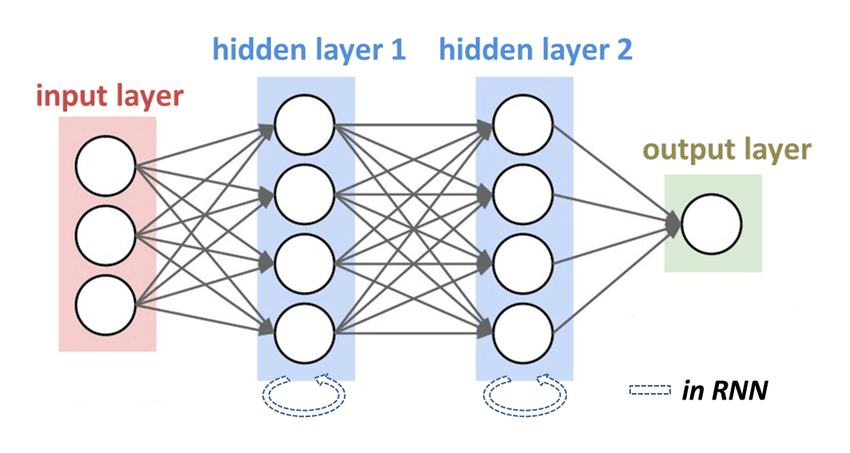
The structure of an RNN consists of an input layer, a hidden layer, and an output layer. Among these, the hidden layer is the core of the RNN. The hidden layer not only processes the current input but also contains a short-term memory component used to store information from previous inputs. This design enables the RNN to capture long-term dependencies in sequence data.
- Input layer: receives input data from the outside.
- Hidden layer: contains recurrent connections, allowing the network to remember previous states.
- Output layer: produces the final output of the network.
Applications of Recurrent Neural Networks
- Natural Language Processing (NLP): RNNs are widely used in NLP tasks such as language modeling, machine translation, sentiment analysis, and text generation. RNNs can capture contextual information in text, making them very effective in understanding and generating human-like language.
- Speech recognition: RNNs have been successfully applied to speech recognition tasks, where the sequential characteristics of speech signals are considered. RNN-based models have achieved state-of-the-art performance in tasks such as speech-to-text conversion and voice command recognition.
- Time series analysis: RNNs are very suitable for analyzing time series data, such as stock prices, weather data, and sensor readings. They can capture temporal dependencies and make predictions based on historical data, making them very valuable in forecasting and anomaly detection.
- Image captioning: RNNs have been used in image captioning tasks, where the network generates textual descriptions of images. By combining visual features extracted from images with the sequential characteristics of language, RNNs can generate meaningful and contextually relevant captions.
Advantages and Limitations of Recurrent Neural Networks
Advantages of Recurrent Neural Networks
- Sequence processing: RNNs excel at processing sequence data, making them suitable for tasks involving sequence analysis.
- Variable input length: RNNs can handle inputs of variable length, giving them flexibility when processing different types of data.
- Context understanding: RNNs can capture contextual information in sequence data, allowing them to understand and generate meaningful output.
Disadvantages of Recurrent Neural Networks
- Vanishing/exploding gradients: RNNs are prone to the vanishing or exploding gradient problem, which may make training difficult.
- Memory limitations: RNNs have limited memory capacity, which may make capturing long-term dependencies in data challenging.
- Computational complexity: RNNs can be computationally expensive, especially when processing long sequences or large amounts of data.
Variants of recurrent neural networks
To address some of the limitations of RNNs, researchers have proposed several variants of RNNs, such as:
- Long short-term memory networks (LSTM): LSTM selectively retains or forgets information by introducing a gating mechanism, effectively solving the vanishing gradient problem.
- Gated recurrent unit (GRU): GRU is a simplified version of LSTM that merges the forget gate and input gate into a single update gate, reducing the number of model parameters.
- Bidirectional RNN (Bi-RNN): Bi-RNN considers both the forward and backward information of the sequence at each time step, and can provide richer contextual information in certain tasks.