
A large language model (LLM) is an artificial intelligence program that learns to understand and generate human language by learning from massive amounts of text data. It is trained through two stages, "pre-training" and "fine-tuning," and its core technology is the Transformer architecture and its "self-attention mechanism."

What Is a Large Language Model
Definition and Overview
A large language model (Large Language Model, LLM) is a type ofartificial intelligence (AI) programthat, by learning from massive amounts of text data, has masteredthe ability to understand and generate human language. You can think of it as an extremely powerful "language master" that has read countless books, articles, web pages, and code, and can converse, answer questions, write articles, translate languages, or write code like a human.
The "large" in large models is reflected in two aspects:
- First, the "amount of knowledge" learned is very large, requiringTB-level (trillion bytes) text datafor training;
- Second, the "brain" (that is, the model parameters) is also very large, often havingtens of billions or even trillions of parameters, and parameters are like neurons in the brain, helping to understand and process language.
For example, Meta's latest open-source Llama 3 model has a parameter count reaching an astonishing70 billion, and was trained using more than15 trillion tokens(which can be understood as words or word fragments) of data, equivalent to reading millions of thick books. This scale of learning enables large language models to capture extremely subtle patterns and associations in language, demonstrating powerful language processing capabilities.
Core Capabilities: Understanding and Generation
"Understanding"
means the model can read the text you input and grasp its meaning, emotion, and intent. For example, when you ask "How is the weather today?", the model can recognize the words "today," "weather," and "how is," and can better understand that you are asking about the current weather conditions. This understanding ability enables the model to conduct effective conversations, rather than simply matching keywords.
"Generation"
means the model can, based on your input or a given topic,create entirely new, coherent, and logical text. For example, you can ask the model to write a poem about spring, or generate a story based on a few keywords, and it can complete the task well. This generation capability is not limited to text; some advanced large language models can also generate code, tables, images, and music.
Technical Cornerstone: Transformer Architecture
The reason large language models can be so powerful is that the core technology behind them is the "Transformer" neural network architecture. The architecture was first proposed by Google researchers in 2017, and it completely changed the face of the natural language processing (NLP) field. The core innovation of the Transformer architecture is the "Self-Attention Mechanism," which allows the model, when processing one word, to simultaneously pay attention to all other words in the input text and assign different weights according to their importance.
It is like when you read a passage, your brain automatically focuses on the key words and sentences to better understand the meaning of the entire paragraph
Through this mechanism, the Transformer architecture can effectively capture long-distance dependencies in text; a word may be semantically related to another word far away. It has good parallel computing capability and can use hardware such as GPUs for efficient training, handling larger-scale data and models.
How are large language models trained?
The training process of a large language model can be vividly compared to "feeding" a growing child. Except that this "child" has an astonishing appetite and needs to "eat" massive amounts of text data to become smart.
Data sources are extensive, including but not limited to books, articles, news, web pages, code repositories, forum discussions, and so on. The quality and quantity of training data directly determine the upper limit of the model's performance.
Data preprocessing includes steps such as removing irrelevant characters, correcting spelling errors, and tokenization (splitting sentences into words or subword units). To ensure that the model can learn broad knowledge, the training data covers multiple domains, multiple languages, and multiple text genres.
Large-scale data "feeding" enables the model to learn the statistical patterns of language, grammatical structures, semantic relationships, and world knowledge, laying a solid foundation for subsequent understanding and generation capabilities. One can imagine that a person who has read widely will naturally have a much higher knowledge reserve and level of cognition than someone who has read only a few books, and the same is true for large language models.
Pre-training and Fine-tuning
The training of large language models is divided into two main stages:Pre-training and Fine-tuning。
Pre-trainingis the most time-consuming and computationally resource-intensive part of the entire training process. Its goal is to enable the model to master general language abilities by learning from massive amounts of unlabeled text data. In the pre-training stage, the model performs "self-supervised learning" tasks, such as "Masked Language Model" (MLM) or "Next Sentence Prediction" (NSP). In the MLM task, some words in the input text are randomly masked, and the model's task is to predict what these masked words are. By repeatedly performing such prediction tasks, the model gradually learns the associations between words and the contextual information of language. After pre-training is completed, the model has a strong foundation for language understanding and generation.
Although the general model obtained from pre-training is knowledgeable, its performance on specific tasks may not be perfect. This requires fine-tuning.
Fine-tuningrefers toon labeled datasets for specific tasks, further training the pre-trained model. For example, if we want to make a large language model specifically for sentiment analysis (determining whether a piece of text expresses positive or negative emotion), we can collect a dataset containing a large amount of text and its corresponding sentiment labels, and then use this dataset to fine-tune the pre-trained model. During fine-tuning, the model's parameters are slightly adjusted according to the requirements of the specific task, so that its performance on that task is better.
The developers of Llama 3 also emphasized improving the model's performance and safety in dialogue scenarios through Instruction Fine-tuning and Alignment.
Key Technology: Self-Attention Mechanism
The Self-Attention Mechanism is the core of the Transformer architecture and also a key technology that enables large language models to effectively process and understand language. The core idea is that when processing an element in a sequence (such as a word in a sentence), the model calculates the degree of association between this element and all other elements in the sequence (including itself), and based on these degrees of association, weights and aggregates the information of the other elements to obtain a new representation of the current element. This process can be understood as the model dynamically assigning "attention weights" to each word while reading, determining which other words in the sequence should be focused on when understanding the current word.
Specifically, the self-attention mechanism maps the embedding representation of each word (a way of converting words into vectors) into three different vectors:Query vector (Query), Key vector (Key), and Value vector (Value). By calculating the dot product of the query vector with all key vectors, an attention score is obtained, which measures the relevance of the current word to other words. After these scores are scaled and normalized by Softmax, attention weights are obtained. Finally, these weights are used to perform a weighted sum of the value vectors to obtain the new representation of the current word after processing by the self-attention mechanism. This new representation integrates information from all other words in the sequence and can highlight the parts most relevant to the current word.
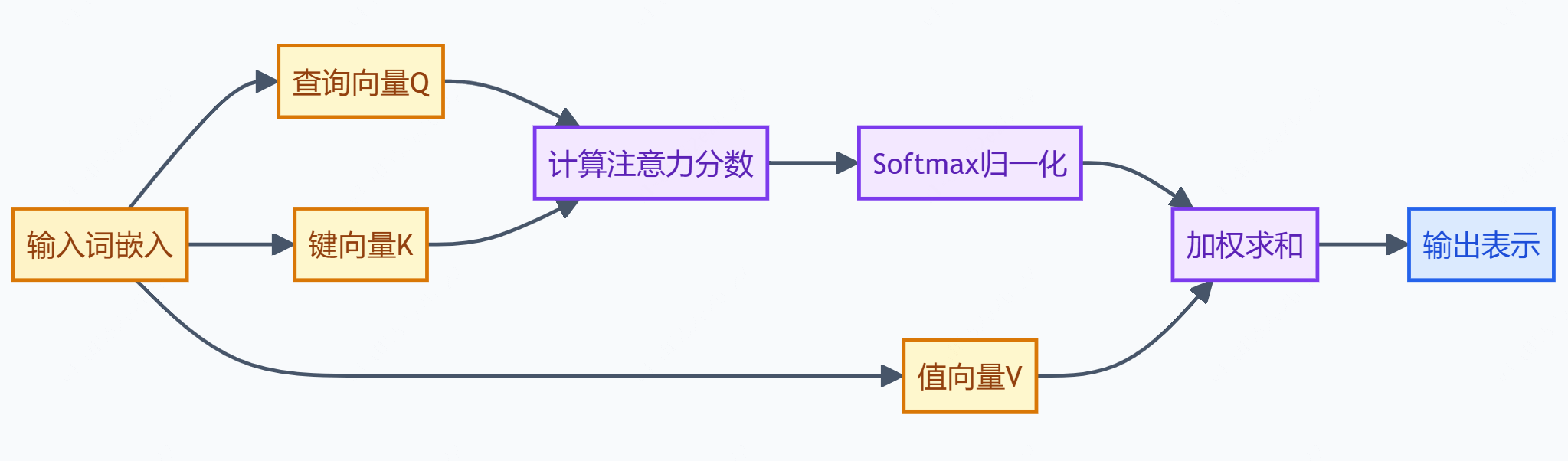
The advantage lies in its ability tocapture long-distance dependencies in text, with goodparallel computing capability. Traditional recurrent neural networks (RNNs), when processing long sequences, are prone to the problems of vanishing gradients or exploding gradients, making it difficult to capture dependencies between distant words. The self-attention mechanism effectively solves this problem by directly calculating the association between any two positions in the sequence. Since the attention calculation at each position can be performed independently, it is very suitable for acceleration on parallel computing hardware such as GPUs. This enables the model to learn complex language patterns and knowledge from massive amounts of text data.
What is the difference between DeepSeek and KIMI
DeepSeek: Focused on code and mathematics
DeepSeek is a series of large language models developed by the Chinese company DeepSeek AI, with strong capabilities in code generation and mathematical reasoning. The DeepSeek Coder series models, especially its version with6.7 billion parameters, achieved a very high pass rate on the HumanEval evaluation (a commonly used benchmark for measuring code generation capability), demonstrating its ability to generate high-quality, functional code.
The DeepSeek model demonstrates strong comprehensive capabilities in multiple aspects such as general language understanding and mathematical problem solving. For example, the DeepSeek LLM 67B model achieved leading results on multiple authoritative Chinese and English evaluation benchmarks, showing its potential in handling complex reasoning and knowledge-intensive tasks.
KIMI: Outstanding long-text processing capability
KIMI is a large language model developed by Moonshot AI, and its core competitiveness lies inpowerful long-text processing capability. The KIMI intelligent assistant announced in October 2023 that it supports input of200,000 Chinese charactersof context length, which was a leading level worldwide at the time. KIMI further improved its long-text processing capability, and can support up to2 million Chinese characterscontextual input. This enables KIMI to easily handle scenarios that require reading and understanding large amounts of documents, such as reading lengthy reports, analyzing complex contracts, and extracting key information from multiple research papers. By focusing on the niche area of long-text processing, KIMI has formed its own unique technical advantages and market positioning.
| Feature | DeepSeek | KIMI |
|---|---|---|
| Developer | DeepSeek AI | Moonshot AI |
| Core strengths | Code generation, mathematical reasoning | Long-text processing |
| Key capabilities | Code generation (such as DeepSeek Coder), general language understanding, complex reasoning | supports200,000 to 2,000,000 Chinese charactersof contextual input, with deep understanding and analysis of long documents |
| Model scale | Provides different parameter scales, such as 7B, 67B, etc. | Specific parameter counts are not disclosed in detail, but long-text processing capability is emphasized |
| Open-source status | Open source, providing model weights for community research and commercial use | Closed source, providing services through APIs or applications |
| Main application scenarios | Assisted programming, software development, mathematical problem solving, logical reasoning tasks | Long report/contract analysis, multi-document information extraction and summarization, academic research assistance, legal document review |
Differences in application scenarios
DeepSeek
It has strong capabilities in code generation and mathematical reasoning, making it more suitable for developers and technical researchers. For example,
- programmers can use DeepSeek Coder to assist in writing code, automatically generate code snippets, and perform code debugging and optimization, improving development efficiency.
- DeepSeek can be applied to scenarios that require strong logical thinking and analytical ability, such as solving difficult mathematical problems and assisting with scientific computing.
KIMI
Outstanding long-text processing capability, more suitable for scenarios that require processing and analyzing large amounts of textual information. For example,
- in the financial field, analysts can use KIMI to read and analyze lengthy industry research reports and company financial statements, quickly extracting key information and insights;
- in the legal field, lawyers and legal staff can use KIMI to review lengthy contracts and legal documents, identifying potential risks and key clauses;
- in the academic research field, researchers can use KIMI to quickly read and understand large amounts of literature, assisting with literature reviews and knowledge discovery.
In summary,DeepSeek is more like a "technical expert", skilled at handling tasks related to code and mathematics,KIMI is like a "master of reading and analysis."
Open-source large models and closed-source large models
Open-source large language models
refer to core resources such as the model's source code, pre-trained weights, and training data (partially or fully) being made open to the public, supporting anyone to freely use, study, modify, and distribute them.
Advantages
- Promotes rapid technological iteration and shared progress. Researchers and developers worldwide can conduct secondary development based on existing open-source models, optimize them for specific tasks or domains, and accelerate innovation.
- Enhances transparency and credibilityBecause the model's internal structure and training details are public, researchers can gain a deeper understanding of how the model works, analyze potential biases and risks, and propose improvements. This helps build user trust in the model and promotes responsible AI development.
- Lowering the technical barrier, enabling small and medium-sized enterprises and individual developers to also leverage advanced large language model technology and develop various innovative applications, avoiding a situation of monopoly by a few large companies that own closed-source models.
Closed-source large language models
means that core resources such as the model's source code and weights are not publicly disclosed and are internally controlled and maintained by the developing company. This model is driven by commercial interests, and the company obtains commercial returns by providing API services based on closed-source models or integrating them into its own products.
Advantages
- Training more powerful models. Development companies have stronger computing resources, higher-quality datasets, and more professional R&D teams, enabling them to train models with larger parameter counts and stronger performance.
- A clearer path in commercialization. Companies can strictly control the use of models and charge through methods such as API call counts and service level agreements (SLAs), forming a sustainable business model. Closed source means companies can better protect their core technologies and intellectual property and avoid imitation by competitors. For users, using API services of closed-source models is usually more convenient, without needing to worry about underlying details such as model deployment and maintenance, and can be quickly integrated into their own applications.
| Feature | Open-source large models | Closed-source large models |
|---|---|---|
| Core resources | Open: source code, weights, and some training data are public | Not public: internally controlled and maintained by the developing company |
| Driving factors | Community collaboration, technology sharing, rapid iteration | Commercial interests, performance leadership, intellectual property protection |
| Main advantages | High transparency, strong customizability, community support, lower costs, avoiding monopoly | Performance leadership, clear commercialization path, easy integration, professional support, technology protection |
| Main disadvantages | May be abused, maintenance depends on the community, performance may not match top closed-source models | Low transparency("black box"), poor controllability, data privacy concerns, may lead to technology monopoly, limited innovation vitality |
| Typical representatives | Llama series, DeepSeek series, Alpaca, Vicuna | GPT series (OpenAI), PaLM series (Google) |
| Applicable scenarios | Needs customization, limited budget, emphasis on transparency, participation in community innovation, high data privacy requirements | Pursuit of top performance, rapid integration and deployment, lack of technical resources, need for commercial support, low requirements for model update frequency |
How to choose open source or closed source
When choosing whether to use an open-source large model or a closed-source large model, there is no absolute "better"; the key lies incomprehensively considering specific needs, application scenarios, resource budgets, and requirements for controllability and transparency。
Open-source large models are more suitable for the following situations:
- Requires a high degree of customization and controllability: If you need to deeply modify a model to adapt it to a specific task, or want complete control over the model's training, deployment, and update process, then open-source models are a better choice. You can access the model's source code and weights and make arbitrary adjustments and optimizations.
- Limited budget or want to avoid API call fees: Open-source models are usually free (although training and deployment may require some investment in computing resources) and can avoid the cost of paying per API call. This is especially attractive for small and medium-sized enterprises or individual developers with limited budgets.
- Focus on transparency and interpretability: If you need to deeply understand model behavior, analyze its potential biases, or conduct academic research, open-source models provide the necessary transparency and accessibility.
- Want to participate in community contributions and collaborative innovation: The open-source community provides opportunities to communicate and collaborate with developers around the world and can jointly advance the development of model technology.
- Extremely high data privacy and security requirements: If the data being processed is very sensitive and the model needs to be deployed locally or in a private environment, open-source models provide this possibility.
Closed-source large models are more suitable for the following situations:(provided through API services)
- Pursuing the most advanced performance and the broadest capabilities: Leading closed-source models (such as GPT-4) perform best in various benchmark tests. If you need a model to provide the highest level of accuracy and intelligence on complex tasks, a closed-source model may be a better choice.
- Want rapid integration and deployment without needing to care about underlying details: Calling closed-source model services through APIs can greatly simplify the complexity of integration and deployment, allowing you to quickly apply the capabilities of large language models to products without investing a lot of effort in model training and maintenance.
- Lack sufficient technical team or computing resources: Training and deploying large language models requires specialized knowledge and expensive hardware. If there is a lack of such resources internally, using closed-source model API services can lower the technical threshold.
- Need stable commercial support and SLA guarantees: Closed-source model API services provided by commercial companies offer technical support and service level agreements to ensure service stability and reliability.
- Application scenarios have low requirements for model update frequency: Updates to closed-source models are controlled by the developing company, and users cannot actively update them. If your application scenario does not depend heavily on the latest model advancements, this is acceptable.
Open source and closed source each have advantages and disadvantages, and which path to choose depends on specific needs and priorities. In many cases, the two can even be used in combination. For example, you can use open-source models for initial exploration and prototype development, and then choose a more powerful closed-source model API service in the production environment according to your needs.
Introduction to Mainstream Models
Mainstream Open-Source Large Language Models
| Model Series | Examples of Representative Models | Main Features | Open-Source License |
|---|---|---|---|
| Meta Llama | Llama 3 (8B, 70B) | Strong general capabilities, multilingual support, optimized for dialogue, emphasis on responsible AI | Custom commercial license |
| TII Falcon | Falcon 7B, Falcon 40B | High-quality training data, efficient architecture, multilingual support, suitable for general NLP and assistant tasks | Apache 2.0 |
| DeepSeek | DeepSeek R1 (MoE, ~37B activated parameters) | Powerful math and reasoning capabilities, MIT license, MoE architecture, 128K context | MIT |
| Mistral AI | Mistral Small 3.1 (24B) | High performance, multimodal, Apache 2.0, 128K context, high inference speed | Apache 2.0 |
Performance
| Model | Key benchmark performance (some examples) | Context window | Notes |
|---|---|---|---|
| Llama 3 70B (It) | MMLU: 82.0 |
8K (extensible) | Meta, custom commercial license, GQA |
| Falcon 40B | Excellent performance on Open LLM Leaderboard, surpassing LLaMa-65B in some aspects | 2K (extensible) | TII, Apache 2.0, MQA, RefinedWeb data |
| DeepSeek R1-0528 | AIME 2025: 87.5% |
128K | DeepSeek, MIT license, MoE architecture (~37B activated parameters) |
| Mistral Small 3.1 | MMLU: ~75-80% (estimated from the chart) |
128K | Mistral AI, Apache 2.0 license, 24 billion parameters, multimodal |
Mainstream closed-source large language models
| Model series | Representative model examples | Main features | Developer/Company |
|---|---|---|---|
| OpenAI GPT | GPT-4o | Powerful multimodal capabilities, near-human response speed, broad language understanding, mature API services | OpenAI |
| Anthropic Claude | Claude 4 (Opus, Sonnet) | Long-text processing, complex reasoning, safety, strong coding capabilities, Constitutional AI | Anthropic |
| Google Gemini | Gemini 2.5 Pro | Ultra-long context processing, multimodal support, integration with the Google ecosystem, powerful reasoning capabilities | |
| xAI Grok | Grok 3 | Real-time knowledge access, personalization and humor, integration with the X platform | xAI |
Challenges and Trends of Large Language Models
Data Security and Privacy Protection. The training and operation of large language models require processing large amounts of data, which may contain personal privacy information or commercially sensitive data.How to ensure the security of such data during collection, storage, and use, and prevent data leakage and abuse, is a key issue that urgently needs to be addressed. When generating content, models may also inadvertently leak sensitive information contained in the training data. How users' interaction data with models is used and protected is also a common concern among users.
In the future, it is necessary to strengthen technical measures such as data encryption, anonymization processing, and access control, and establish sound relevant laws, regulations, and ethical norms to safeguard data security and user privacy.
Model Bias and Ethical Issues. Large language models acquire knowledge by learning from massive amounts of data. If bias exists in the training data (such as gender bias, racial bias, regional bias, etc.), the model is very likely toreplicate or even amplify these biases when generating content, leading to unfair or discriminatory results. Models may be used to generate false information or malicious content, or for illegal activities such as fraud, causing serious ethical and social problems. How to effectively identify and eliminate model bias and ensure that model outputs comply with ethical and legal norms is a current research hotspot and difficulty.
In the future, it is necessary to develop more advanced bias detection and mitigation technologies and establish sound ethical review and regulatory mechanisms.
Multimodal Fusion and Artificial General Intelligence. Current mainstream large language models mainly process text information, but information in the real world exists in multiple modalities, such as images, audio, and video.
An important future trend isthe development of multimodal large language models, the model can simultaneously understand and generate information from multiple modalities, achieving something closer to human cognitive capabilities:Artificial General Intelligence (AGI). For example, a model can not only understand image descriptions, but also perform reasoning and question answering based on image content; it can understand voice commands and combine visual information for more complex interactions. Multimodal fusion will greatly expand the application scenarios of large language models and enable them to better understand and integrate into the physical world. Improving a model's reasoning ability, planning ability, interpretability, and ability to interact with the real world is also a key path toward artificial general intelligence.