
The Harmony Agent Framework HMAF (Harmony Agent Framework) is a core artificial intelligence framework launched by Huawei, building an AI ecosystem with autonomous decision-making and group collaboration capabilities, comprehensively empowering the intelligent upgrade of HarmonyOS applications. By deeply integrating AI capabilities into the underlying operating system, HMAF drives the evolution of human-computer interaction from traditional graphical interfaces to more natural language interaction, providing developers with powerful tools and platform support, and accelerating the innovation and implementation of agent applications.
What is the Harmony Agent Framework
Definition
The Harmony Agent Framework (Harmony Agent Framework, abbreviated as HMAF) is a core artificial intelligence framework built by Huawei for its self-developed HarmonyOS operating system. It aims to build an AI ecosystem with autonomous decision-making and group collaboration capabilities, comprehensively empowering the intelligent upgrade of applications and driving the HarmonyOS ecosystem toward a more advanced stage of intelligence.
Core Objectives
To build a new "human-centered" operating system paradigm and create an "open and win-win" ecosystem. This concept is reflected in its design philosophy, which is to understand and satisfy users' potential needs through agents, rather than merely responding to users' explicit instructions. HMAF drives the comprehensive evolution of human-computer interaction from the traditional graphical user interface (GUI) to the language user interface (LUI), distributing through HarmonyOS system entry points and Xiaoyi (Huawei's intelligent assistant), making services more efficient and more continuous. HMAF supports applications with autonomous agent capabilities, enabling multi-agent collaboration to complete complex tasks, elevating the convenience and practicality of AI to a new height. Through the deep integration of the system-level agent Xiaoyi and application Agents, seamless collaboration is achieved, allowing users' needs and intentions to be smoothly realized through collaboration among agents.
Strategic Significance in the HarmonyOS Ecosystem
The Harmony Agent Framework (HMAF) has far-reaching strategic significance in the entire HarmonyOS ecosystem and even the entire AI industry. HMAF is a key initiative in the evolution of the HarmonyOS system toward an "AI-native operating system," and is also the core driving force for building differentiated competitive advantages in the HarmonyOS ecosystem. By deeply embedding AI capabilities into the HarmonyOS system kernel, HMAF will enable the HarmonyOS system to have stronger scenario awareness, intent understanding, and autonomous decision-making capabilities, and to provide users with more proactive, intelligent, and personalized services. The transformation from "people adapting to machines" to "machines adapting to people" greatly improves the user experience, enhances user stickiness, and drives HarmonyOS applications to transform from traditional function execution to intelligent partners providing proactive services.
HMAF builds an AI ecosystem with autonomous decision-making and group collaboration capabilities, greatly enriching the application scenarios and service capabilities of the HarmonyOS ecosystem. By supporting multi-agent collaborative work, HMAF can break down barriers between applications and realize seamless service flow and task collaboration across applications and devices. The realization of this capability will attract more developers and partners to join the HarmonyOS ecosystem, jointly develop innovative applications and services based on HMAF, and accelerate the prosperity and development of the HarmonyOS ecosystem. By launching the Xiaoyi Agent Open Platform, Huawei comprehensively empowers developers and drives the vigorous development of agent development, helping the HarmonyOS ecosystem quickly make up for its shortcomings in the number of applications and form differentiated competitive advantages.
The launch of HMAF is a key move for the HarmonyOS ecosystem to respond to competition in the future AI era, and is an important step in Huawei's AI industry layout. With the rapid development of AI technology, agents are becoming a new paradigm for mobile application transformation. By providing a unified agent development framework and standards, HMAF lowers the development threshold, enabling more developers to participate in innovation in agent applications. The features emphasized by HMAF, such as device-cloud collaboration and security and trustworthiness, also lay a solid foundation for the sustainable development of the HarmonyOS ecosystem in the AI era. By building an agent value network with HMAF at its core, the HarmonyOS ecosystem is expected to occupy a favorable position in future AI industry competition and achieve a leap from 'interconnection of all things' to 'intelligent connection of all things'.
Core Features of the HarmonyOS Agent Framework
A Brand-New Agent Interaction Paradigm
Through system-level entrances (such as Xiaoyi voice dialogue, navigation bar, Xiaoyi Suggestions, Xiaoyi Search, etc.) and in-app entrances, natural interaction between agents and users is achieved. No longer limited to the traditional graphical user interface (GUI), it is fully evolving toward a language user interface (LUI), allowing users to engage in multi-turn conversations with agents through natural language and express complex intentions. HMAF supports multiple interaction forms, including agent manipulation (efficiently accessing and controlling application functions through natural language), agent companionship (agents continuously providing support in the background, such as a meeting assistant), and agent GUI tasks (combining GUI and LUI to provide a richer interactive experience). This makes service reach more efficient and convenient. Users can wake up Xiaoyi anytime and anywhere and reach the required agent service directly with one sentence, greatly shortening the operation path.
Agent Protocol Upgrade
The HarmonyOS Agent communication protocol is proposed, breaking down collaboration barriers between applications and agents within the HarmonyOS system, as well as between agents and agents, to achieve deep collaboration. The protocol supports complex device-cloud tasks and all-scenario cross-device interoperability, enabling system agents to collaborate efficiently with application agents to jointly complete user requests. HMAF has comprehensively upgraded the intent framework, supports custom intent development, and is compatible with the MCP (Message Channel Protocol), further enriching the agent tool ecosystem. This upgrade at the protocol level lays a solid foundation for building an AI ecosystem with autonomous decision-making and collective collaboration capabilities.
Efficient Agent Development
Through the Xiaoyi Agent Open Platform and HarmonyOS Agent Kit, HMAF provides developers with solutions covering the entire agent lifecycle, including full-chain support from design, development, and debugging to deployment. The platform supports multiple development modes, such as LLM (large language model) mode, workflow mode, A2A (Agent-to-Agent) mode, and multi-agent mode, adapting to the needs of different business logic. HMAF provides rich system-level plug-ins and third-party tools, supports flexible orchestration of device-cloud plug-ins, and achieves efficient listing and distribution of agents through the agent marketplace, building a virtuous cycle between developers and users. Huawei has launched the 'DevEco Code Genie' code tool to improve development efficiency and reduce development costs through AI-assisted development.
Secure and Trustworthy Agents
A full-stack security protection system has been built to protect user data and privacy. Based on trusted infrastructure, the system has built multiple lines of defense, including agent data security, device-cloud execution environment security, and unified identity authentication. HMAF particularly emphasizes the protection of key assets such as users' sensitive data, device access permissions, and user identity credentials, ensuring that agents do not harm users' privacy and security interests while providing convenient services. The emphasis on security and trustworthiness is an important prerequisite for HMAF to gain user trust and be widely promoted.
Main Advantages of the HarmonyOS Agent Framework
For users
The most direct advantage brought by HMAF isa more natural, more powerful, more efficient, and more collaborative interaction experience . Through natural language understanding and multimodal interaction, users can communicate with devices in a way closer to human communication, and intelligent agents can understand users' complex intentions, proactively predict user needs, and provide services. For example, users can ask the Himalaya intelligent agent to filter podcasts via voice commands, or directly operate Excel spreadsheets through the Xiaoyi assistant. HMAF supports multi-agent collaboration and can handle complex tasks across applications and devices. For example, when a user sets a schedule reminder on a phone, the intelligent agent can automatically sync it to a tablet, watch, or even car system, achieving seamless flow across all scenarios. System-level entry points (such as Xiaoyi) realize a continuous service loop, can understand users' higher-order intentions, handle more complex tasks, and greatly shorten the path for users to obtain services.
For developers
HMAF provides powerfuldevelopment empowerment and efficiency improvement. The Xiaoyi intelligent agent open platform provides a one-stop efficient development environment. Developers can use preset AI capabilities, standardized API interfaces, and rich development tools to quickly build and deploy HarmonyOS intelligent agents. HMAF supports multiple development modes, including LLM, workflow, A2A, etc., lowering the threshold for AI application development, and developers can get started without deeply understanding complex AI algorithms. Huawei's DevEco Code Genie code tool can use AI to assist with code continuation, problem localization, and UI generation, and is said to improve development efficiency by more than 30%. HMAF provides more than 50 prebuilt AI intelligent agents and system plugins, which developers can directly call or further develop, further accelerating the process of application intelligence.
For the HarmonyOS ecosystem
The introduction of HMAFenhances its core competitiveness and promotes ecosystem prosperity. As the core framework of the HarmonyOS system in the AI era, HMAF is one of its important features that distinguishes it from other operating systems. It promotes the transformation of HarmonyOS applications from traditional function execution to intelligent partners that provide proactive services, raising the intelligence level of the entire ecosystem. By attracting more developers to innovate based on HMAF, the HarmonyOS ecosystem can provide more intelligent applications and services with differentiated advantages, attract more users, and form a virtuous cycle. The openness and standardization of HMAF also help integrate more third-party services and applications, build a richer and more diverse intelligent agent network, and ultimately enhance the overall value and appeal of the HarmonyOS ecosystem. The first batch of more than 50 pioneer HarmonyOS intelligent agents is already under development, covering multiple fields such as shopping, social networking, and life services, indicating that the HarmonyOS ecosystem will usher in a new round of intelligent upgrading.
Technical principles of the HarmonyOS intelligent agent framework
Basic working principles
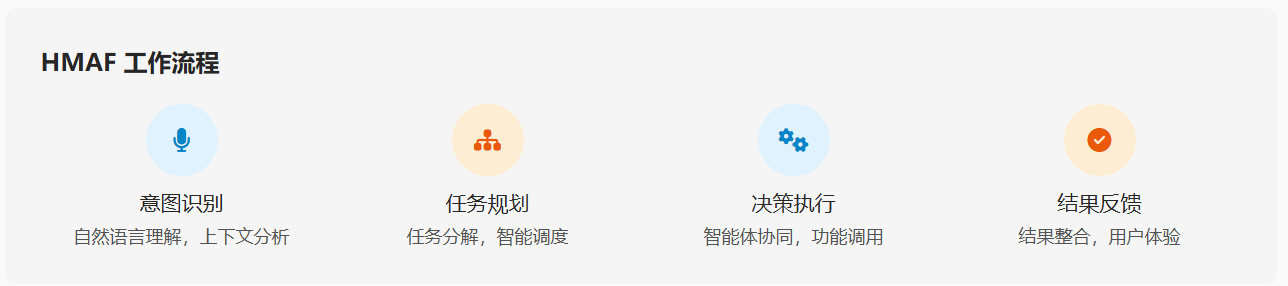
The basic working principles of the HarmonyOS intelligent agent framework (HMAF) revolve aroundunderstanding user intent, planning tasks, decision execution, and multi-agent collaboration, building an AI ecosystem capable of proactive service and efficient collaboration. AI capabilities are deeply integrated into the HarmonyOS operating system, enabling intelligent agents to act like a "central control brain," coordinating and scheduling various system resources and application services to provide users with a smoother, more natural, and more efficient interaction experience.
- Recognition of user intent: Users can interact with agents in multiple ways, such as voice commands, text input, or analysis based on screen content (such as Xiaoyi's real-time screen scanning capability). Based on powerful natural language understanding (NLU) capabilities, HMAF performs real-time contextual analysis of user input, understanding users' explicit needs as well as potential implicit needs. This involves multi-turn dialogue, clarifying user intent, or obtaining more necessary information. Backed by massive training data, HMAF can more accurately grasp the subtle differences in user intent.
- Task Planning and Decision-Making Stage: System-level agents (such as Xiaoyi) play a key role here, able to decompose complex user requests into a series of executable subtasks. Then, Xiaoyi distributes these subtasks, based on task type, current context, and the capabilities of available agents, to the most appropriate HarmonyOS application agents or system services for processing. Through the HarmonyOS Agent communication protocol, HMAF enables efficient communication and collaboration among the system, applications, and agents. This protocol upgrade breaks down the collaboration barriers between applications and agents, and between agents and agents, enabling them to work together like an organic whole. In the execution stage, the selected agents invoke their specific functions or services to complete the assigned tasks. These agents can be Huawei's own (such as weather, music, etc., which have already been integrated into agent form), or they can be built by third-party developers based on the Xiaoyi Agent Open Platform. HMAF supportslocal processing and cloud collaboration, for privacy-sensitive tasks, processing can be done locally on the device, ensuring user data security; for tasks requiring strong computing power, cloud AI capabilities can be used. During task execution, agents can exchange information and collaborate to jointly advance the completion of the task.
For example, a restaurant recommendation agent may need to collaborate with a calendar agent to obtain the user's free time, and then combine it with the user's dietary preferences to make a recommendation.
- After the task is completed, the results are integrated and fed back to the user through the system-level agent Xiaoyi. HMAF emphasizes seamless service flow and continuous experience. Users can view task status and obtain results through a unified entry point (such as Xiaoyi), achieving "one interaction, multi-device response." Throughout the entire process, HMAF continuously learns and adapts to user behavior patterns, constantly optimizing its understanding and decision-making capabilities to provide more personalized and precise services.
Architecture Design
From a macro perspective, HMAF's architecture can be understood as being composed ofthe application and agent layer, the protocol layer, and the platform layer.
- Application and Agent Layer:This is the layer directly facing users and developers, containing various HarmonyOS applications, meta services, and the agents running on them. These agents can be built into the system, or created and published by third-party developers through the Xiaoyi Agent Open Platform.
- Protocol Layer: This is the key to HMAF achieving efficient collaboration, with the core being theHarmonyOS Agent communication protocol . The protocol defines the interaction rules and data formats between agents, between agents and the operating system, and between agents and users, ensuring that different components can communicate and collaborate smoothly. The protocol layer also includes the upgradedintent framework, which is responsible for parsing user input, identifying user intent, and distributing the intent to the corresponding agents for processing.
- Platform Layer: Provides the infrastructure and core services required for HMAF to operate, including the Xiaoyi Agent Open Platform, AI model library, development toolchain (such as HarmonyOS Agent Kit and DevEco Code Genie), and a secure and trustworthy execution environment.
Application Scenarios of the HarmonyOS Agent Framework
Personal Life and Entertainment
HMAF can play the role of an intelligent steward. For example, users can use natural language commands to have the Xiaoyi Agent help plan itineraries, book flights and hotels (such as the Shenzhen Airlines Feifei Agent), manage schedules, play customized music or podcast content (such as Himalaya's Xiaoya Assistant Agent), control smart home devices, and more. The Agent can provide personalized suggestions and services based on the user's preferences, historical behavior, and current context. For example, before the user returns home from work, the Agent can proactively ask whether to turn on the air conditioner and lights; or, based on the user's listening history, recommend new playlists.
Work Efficiency and Office
HMAF can significantly improve productivity. For example, users can use voice commands to have the Xiaoyi Agent handle emails, schedule meetings, create and edit documents (such as the ChatExcel Agent, which can directly process Excel data analysis through chat instructions), perform real-time translation, and more. The Agent can also assist with information retrieval and content integration; for example, users can have the Agent search for materials on a specific topic and organize them into a report. In terms of multi-device collaboration, HMAF can achieve seamless cross-device content flow and task continuation; for example, a document not finished on a phone can continue to be edited on a PC, or images on a phone can be quickly inserted into a presentation on a PC.
Travel and Transportation
HMAF can provide more intelligent and convenient services. For example, combined with applications such as Amap, the Agent can provide real-time traffic information, intelligent navigation, parking lot recommendations and automatic payment, quick payment at gas stations, and more. In in-vehicle scenarios, the Agent can deeply integrate with the vehicle system to enable voice control of vehicle functions, provide entertainment information, and linkage with other devices.
HMAF's applications extend toeducation, finance, social networking, shoppingand many other fields. For example, in the education field, the Agent can provide personalized learning tutoring; in the finance field, the Agent can provide services such as intelligent investment advisory and risk control; in the social networking field, such as Weibo's Agent, it can perform social content analysis and recommendations; in the shopping field, such as JD.com's Agent, it can provide intelligent shopping guidance and personalized recommendations. Through its powerful intent understanding, task planning, and multi-Agent collaboration capabilities, HMAF is penetrating intelligent services into every corner, bringing users a richer, more convenient, and more efficient AI smart experience.
Application Cases of the HarmonyOS Agent Framework
Shenzhen Airlines' "Shenzhen Airlines Feifei Agent"
This agent is designed as an aviation travel AI assistant that understands questions and can handle tasks. Users only need to long-press the Xiaoyi navigation bar to wake up Xiaoyi and state their ticketing needs, for example, "Help me book a flight to Shenzhen on June 20 with Shenzhen Airlines." Xiaoyi will then proactively distribute the service and invoke the Shenzhen Airlines Feifei agent. It can intelligently identify the user's city and complete the flight query and selection process. When there are flight changes, Shenzhen Airlines Feifei will combine the airline's historical data and meteorological large models to promptly push official flight change information to passengers, assist passengers in completing refunds and changes, and provide corresponding travel suggestions. Users can check in via voice commands, ask Shenzhen Airlines Feifei to recommend scenic-view seats, and more, demonstrating HMAF's advantages in understanding complex user intent, invoking multiple service capabilities, and providing personalized, scenario-based services.
Inthe entertainment and life services sector, multiple mainstream applications have already launched or are about to launch HarmonyOS agent versions. For example,
Weibo's HarmonyOS agent can provide social content analysis and recommendation functions;
Ximalaya's agent can recommend and play audio content according to the user's voice commands, realizing a more convenient "listening" experience;
Dianping's agent can act as a store-finding helper, able to recommend restaurants according to user needs and help pair dishes.
Damai Entertainment and Taopiaopiao, by connecting to the HarmonyOS intent framework, have achieved "one-step direct access" for performance and movie ticketing queries. Users only need to say to Xiaoyi, "Help me check Jay Chou's concert," and the intent framework will automatically launch the Damai App to query information such as performance times and available sessions. In the future, it will also support more complex intent scenarios such as ticket purchasing through natural language dialogue and querying purchased orders.
The ChatExcel agentcan understand users' natural language instructions to process spreadsheet data. Users can complete operations such as data filtering, sorting, and calculation through dialogue, without manually writing formulas or performing complex menu operations.
Development Prospects of the HarmonyOS Agent Framework
The development of the HarmonyOS Agent Framework (HMAF) will closely revolve around improving intelligence levels, expanding application boundaries, and building a more complete ecosystem. In terms of intelligence level, HMAF will continue to integrate more advanced AI large model technologies and continuously improve its capabilities in natural language understanding, multimodal perception, complex decision-making, and more. With the continuous iteration and optimization of large models such as Huawei Pangu, HMAF is expected to achieve deeper user intent understanding, more accurate personalized recommendations, and stronger autonomous task execution capabilities. The collaboration between on-device AI and cloud-based large models will become closer and more intelligent, achieving optimized allocation of computing power and complementary capabilities. HMAF will pay more attention to user privacy protection and data security, and win users' trust through stronger on-device processing capabilities and more complete privacy protection mechanisms.
In terms of expanding application boundaries, HMAF will drive agents to penetrate into more industries and scenarios. At present, HMAF has already shown application potential in fields such as government affairs, healthcare, industry, and mobility. As the technology matures and the ecosystem improves, HMAF is expected to spawn innovative intelligent applications in more industries such as education, finance, retail, and entertainment. The forms of agents will also become more diverse, evolving from simple task executors to intelligent partners with stronger cognitive and collaboration capabilities. HMAF will support more complex multi-agent collaboration mechanisms, enabling multiple agents to work together like a human team to jointly complete highly complex tasks. The integration of HMAF with technologies such as the Internet of Things (IoT), cloud computing, and big data will become deeper, building a more ubiquitous and intelligent digital infrastructure.
In terms of ecosystem building, Huawei will continue to increase investment in the HMAF ecosystem and attract more developers and partners to join. By providing more complete development tools, richer API interfaces, higher-quality training resources, and more effective incentive mechanisms, Huawei is committed to building HMAF into an open, prosperous, and sustainably developing AI application innovation platform. The open source project OpenHarmony will continue to serve as an important cornerstone of the HMAF ecosystem, promoting the standardization and popularization of technology. As the number of HarmonyOS native applications and atomic services continues to grow, and the number of registered developers continues to rise, the scale of the HMAF ecosystem will continue to expand, forming a strong network effect. In the future, HMAF is expected to become an intelligent core that connects billions of devices, empowers thousands of industries, and serves users around the world, contributing key strength to building an intelligent world of ubiquitous connectivity.