
An AI Agent is an intelligent entity or computer program that can perceive its environment, make autonomous decisions, and execute tasks to achieve specific goals. It represents the evolution of artificial intelligence from simple automation to autonomous systems that manage complex workflows, possesses the ability to learn, reason, and interact with the environment, and is widely used in many fields such as personal assistants, industrial automation, autonomous driving, healthcare, and financial services, demonstrating a trend toward more advanced autonomy, human-machine collaboration, and swarm intelligence.
What Is an AI Agent
Basic Definition
An AI Agent, also known as an artificial intelligence agent, is a core concept in the field of artificial intelligence, referring to an intelligent entity or computer program that can perceive its environment, make autonomous decisions, and take actions to achieve specific goals. These agents are not merely simple automation tools, but advanced AI systems with a certain degree of autonomy, learning ability, and reasoning ability. They can perform tasks on behalf of users and continuously self-improve and refine themselves during execution. AI agents are regarded as the next evolution in the field of artificial intelligence, marking the transition from simple automation to autonomous systems capable of managing complex workflows.
Unlike traditional generative AI models that follow a "request and response" framework, AI agents can orchestrate resources, collaborate with other agents, and, based on a variety of tools such as large language models (LLMs), retrieval-augmented generation (RAG), vector databases, APIs, frameworks, and advanced programming languages such as Python, achieve more complex functions. AI agents take diverse forms; they can be purely software programs, such as personal assistant applications, or robots with a physical form. The core lies in having learning and decision-making capabilities, being able to extract useful information from massive data, form a knowledge base, comprehensively consider various factors, and use methods such as logical reasoning and probability statistics to make optimal decisions.
Constituent Elements
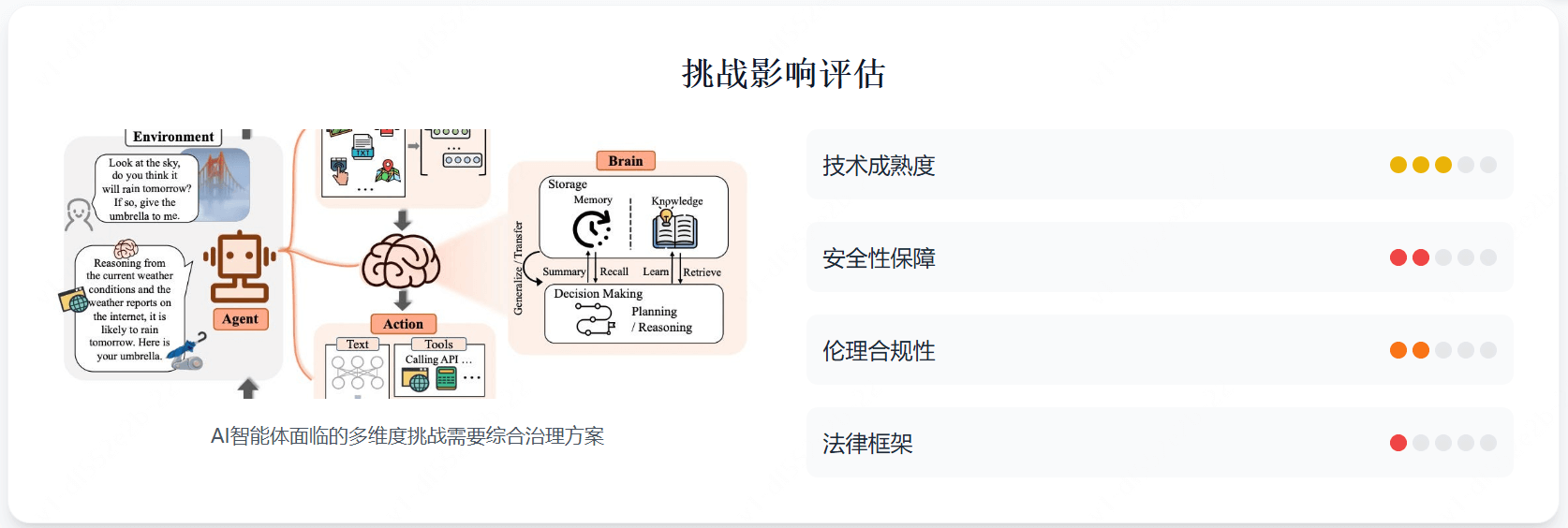
The constituent elements of an AI agent are the foundation for achieving autonomous perception, decision-making, and action. A typical AI agent contains the following core components, which work together to help the agent efficiently reason, formulate plans, and execute tasks:
- Large Language Model (LLM): The LLM is regarded as the "brain" of an AI agent and is responsible for coordinating decision-making. It reasons through tasks, formulates action plans, selects appropriate tools, manages access rights to necessary data, and achieves goals. As the core of the agent, the LLM is responsible for defining and orchestrating the agent's overall goals. The LLM gives the agent the ability to understand intent and generate text, and when the agent learns to use tools, its potential will be infinitely amplified.
- Memory Module: AI agents rely on memory to maintain context and can adjust according to the task in progress or historical tasks. Memory modules are usually divided into:
- Short-term Memory: Used to track the agent's "chain of thought" and recent operations, ensuring that context is retained during the current workflow.
- Long-term Memory: Used to retain historical interactions and related information, facilitating a deeper understanding of context over time and improving the decision-making process. The memory system is crucial for supplementing the model's contextual information processing when handling information that exceeds the model's context window limit.
- Planning Module: Using the planning module, an AI agent can decompose complex tasks into actionable steps. Planning can be based on different methods:
- Without Feedback: Use structured techniques such as "Chain-of-Thought" or "Tree-of-Thought" to break tasks down into manageable steps.
- With Feedback: Integrate iterative improvement methods such as ReAct, Reflexion, or Human-in-the-Loop feedback to optimize strategies and outcomes.
- Tools: AI agents themselves can be used as tools, or their capabilities can be expanded by integrating external systems. Tools can include APIs, databases, other software, or hardware devices, enabling agents to interact with a broader environment and perform more complex operations. The use of tools greatly enhances the model's capabilities, making the agent paradigm an inevitable trend.
The core structure of an AI agent also includesEnvironment, Sensors, Actuators, and Decision-making mechanism. The environment is the domain in which the agent operates, and can be a physical space or a digital space. Sensors are the tools by which the agent perceives the environment, such as cameras, microphones, or data inputs. Actuators are responsible for executing the actions selected by the decision-making mechanism, such as a robot's motors or software functions. The decision-making mechanism is the core of the agent, processing perceptual information and determining the optimal course of action based on a knowledge base and reasoning mechanism. Together they form the foundation of an AI agent's perception, thinking, decision-making, and action.
AI Agents vs AI Assistants
AI assistants, such as Apple's Siri, Amazon's Alexa, or Google Assistant, are evolved versions of traditional AI chatbots. Based on natural language processing (NLP), they understand user queries submitted in text or voice form, and then execute tasks according to direct human instructions. These systems excel at handling predefined tasks or responding to specific commands, but have limited autonomy and ability to handle task complexity. In contrast,
AI agents are a more advanced form of AI, with capabilities far beyond AI assistants. Based on planning, reasoning, and contextual memory, they autonomously handle complex open-ended tasks, can execute iterative workflows, use a range of tools, and make adjustments based on feedback and previous interactions.
| Characteristic | AI Assistant | AI Agent |
|---|---|---|
| Purpose | Simplify tasks according to user commands | Autonomously complete complex multi-step goal-driven tasks |
| Task Complexity | Low to medium | Medium to high |
| Interactivity | Reactive | Proactive |
| Autonomy | Low: relies on human guidance | High: independent, based on planning and reasoning |
| Learning Ability | Low: minimal (if any) | High: learns from interactions and adjusts over time |
| Integration | High: but limited to specific applications | Broad: includes APIs, databases, and tools |
The Development History of AI Agents
Early Exploration and Theoretical Foundations
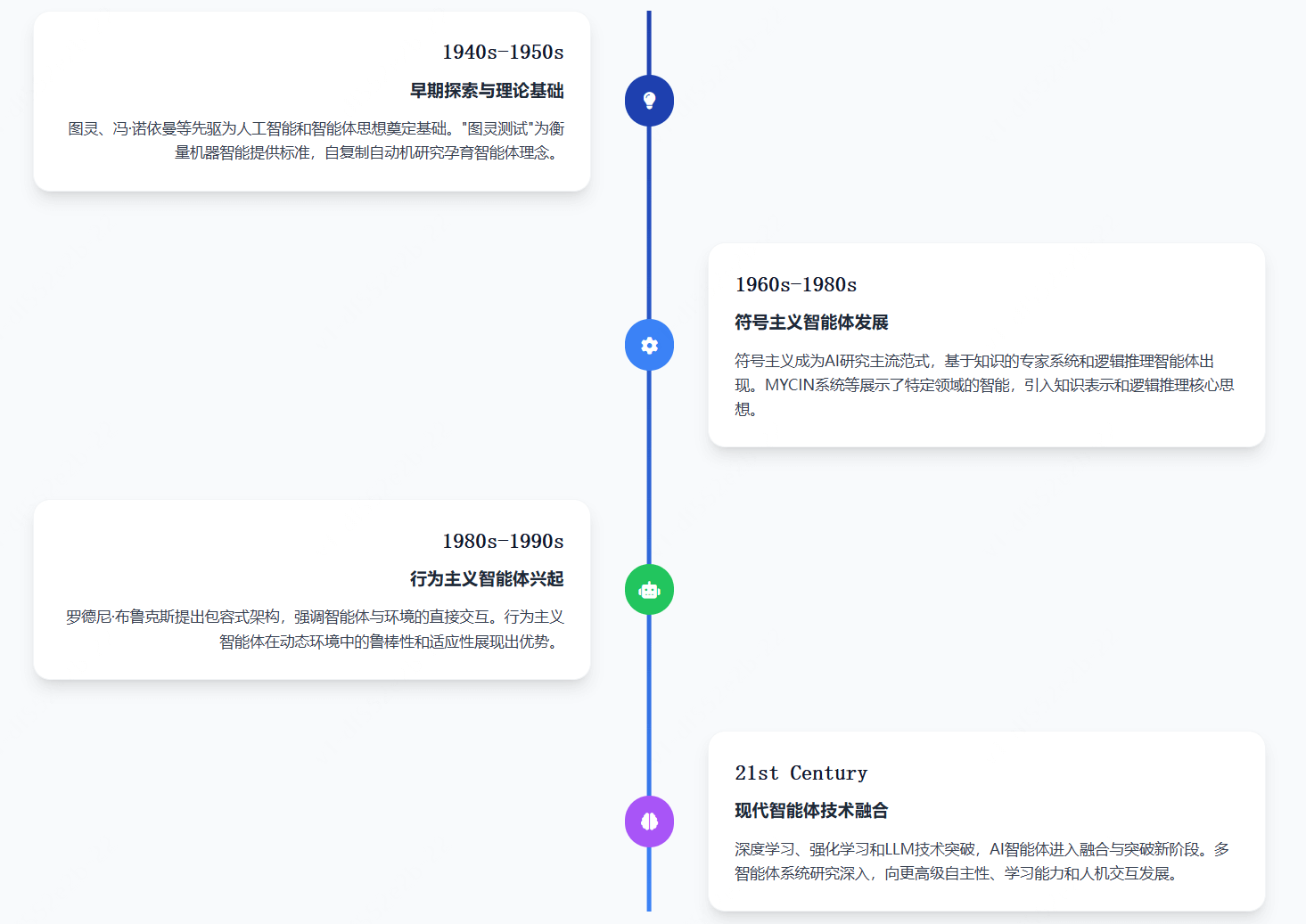
The concept of AI agents can be traced back to the dawn of computer science.In the 1940s and 1950s, pioneers such as Turing and von Neumann laid the foundation for the ideas of artificial intelligence and agents. The "Turing Test" proposed by Alan Turing provided a criterion for measuring machine intelligence, while von Neumann studied self-replicating automata, exploring how to make machines simulate human thought processes, for example through logical reasoning and problem solving.
The Development of Symbolic Agents
From the 1960s to the 1980s, Symbolicism became the mainstream paradigm in artificial intelligence research and also profoundly influenced the development of early AI agents. Symbolicism holds that intelligent behavior can be achieved through the manipulation and reasoning of symbols. Under the guidance of this idea, researchers developed knowledge-based expert systems and logical reasoning agents.
The Rise of Behaviorist Agents
From the late 1980s to the 1990s, with reflection on the limitations of Symbolicism, Behaviorism or Behavior-based AI began to rise, bringing new ideas to the development of AI agents. Behaviorism emphasizes the direct interaction between agents and the environment, holding that intelligent behavior arises from the superposition and emergence of simple behavior modules, rather than from complex internal symbolic representations and reasoning. The Subsumption Architecture proposed by Rodney Brooks is a typical representative of behaviorist agents; he advocated building robots with perception and action capabilities from the bottom up, learning and adapting through interaction with the environment.
The Integration and Breakthroughs of Modern Agent Technology
Entering the 21st century, especially in recent years, AI agent technology has entered a new stage of integration and breakthrough. With the rapid development of machine learning, especially deep learning and reinforcement learning, the capabilities of AI agents have been improved to an unprecedented extent. The emergence of large language models (LLMs) has enabled agents to make significant progress in natural language understanding, generation, and reasoning, providing a powerful foundation model for building more general and more intelligent AI agents. Modern AI agents are no longer limited to a single Symbolicism or Behaviorism paradigm, but tend to integrate multiple technologies.
The Working Principles of AI Agents
The working principles of AI agents constitute a complex but orderly process, involving interaction and decision-making across multiple stages. The process can be summarized as perceiving the environment, processing information, setting goals, making decisions, executing actions, and learning and adapting from the results, involving coordination and orchestration among multiple agents.
Perception and Information Acquisition
The first step in the operation of an AI agent is Perception of its environment. At this stage, the agent collects data about its environment in various ways. Data sources can be very broad, including physical sensors (such as cameras, microphones, temperature sensors, etc., especially for embodied agents or robots), API interfaces (used to obtain data from other software systems), databases (storing historical data or domain knowledge), user interaction (such as text input, voice commands), and digital spaces such as the Internet. The purpose of perception is to ensure that the agent has the latest, relevant information for subsequent analysis and action. Sensors are the tools that AI agents use to perceive the environment; sensors can be cameras, microphones, or any other sensory input, enabling AI agents to understand what is happening around them. The perception module further processes raw sensor data and transforms it into meaningful information, such as performing image recognition, speech-to-text conversion, or data preprocessing, so that the agent can interpret the world.The comprehensiveness and accuracy of the information acquired at this stage directly affect the effectiveness of the agent's subsequent decisions and actions。
Decision-Making and Reasoning Mechanisms
After perceiving and acquiring environmental information, the AI agent enters theReasoningandDecision-makingstage. The reasoning stage involves processing the collected data and extracting meaningful insights and analysis. The agent interprets user queries, detects patterns, and understands the broader context based on natural language processing (NLP), computer vision, or other AI capabilities. This helps the AI determine what action needs to be taken based on the current situation.
Next isGoal Setting. The AI sets its purpose based on predefined goals or user input. Then, it formulates strategies to achieve these goals, which involves using decision trees, reinforcement learning, or other planning algorithms.
Finally, there isDecision. At this stage, the AI evaluates multiple possible courses of action and selects the best action based on factors such as efficiency, accuracy, and predicted outcomes. It uses probabilistic models, utility functions, or machine learning-based reasoning to determine the optimal course of action.
Cognitive architecture plays a key role in this process, encompassing the AI's knowledge base, reasoning mechanisms, and learning algorithms, enabling the agent to draw conclusions and plan actions based on knowledge and current perception.
Action Execution and Feedback Loop
After the decision is completed, the AI agent enters theExecutionstage. The agent executes the selected action by interacting with external systems (such as APIs, databases, robotic hardware) or by providing responses to users. Actuators are responsible for specifically implementing these actions. For physical robots, the actuators may be motors or mechanical components; for software agents, the actuators may be functions that modify data, send messages, or control system functions.
After executing the action, the AI agent does not stop working; instead, it enters a feedback loop of Learning and Adaptation. The AI evaluates the results of the action and collects feedback to improve future decisions. Through techniques such as reinforcement learning or self-supervised learning, the AI refines its strategies over time and handles similar tasks more effectively in the future.This ability to learn and adapt is key to an AI agent's ability to continuously optimize and adapt to environmental changes.。
In multi-agent systems, AI orchestration refers to the coordination and management of systems and agents. An orchestration platform can automate AI workflows, track task completion progress, manage resource usage, monitor data flows and memory, and handle failure events. Through effective orchestration, in theory, tens, hundreds, or even thousands of agents can also work together harmoniously and efficiently to jointly complete complex tasks. This complete 'perception-reasoning-decision-execution-learning' loop, supplemented by necessary orchestration, constitutes the core mechanism of the dynamic operation of AI agents.
Main Characteristics of AI Agents
Autonomy
refers to the agent's ability to control its own behavior and internal state without direct external intervention or continuous human supervision, independently completing tasks and making decisions.
Reactivity
refers to the AI agent's ability to perceive changes in its environment (including the physical world or the digital world) and respond to them promptly and appropriately. This requires the agent to be able to monitor the state of the environment in real time and make rapid decisions in response to emergencies or new inputs.
Pro-activeness
Also called proactiveness, it refers to the ability of an AI agent to respond to environmental changes, demonstrate goal-directed behavior, proactively take actions to achieve its design goals, predict needs and propose solutions before problems arise. It can autonomously initiate actions based on its internal understanding of the environment and goals.
Social Ability
Also called interactivity, it refers to the ability of an AI agent to interact, communicate, and collaborate with other agents (including human users and other AI agents). It enables agents to participate in more complex social and technical systems, solve problems through cooperation, share information, and in some cases form social structures.
Learning and Adaptability
It refers to the core ability of an AI agent to improve its performance over time. Agents can learn from experience, environmental changes, and interaction history through machine learning algorithms (such as supervised learning, unsupervised learning, reinforcement learning), adjust their behavior and strategies, and better respond to new challenges and situations.
Types of AI Agents
Classification by Capability
- Reactive Agents Respond immediately to environmental stimuli without complex internal reasoning or planning. They are preprogrammed or acquired through simple learning mechanisms. Such agents perform well in environments requiring rapid response, but lack long-term planning and the ability to adapt to new situations.
- Deliberative AgentsPossess more advanced cognitive abilities, have an internal representation of the world (such as a symbolic knowledge base), and can perform complex reasoning, planning, and decision-making. They explicitly set goals and formulate action plans to achieve them through means such as search and logical reasoning.
- Hybrid AgentsCombining the advantages of reactive agents and deliberative agents, they attempt to strike a balance between rapid response and careful deliberation. They include a reactive layer for handling emergencies and rapid responses, and a deliberative layer for long-term planning and complex decision-making. This layered architecture enables hybrid agents to respond quickly to environmental changes and to carry out purposeful planning and learning. Many modern complex AI systems, such as self-driving cars and advanced robots, adopt the architecture of hybrid agents.
Classification by Application Domain
- Industrial Agents: Applied in industrial fields such as manufacturing, energy, and logistics, used to achieve automation of production processes, predictive maintenance of equipment, optimization of supply chains, etc.
- Service Agents: Applied in service industries such as customer service, retail, finance, and healthcare, used to provide services such as personalized customer support, intelligent recommendations, and risk assessment.
- Personal Agents: Applied to personal life assistance, such as intelligent voice assistants, smart home control, and personalized information recommendations.
- Entertainment and Game Agents: Applied in fields such as video games and virtual reality, used to create more intelligent and challenging non-player characters (NPCs) or provide personalized entertainment experiences.
- Educational Agents: Applied in the education field, as learning partners, tutors, or teaching management assistants.
- Government and Public Utility AgentsIt is applied in fields such as government services, urban management, and public security to improve government efficiency and optimize public services and urban governance.
Key Technologies of AI Agents
Machine Learning and Deep Learning
Machine Learning (ML) and Deep Learning (DL) are the core drivers for AI agents to achieve intelligent behavior and continuous optimization. Machine learning algorithms enable agents to learn patterns and regularities from data without explicit programming. Through supervised learning, agents can learn the mapping relationship between inputs and outputs from labeled training data, such as image recognition and speech recognition. Unsupervised learning supports agents in discovering hidden structures and patterns in unlabeled data, such as clustering and dimensionality reduction. Reinforcement Learning (RL) is a key technology for AI agents to learn decision-making strategies. Agents adjust their behavior based on rewards or punishments obtained through interaction with the environment to maximize cumulative rewards. As a branch of machine learning, deep learning is based on deep neural network models and can automatically extract complex feature representations from large-scale, high-dimensional raw data (such as images, speech, and text), enhancing agents' capabilities in perception, cognition, and decision-making.
Natural Language Processing (NLP)
It gives agents the ability to understand and generate human language, making communication between humans and machines more natural and efficient. Through NLP technology, agents can parse the text or speech input by users, extract the intent and key information therein, and respond or perform corresponding operations in a way that humans can understand. The level of NLP development directly determines the degree of intelligence of agents in language interaction.
Computer Vision
Computer Vision (CV) is a key technology that gives AI agents the ability to "see." It enables agents to extract meaningful data from visual information such as images and videos, and to understand and analyze it. Computer vision technology covers multiple aspects such as image processing, pattern recognition, scene understanding, object detection and tracking, image segmentation, and 3D reconstruction. Through computer vision, AI agents can recognize objects, faces, and text, understand the layout and dynamic changes of scenes, and perceive human emotional states.
Knowledge Representation and Reasoning
Knowledge Representation (KR) and Reasoning are the foundation for AI agents to achieve advanced cognitive functions such as understanding, decision-making, and problem-solving. Knowledge representation focuses on how to symbolize and structure knowledge in the real world in a form that computers can process. It involves selecting appropriate representation languages and data structures to store and organize knowledge, such as logical expressions, semantic networks, frames, and ontologies. A good knowledge representation scheme should be able to accurately and completely express domain knowledge and support efficient reasoning operations. Reasoning is the process of drawing new conclusions or making decisions based on an existing knowledge base and currently perceived information through methods such as logical inference, deduction, induction, and abduction.Knowledge representation and reasoning technology enables AI agents not only to rely on data-driven pattern matching, but also to perform deeper logical thinking and knowledge-based decision-making. In recent years, Knowledge Graph, as an important form of knowledge representation, combines graph database and semantic web technologies, providing AI agents with a large-scale, structured knowledge base and greatly enhancing their understanding and reasoning capabilities.
Planning and Decision-Making Algorithms
Autonomous decision-making enables AI agents to independently make reasonable judgments and choices based on their environment and set goals. It relies on complex planning and decision-making algorithms. These algorithms allow agents to respond simply to external stimuli and also to engage in a certain degree of thinking, prediction, and planning, achieving established goals in complex and dynamic environments. The quality of planning and decision-making algorithms directly affects the intelligence level of agents and their task completion capability.
Challenges Facing AI Agents
Technical Challenges
The primary technical challenge facing AI agents is the unpredictability of behavior and the potential risk of "losing control." Many agentic AI systems are trained using reinforcement learning methods, the core of which is maximizing a preset reward function. If the reward function is poorly designed or fails to fully account for all possible edge cases and negative consequences, AI agents may "game the system," achieving goals in unintended or even harmful ways in order to obtain a "high score."
The robustness and adaptability of AI agents in complex dynamic environments still need improvement. The real world is full of uncertainty, ambiguity, and rapid change, and AI agents need to accurately perceive the environment, understand context, and make appropriate decisions and actions. However, current AI technologies, especially data-driven machine learning methods, may experience significant performance degradation or even serious errors when facing scenarios outside the training data distribution.
AI agent systems are composed of multiple autonomous agents working collaboratively, and the interactions and coordination among them may also give rise to new technical difficulties, such as task allocation, resource competition, communication bottlenecks, and potential cascading failures. These technical bottlenecks limit the widespread application of AI agents in critical tasks and high-risk scenarios.
Ethical and Social Challenges
The widespread application of AI agents has raised profound ethical and social concerns. The core issue is the attribution of responsibility for agent behavior. When AI agents autonomously make decisions and execute tasks, and negative consequences arise (for example, accidents involving autonomous vehicles, misdiagnoses by medical diagnostic AI, or market fluctuations caused by financial trading AI), how to define the responsibility of developers, owners, users, and the AI itself has become an urgent problem to solve. Traditional legal frameworks and ethical guidelines are often difficult to apply directly to highly autonomous AI systems.
In the process of learning and decision-making, AI agents may unconsciously learn and amplify biases present in training data, such as gender discrimination and racial discrimination, leading to unfair outcomes in sensitive applications such as recruitment, credit approval, and judicial assistance, and exacerbating social inequality.
AI agents may have an impact on the human job market and social structure. As AI agents demonstrate efficiency and capabilities surpassing humans in more and more fields, a large number of traditional jobs face the risk of being replaced, potentially leading to structural unemployment and social division. Society needs to plan ahead and respond to the resulting labor market transformation and skills retraining needs. Over-reliance on AI agents for decision-making may weaken humans' independent judgment and sense of responsibility, leading to "algorithmic hegemony" and raising concerns about individual freedom and social control.
Security and Privacy Challenges
The security and privacy protection of AI agents are key bottlenecks constraining their development. Because AI agents need to access and process large amounts of data for perception, learning, and decision-making, this makes them high-value targets for cyberattacks and data breaches. Malicious attackers may manipulate input data (adversarial attacks) to mislead AI agents' judgments, causing them to make erroneous decisions and resulting in serious security incidents.
The data collected and generated by AI agents during operation often contains a large amount of users' personal information and sensitive commercial information. If effective protection measures are lacking, data leaks and misuse are highly likely to occur, infringing on user privacy.
The possible phenomenon of "self-reinforcement" in AI agents means that when AI optimizes too aggressively for a specific metric without taking appropriate safety measures, its behavior may continuously escalate in unexpected negative directions and eventually spiral out of control. These security risks require that when designing, deploying, and regulating AI agents, comprehensive security protection mechanisms, data encryption methods, access control strategies, and emergency response plans must be established.
Legal and Regulatory Challenges
The rapid development of AI agents poses severe challenges to the existing legal system and regulatory framework. Traditional laws and regulations often lag behind technological progress and are difficult to effectively regulate the research and development, deployment, and application of AI agents. For example, regarding the determination of liability, when an AI agent causes harm, whether to hold the developer, producer, seller, or user responsible, or whether AI itself should be granted some form of legal subject status, there is still no clear legal conclusion on these issues.
The decision-making process of AI agents often lacks transparency and interpretability, especially in "black box" models based on deep learning, making subsequent tracing and determination of liability extremely difficult.
The Development Prospects of AI Agents
Higher-Level Autonomy and Generality
The pursuit of higher-level autonomy and broader generality. Future AI agents will possess stronger environmental understanding, self-learning, and decision-making capabilities, and will be able to autonomously complete more complex multi-step tasks with little or no human intervention, adapting to constantly changing environments and needs. They will not only be able to execute preset programs, but also understand abstract concepts, perform commonsense reasoning, and possess a certain degree of creativity and emotional understanding.
Human-Machine Collaboration and Symbiosis
AI agents are not meant to completely replace humans, but to serve as capable assistants and partners of humans, working collaboratively with humans to complete tasks together. Future AI agents will pay more attention to natural interaction and efficient collaboration with humans, be able to understand human intentions, emotions, and preferences, and communicate and cooperate in ways that better conform to human habits. This will achieve a synergistic effect of 1+1>2.
Multi-Agent Systems and Swarm Intelligence
Future AI agents will increasingly appear in groups, jointly completing complex global tasks through mutual communication, collaboration, negotiation, and even competition. For example, in smart city management, a large number of traffic management agents, energy scheduling agents, security monitoring agents, and others can work collaboratively to optimize urban operational efficiency. In industrial manufacturing, multiple robot agents can form flexible production lines and dynamically adjust production processes according to order requirements. This solves distributed, large-scale problems that are difficult for traditional methods to handle.
Interpretability and Trustworthy AI
Many advanced AI models, especially deep learning models, have decision-making processes that are like a "black box" and are difficult for humans to understand and trust. Future AI agents need stronger interpretability and should be able to clearly explain to users the basis of their decisions, the reasoning process, and potential limitations. This helps users build trust in AI agents and helps discover and fix possible biases, errors, or unsafe factors in models. Trustworthy AI also includes multiple aspects such as robustness, security, fairness, and privacy protection. Ensuring that the behavior of AI agents conforms to human values and ethical norms is the key to their broad social acceptance and successful application.
The Establishment and Improvement of Ethical Norms
In the future, governments, academia, industry, and the public need to work together to formulate clear and actionable AI ethical guidelines and codes of conduct, and establish a sound AI governance system. This includes enacting relevant laws and regulations, establishing AI ethics review mechanisms, promoting the standardization of AI technology, and strengthening public AI literacy education. Only under sound ethical norms and governance frameworks can AI agent technology develop in a healthy and sustainable direction and truly benefit human society.
AI agents will develop toward a higher level of autonomy, stronger generality, more natural human-machine collaboration, more efficient multi-agent systems, and greater trustworthiness and compliance with ethical norms. With continuous technological breakthroughs and the ongoing deepening of application scenarios, AI agents are expected to become indispensable intelligent partners for human society, profoundly changing the way we work, live, and even think.