
Artificial General Intelligence (AGI) is a theoretical form of intelligence that enables machines to possess broad cognitive abilities comparable to or even surpassing those of humans, allowing them to learn, understand, reason, and solve problems across a wide variety of tasks and environments, not limited to a specific domain. The realization of AGI will mark a fundamental shift in artificial intelligence from being tool-like and domain-specific to being universal and general-purpose, with potentially far-reaching implications that could completely transform scientific research, economic development, social services, and even global governance. The development of AGI still faces many technical bottlenecks, ethical dilemmas, and potential risks, requiring global collective efforts to ensure it is safe, controllable, and beneficial to all humanity.
What Is Artificial General Intelligence
Definition of AGI
Artificial General Intelligence (AGI) is a form of artificial intelligence that possesses broad cognitive abilities comparable to or even surpassing those of humans. It can exhibit intelligent behavior like humans across a wide variety of tasks and environments, not limited to a specific domain. The goal of AGI is to create intelligent systems that can understand, learn, reason, and adapt to new situations, with capabilities not limited to predefined tasks and able to handle almost any intellectual task that humans can complete. Unlike the current mainstream "Narrow AI" or "Weak AI," AGI pursues intelligence with generality, capable of demonstrating human-like adaptability and learning ability across multiple domains and tasks. AGI systems can not only execute tasks, but more importantly, can understand the problems they face and possess the ability to make independent decisions. Such agents are expected to integrate multiple capabilities, such as automated reasoning, knowledge representation, automated planning, autonomous learning, and natural language communication, to achieve set goals. AGI is also known as Strong AI, Full AI, or Human-Level AI.
Differences Between AGI and Narrow Artificial Intelligence (ANI)
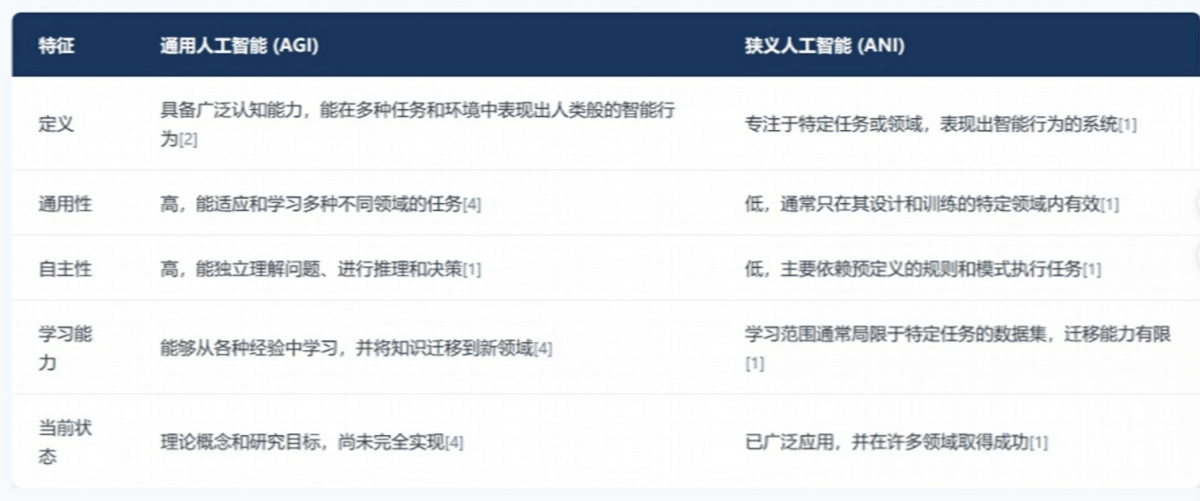
Artificial General Intelligence (AGI) and Artificial Narrow Intelligence (ANI), also known as Weak AI, differ fundamentally in the breadth, depth, and autonomy of intelligence. ANI is the most common type of AI today, focused on solving problems in a specific domain or specific task, such as image recognition, speech recognition, specific applications in natural language processing (such as machine translation or sentiment analysis), or chess-playing programs. These systems are trained through large amounts of data and algorithms to achieve specific goals, but they can only excel in their predefined domains, and perform poorly or not at all in other domains.
For example, an ANI system that performs exceptionally well at Go cannot directly transfer its capabilities to driving a car or making medical diagnoses. Models like ChatGPT, Midjourney, and Meta AI, although powerful, are still examples of weak AI or narrow AI and do not possess true human-level intelligence.
In contrast, AGI possesses broad cognitive abilities and can learn and adapt across various tasks and environments like a human, performing any intellectual task that humans can perform. The core distinction of AGI lies in "generality" and "autonomy." First, in terms of understanding tasks and problems, AGI needs not only to execute tasks but also to understand the problems it faces, enabling AGI to be more adaptable and viable. Second, in terms of decision-making ability, AGI needs the ability to make independent, context-based decisions, which is an important factor for greater reliability. Finally, in terms of intelligence level, AGI is regarded as a kind of general artificial intelligence, roughly equivalent to a computer possessing all the intellectual abilities of an ordinary person, including the abilities to communicate in natural language, solve problems, reason, and perceive the environment, at an intelligence level equal to or higher than that of an ordinary person. In short, ANI is a "specialist," while AGI pursues being a "generalist."
Core Characteristics of Artificial General Intelligence
Generality
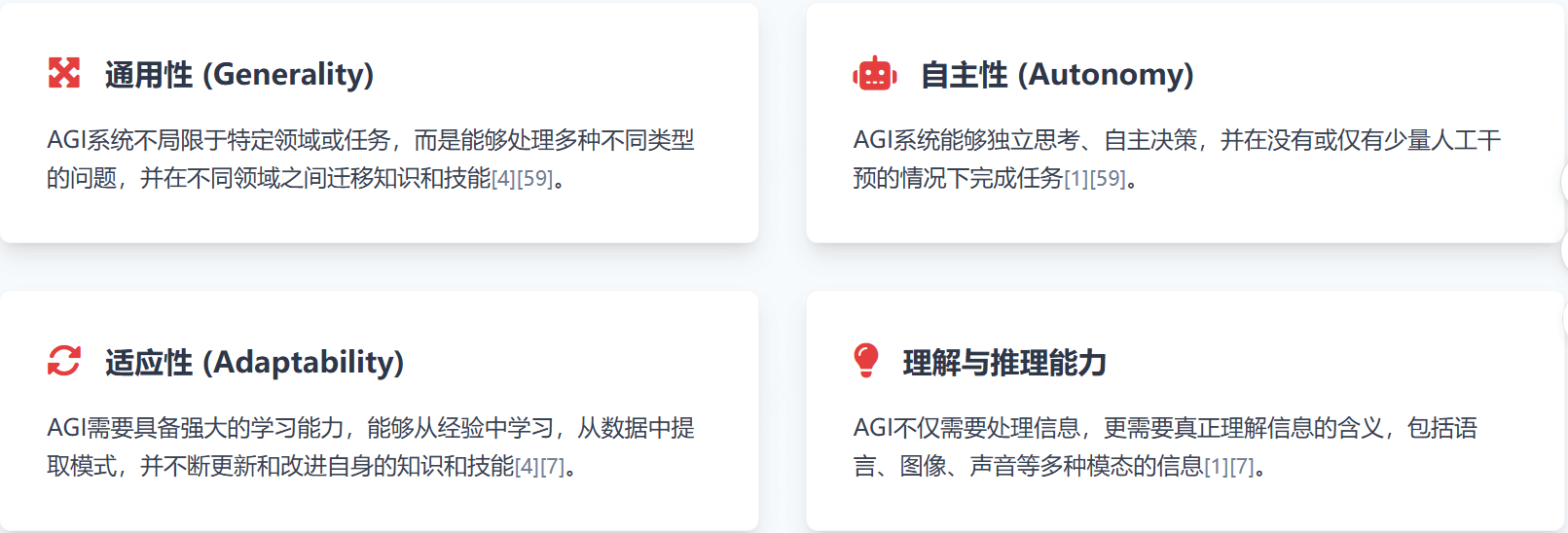
It is the most prominent characteristic of AGI. A key advantage of human intelligence is generality: we can learn mathematics, language, and art, and can combine knowledge from different fields to solve complex problems. AGI imitates this ability, enabling it to "comprehend by analogy" like a human.
For example, an AGI system with generality can not only perform complex scientific computations, but also understand literary works and even compose music.
Professor Zhu Songchun, dean of the Beijing Institute for General Artificial Intelligence, proposed that artificial general intelligence needs to satisfy three basic conditions, the first of which is "being able to complete an infinite number of tasks."
Autonomy
AGI systems are expected to be able to think independently and make decisions autonomously, completing tasks with no or only a small amount of human intervention. This includes the ability to execute preset instructions, and more importantly, the ability to understand task goals, analyze environmental information, and formulate action plans based on their own learning and experience. Autonomy means that AGI can proactively discover problems, set goals, and proactively seek solutions, rather than passively waiting for instructions.
The second condition proposed by Professor Zhu Songchun is "being able to proactively and autonomously discover tasks in a scenario, that is, 'having an eye for work.'"
For example, an autonomous AGI robot can not only clean a room according to instructions, but also proactively identify how dirty and messy the room is, plan a cleaning path, and respond to unexpected situations during the cleaning process, such as avoiding obstacles or replenishing cleaning agents.
Adaptability and Learning Ability
They are the foundation for AGI to achieve generality and autonomy. AGI needs to possess strong learning ability, be able to learn from experience, extract patterns from data, and continuously update and improve its own knowledge and skills. This includes existing AI technologies such as supervised learning, unsupervised learning, and reinforcement learning, and may also involve more advanced forms of learning, such as meta-learning (learning how to learn) and transfer learning (applying knowledge learned in one domain to another domain). Adaptability requires AGI to quickly adapt to new, unknown environments and tasks, and adjust its behavioral strategies to cope with changes.
Understanding and Reasoning Ability
AGI needs to process information, and more importantly, truly understand the meaning of information, including information in multiple modalities such as language, images, and sound. AGI needs to possess common-sense knowledge and be able to perform logical reasoning, causal inference, and abstract thinking.
For example, when reading an article, AGI needs to understand the intent, emotions, and implicit information behind the text, not just recognize words and sentence structure. When solving problems, AGI needs to be able to analyze the essence of the problem, use existing knowledge for reasoning, and find effective solutions.
The Development History of Artificial General Intelligence
The Proposal of the AGI Concept and Early Exploration
The concept of Artificial General Intelligence (AGI) did not emerge overnight; it has accompanied the entire development history of the artificial intelligence discipline and has been given different meanings and expectations at different stages. Early explorations in artificial intelligence, even before the term "artificial intelligence" was formally born, already contained a yearning for general intelligence.
The 1956 Dartmouth Conferenceis widely regarded as the beginning of the field of artificial intelligence. The goal proposed at the conference was to explore how to enable machines to think, learn, and solve problems like humans. Early AI researchers, such as Alan Turing, Marvin Minsky, and John McCarthy, envisioned creating machines with human-level intelligence. The "Turing Test" proposed by Turing in his 1950 paper "Computing Machinery and Intelligence," although it did not directly define AGI, set an important reference standard for the goal of AGI with its core idea—judging whether a machine can exhibit intelligent behavior indistinguishable from that of a human. Herbert A. Simon predicted in 1965: "Machines will be capable, within twenty years, of doing any work a man can do."
By the late 1970s and early 1980s, AI research gradually shifted toward more specific and practical areas, and expert systems became a research hotspot. These systems attempted to encode human expert knowledge in specific domains into computers to solve specific problems. Although expert systems achieved success in certain areas, they were essentially "narrow AI" and lacked generality. This led to the first "AI winter" (1974–1980), and mainstream research methods gradually shifted from general purposes to specific domains.
The term "Artificial General Intelligence" (AGI) itself was first proposed byMark Gubrud in 1997in the context of discussing nanotechnology and international security, to describe systems that can match or even surpass the human brain in complexity and speed, systems that can acquire, manipulate, and reason about everyday knowledge and play a role in fields requiring human intelligence.
Around 2001, some artificial intelligence researchers, such as Ben Goertzel, Shane Legg, and Peter Voss, began to promote and use the concept of AGI in order to return to the original vision of artificial intelligence, namely creating machines with general intelligence. They believed that mainstream AI focused too much on specific applications and ignored the core issue of general intelligence. The explicit proposal of the AGI concept marked a rethinking of and renewed focus on the direction of artificial intelligence development, distinguishing it from the then-mainstream research on "weak AI" or "applied AI."
Around 2004 to 2007, calls for research on general-purpose systems re-emerged both inside and outside the mainstream AI field, and topics such as "integrated AI," "general-purpose system," and "human-level AI" gradually attracted attention.
After 2008, the emergence of academic conferences and organizations such as the AGI conference series, the Conference on Artificial General Intelligence, Advances in Cognitive Systems, and the IEEE Task Force on Towards Human-Level Intelligence marked further clarification and development of AGI as an independent research direction.

Different Technical Paths and Major Research Schools
Symbolism
Also known as logicism, the psychological school, or the computer school, its theoretical foundation is the physical symbol system hypothesis, which holds that intelligent behavior can be achieved through symbol manipulation. Symbolists attempt to simulate human cognitive processes by building systems based on logical reasoning and knowledge representation. They believe that the core of intelligence lies in the manipulation and reasoning of abstract symbols, and that as long as human knowledge and reasoning processes can be formalized into symbols and rules, general intelligence can be achieved. Early expert systems, knowledge graphs, and the like are embodiments of symbolist thought. Although symbolism has achieved success in handling explicit rules and structured knowledge, it has encountered challenges in dealing with perception, learning, and the uncertainty and ambiguity of the real world, namely the so-called "knowledge acquisition bottleneck" and "frame problem".
Connectionism
Also known as the bionics school or the physiological school, its inspiration comes from the structure and function of the human brain's neural networks. Connectionists believe that intelligence arises from the interconnection and parallel processing among large numbers of simple processing units (neurons). Artificial neural networks (ANNs) are built to simulate the brain's learning and cognitive processes. Deep learning is the representative of connectionism's tremendous success in the contemporary era, especially having achieved breakthrough progress in fields such as image recognition and natural language processing. Most current deep learning models rely on large amounts of labeled data for training, and still have limitations in interpretability, robustness, and common-sense reasoning, and are still some distance from true AGI.
Behaviorism/Embodied Cognition
Emphasizes the interaction between an agent and its environment and the importance of perception and action. They believe that intelligence cannot remain merely at the level of abstract symbol manipulation or neural network computation, but must be produced and developed through real-time interaction between a physical body and the environment. The theory of embodied cognition holds that cognitive processes are profoundly influenced by body morphology, sensorimotor abilities, and ways of interacting with the environment. Therefore, the realization of AGI requires building embodied intelligent agents that can perceive the environment, take actions, and learn from interaction. Research in fields such as robotics and reinforcement learning is closely related to this school. This school emphasizes the importance of a "world model," that is, an agent needs to construct internal representations of the environment and use these representations for planning and decision-making.
In addition to the above major schools, there are also some other research directions and theories, such as:
Evolutionary Computation, which draws on the ideas of biological evolution and optimizes and designs intelligent systems through operations such as selection, crossover, and mutation;
Bayesian Networks, which provide a framework for reasoning under uncertainty based on probabilistic graphical models;
Integrative Approaches, such as projects like OpenCog, attempt to combine the advantages of different AI methodologies, for example combining the reasoning ability of symbolic logic with the pattern recognition ability of neural networks, to achieve more comprehensive intelligence;
Cognitive Architectures(such as ACT-R, SOAR, LIDA) build unified computational models based on principles of cognitive science to simulate various abilities of the human mind;
AI agents,combining large language models and reinforcement learning,AI Agentare regarded as the necessary path to AGI; these Agents can understand instructions, formulate plans, and execute complex tasks. The current research trend in AGI is also increasingly showing the characteristics of multidisciplinary intersection and the integration of multiple technologies, for example combining deep learning with symbolic reasoning, or combining reinforcement learning with cognitive architectures, to overcome the limitations of a single method and advance toward true general intelligence.
Research Progress in Artificial General Intelligence
Progress
Currently, research on artificial general intelligence (AGI) is in a stage full of vitality but also facing significant challenges. With the breakthrough progress of generative AI technologies represented by large language models (LLMs), many researchers and technology companies, such as OpenAI, DeepMind, Google, Baidu, iFLYTEK, and others, are actively exploring paths toward AGI and have launched a series of models considered to be "approaching AGI-level," such as GPT-4, Claude 3, Sora, etc. These models demonstrate astonishing capabilities in many areas, including natural language understanding and generation, image generation, code writing, and multitasking, and their performance on certain specific tasks exceeds the average human level.
Internally, OpenAI divides the path to AGI into five levels and believes that its current AI models (such as GPT-4) are still at the L1 level (chatbot), but are expected to soon reach the L2 level (reasoner), with the ability to solve basic doctoral-level problems.
Bottlenecks
Constraints of computing power and energy. Training and running advanced large models require enormous computing resources and energy consumption, bringing high costs and also putting pressure on the environment, which limits the popularization and further development of AGI technology.
Limitations of model capabilities. Although existing large models show powerful pattern recognition and generation capabilities, in deeper cognitive abilities, such as common-sense reasoning, causal inference, interpretability, robustness, and long-term planning, there is still a large gap compared with human intelligence. For example, large models are still prone to errors when handling problems that require complex logical reasoning or understanding common sense about the physical world. They are also easily influenced by prompts, producing "hallucinations" (that is, generating inaccurate or meaningless content), and their decision-making processes often lack transparency and interpretability.
Data bottleneck. High-quality, diverse training data is crucial for improving model performance, but obtaining and annotating large-scale, unbiased datasets is itself a huge challenge. The learning methods of existing models are often "force-feeding," lacking true understanding and the ability for active exploration.
Ethical and safety issues of AGI. These include data privacy, algorithmic bias, the spread of false information, potential risks of misuse, and impacts on the job market and social structure. These issues need to be properly addressed in the course of technological development.
Key Technical Challenges of Artificial General Intelligence
Learning from multimodal data such as video
A key technical challenge in achieving artificial general intelligence (AGI) is the ability to learn from data in multiple modalities like humans do, especially from dynamic, context-rich media such as video. One of the main ways humans acquire knowledge and understand the world is through visual observation and accumulated experience, and video data contains exactly rich visual information, temporal sequence information, as well as interactions and causal relationships between objects. Current AI models, especially large language models, mainly rely on text data for training, which accounts for only a small part of human learning experience. Research shows that text learning accounts for only about 5% of human learning methods. For machines to truly understand the physical world and social scenarios, they must have the ability to extract semantic information from video, such as identifying objects, actions, scenes, and the complex relationships among them. Develop algorithms and model architectures that can effectively process and fuse multimodal information. This requires advances in computer vision technologies, such as more precise object detection, action recognition, and scene understanding, and requires aligning and associating this visual information with information from other modalities such as text and audio.
For example, when an AGI system watches a cooking video, it not only needs to identify ingredients, kitchen utensils, and cooking actions, but also needs to understand the order and purpose of these actions, as well as possible unexpected situations and corresponding ways to handle them. Learning from video also involves modeling temporal dynamics and causal relationships. Events in video unfold over time, and AGI needs to understand the sequence, duration, and causal connections between events, which is crucial for effective planning and decision-making. Although some research has begun to explore tasks such as video understanding, video caption generation, and video-based question answering, there is still a long way to go before machines can learn efficiently from video like humans and build a deep understanding of the world. Solving this challenge will greatly advance AGI applications in fields such as robotics, autonomous driving, intelligent surveillance, and human-computer interaction.
Understanding Time, Causality, and Planning
If artificial general intelligence (AGI) is to possess a level of intelligence comparable to humans, one of its core capabilities is to deeply understand time and causality, and on that basis carry out effective planning. It must be able to understand the sequence in which events occur, their duration, and the causal connections between different events.
For example, when we plan a trip, we consider transportation methods, required time, possible delays, and the consequences that different choices may bring. These are all applications of the ability to understand time, causality, and planning.
Achieving AGI's mastery of time, causality, and planning faces technical challenges in many aspects.
First,temporal representation and reasoningis a foundational problem. AGI needs to be able to represent temporal information in appropriate ways, such as discrete time points, continuous time intervals, and their relative relationships (such as before, after, simultaneous occurrence, etc.). On this basis, AGI also needs to be able to perform temporal reasoning, such as determining whether two events may occur simultaneously, or whether the occurrence of one event requires another event to occur first.
Second,causal discovery and inferenceis a more complex problem. Merely observing correlations between events is not enough to infer their causal relationships. AGI needs to be able to identify potential causal relationships from observational data, distinguish causation from correlation, and understand the strength and direction of causal relationships. This requires going beyond traditional statistical methods and introducing more complex causal models and reasoning mechanisms.
Finally,planning based on causal understandingis the ultimate goal. AGI needs to be able to use its understanding of temporal dynamics and causal relationships to formulate action plans that can achieve specific goals. It requires AGI to be able to predict the possible outcomes of different actions, evaluate the pros and cons of these outcomes, and make decisions in complex and uncertain environments.
Achieving Interpretability and Robustness
Interpretability
refers to the ability of humans to understand the reasons and processes by which an AGI system makes a particular decision or prediction. Many current advanced AI models, especially deep learning models, are considered "black box" models, whose internal working mechanisms are difficult for humans to understand. Although these models may show very high accuracy on specific tasks, the lack of interpretability makes it difficult for us to trust their decisions, especially in high-risk areas such as healthcare, finance, and law. If an AGI system makes an incorrect decision, we cannot trace the cause of its error, nor can we effectively correct it. Therefore, developing AGI systems that can provide clear and understandable explanations is crucial for building user trust, ensuring fairness, and conducting effective debugging and improvement. Interpretability also helps us discover possible biases or vulnerabilities in models. Explainable AI (XAI) techniques, such as LIME (Local Interpretable Model-agnostic Explanations) and SHAP (SHapley Additive exPlanations), are being actively researched to provide local or global explanations of model decisions.
Robustness
refers to the ability of an AGI system to maintain stable performance and correct decisions when faced with noise, interference, adversarial attacks, or unexpected inputs. The real world is full of uncertainty and complexity, and AGI systems must be able to handle various unexpected situations without easily failing or producing catastrophic errors. Current AI models often perform well within the distribution of their training data, but their performance may decline sharply when encountering out-of-distribution data or carefully designed adversarial examples. For example, self-driving cars must be able to operate safely and reliably when encountering severe weather or rare traffic conditions. Improving the robustness of AGI requires efforts on multiple fronts, including designing more powerful model architectures, adopting more effective regularization methods, conducting more comprehensive testing and validation, and developing mechanisms that can detect and handle anomalous situations. An AGI system lacking robustness is not only unreliable but may also bring serious safety risks. Therefore, while pursuing improvements in AGI capabilities, it is essential to attach great importance to research on its interpretability and robustness to ensure the safe, reliable, and responsible development of AGI technology.
Overcoming Data and Computing Power Bottlenecks
The realization of artificial general intelligence (AGI) depends to a large extent on being driven by massive amounts of high-quality data and supported by powerful computing capabilities,
Data bottleneck
is reflected in multiple aspects. On the one hand, obtaining training data of sufficient scale, diversity, and quality is itself a huge challenge. Many real-world problems lack sufficient labeled data, and the cost of manual annotation is very high. Although methods such as unsupervised learning and self-supervised learning have alleviated the dependence on labeled data to some extent, they still require large amounts of raw data. On the other hand, the learning efficiency of current AI models is far lower than that of humans, and they often require far more data than humans to reach a similar level. AGI needs to have the ability to learn quickly from a small amount of data (few-shot learning) and to continuously learn new knowledge without forgetting old knowledge. Current models perform poorly in this regard and are prone to suffering from "catastrophic forgetting." Biases, noise, and inconsistencies that may exist in the data can also negatively affect model performance and generalization ability.
Computing power bottleneck
Training advanced AI models, especially large-scale deep learning models, requires enormous computational resources. For example, training a model like GPT-3 may require millions of dollars in computational costs, while the training of GPT-4 consumed an amount of computing power equivalent to the energy use of thousands of households for several weeks. As model sizes continue to grow, the demand for computing power also increases exponentially. This brings high economic costs and also poses severe challenges to energy supply and environmental impact. If the current sales pace of AI chips continues, by 2028 AI chips will consume more than 4% of U.S. electricity. Although hardware technology (such as specialized AI chips) is continuously advancing, whether its development speed can keep up with the growth speed of AGI's computing power demand remains unknown.
Algorithmic efficiency is also a key factor. Developing more efficient and more energy-saving algorithms and model architectures to reduce dependence on computing power is an important way to overcome the computing power bottleneck. If AGI development relies excessively on the accumulation of computing power, then its popularization and application will be greatly limited, and only a few institutions with abundant resources will be able to participate, which is not conducive to the healthy development and broad benefits of AGI technology. How to improve AGI's learning efficiency and performance under limited data and computing power conditions is a key issue urgently needing to be solved in current research.
Potential Applications of Artificial General Intelligence
Scientific Research and Exploration
AGI systems can autonomously analyze massive scientific data, identify complex patterns and correlations, propose new scientific hypotheses, and even design and execute experiments. For example,
inthe field of drug development, AGI can accelerate the process of new drug discovery, by analyzing molecular structures, biological pathways, and clinical trial data, predicting the efficacy and side effects of drugs, thereby greatly shortening the R&D cycle and reducing costs.
inthe field of materials science, AGI can help design and discover new materials with specific properties.
inbasic science fields such as astronomy and physics, AGI can process and analyze enormous datasets from equipment such as telescopes and particle colliders, helping scientists discover new astrophysical phenomena or fundamental particles.
AGI cansimulate complex natural systems, such as climate change and ecosystem evolution, providing scientists with deeper understanding and more accurate predictions.
Economic Development and Industrial Transformation
As a potential general-purpose technology (GPT), AGI may have an impact no less than that of the steam engine, electricity, and the internet in history. AGI is expected to greatly improve production efficiency and automation levels.
inthe manufacturing field, AGI can optimize the entire production process, from supply chain management, production line scheduling, quality control to equipment maintenance, achieving full-process intelligence and autonomy. For example, an AGI system can analyze massive data from sensors, identify production bottlenecks in real time, predict equipment failures, and automatically adjust production plans to maximize efficiency and reduce waste.
inthe agricultural field, AGI can assist with precision planting, pest and disease prediction, and automated harvesting, improving crop yield and quality. In the service industry, AGI-driven intelligent customer service, personalized recommendations, and intelligent investment advisory will reshape customer experience and improve service efficiency.
inthe field of content creation, AGI can autonomously generate high-quality text, images, music, and videos, bringing revolutionary changes to industries such as media, entertainment, and advertising.
inScientific ResearchIn scientific research, AGI can assist scientists in large-scale data analysis, propose new scientific hypotheses, design experimental plans, and directly participate in the discovery of new materials and the development of new drugs, greatly accelerating the process of scientific discovery. AGI may promote the widespread adoption of the "Artificial Intelligence as a Service" (AIaaS) model, enabling small and medium-sized enterprises and individual developers to conveniently use powerful AGI capabilities, stimulating broader innovation vitality.
AGI will reshape global value chains and the competitive landscape. Countries or enterprises that possess core AGI technologies and application capabilities will occupy a dominant position in future global economic competition. The development and application of AGI technology will attract substantial capital and talent investment, forming a strong industrial cluster effect. China has enormous market advantages and data resources in the application of artificial intelligence, especially in fields such as manufacturing, and is expected to promote the deep integration of AGI technology with the real economy through the "Artificial Intelligence Plus" initiative, achieving industrial upgrading. In core technologies such as high-end chips and underlying algorithms, there is still a gap compared with the international leading level, and continuous increased investment in research and development is needed to break through key bottlenecks. The development of AGI will also intensify international technological competition and talent contention. Governments of various countries need to formulate forward-looking development strategies and policies to seize the opportunities brought by AGI while guarding against potential risks.
The scale of China's artificial intelligence industry is expected to achieve significant growth in the next decade, from nearly 400 billion yuan in 2025 to more than 1.7 trillion yuan in 2035, with a compound annual growth rate of 15.6%, which fully demonstrates the huge driving potential of AGI and related AI technologies for economic development.
Social Services and Improvement of People's Livelihood
Inthe healthcare sector, AGI systems can integrate and analyze massive amounts of medical literature, clinical cases, genomic data, and real-time physiological monitoring data to assist doctors in making more precise disease diagnoses, formulating personalized treatment plans, and predicting disease risks. For example, AGI can analyze medical images (such as CT and MRI scans) to detect early lesions such as tumors, and its accuracy and efficiency may surpass those of human doctors. In drug research and development, AGI can accelerate the process of new drug discovery by simulating molecular interactions, screening candidate compounds, and optimizing clinical trial design, shortening research and development cycles and reducing research and development costs. AGI-driven intelligent health management assistants can provide individuals with round-the-clock health consultation, chronic disease management, and emergency response services, improving the health level of the entire population. AGI can provide personalized dietary and exercise recommendations based on users' health data and lifestyle habits, and automatically contact medical institutions in emergency situations.
Inthe education sector, AGI has the potential to achieve truly personalized learning, teaching according to aptitude, and improving the quality and equity of education. AGI tutors can dynamically adjust teaching content and pace according to each student's learning progress, cognitive characteristics, and interest preferences, providing customized learning paths and tutoring plans. They can help students master knowledge more effectively, stimulate interest in learning, and cultivate innovation ability.
Inthe transportation sector, AGI is a key technology for achieving fully autonomous driving, and is expected to greatly improve the safety and efficiency of the transportation system and reduce traffic congestion and accidents. AGI-driven intelligent traffic management systems can optimize traffic lights in real time, predict traffic flow, and schedule public transportation resources, providing citizens with a more convenient and efficient travel experience. AGI can be applied to many aspects such as smart homes, environmental protection, disaster early warning and rescue, and refined urban management. For example, by analyzing environmental data to predict pollution incidents and optimize energy consumption, and by assisting in planning rescue routes and dispatching rescue resources when disasters occur, it can provide strong technical support for building a safer, more convenient, and more livable social environment.
National Defense Security and Global Governance
The emergence of artificial general intelligence (AGI) will have far-reaching and complex impacts on national defense security and global governance, bringing both unprecedented opportunities and severe challenges and risks. The development of AGI poses five major problems for U.S. national security, including the possibility of spawning "disruptive" weapons, triggering a systemic shift in the structure of national power, lowering the technical threshold for weapons of mass destruction, leading to uncontrolled agents, and exacerbating instability in development paths and the post-AGI world. These potential impacts indicate that once AGI technology matures, its military and strategic significance will be no less than that of nuclear weapons or the information technology revolution.
Inthe field of national defense security, AGI may profoundly change the forms of warfare and the military balance through applications in intelligence analysis, strategic decision support, research and development of autonomous weapon systems (AWS), cyber offense and defense, and logistics support. AGI systems can quickly process and analyze massive amounts of data from various sensors and intelligence sources, identify potential threats, assess risks, and provide decision recommendations to commanders.
Inthe area of global governance, AGI can be used to analyze global challenges (such as climate change, epidemic spread, and transnational crime) and assist in formulating more effective response strategies.
The Development Prospects of Artificial General Intelligence
The development of artificial general intelligence (AGI) will continue to be a focus of attention in the technology field and even in society as a whole. Although achieving AGI in the true sense still faces many uncertainties and challenges, its potentially enormous value and far-reaching impact inspire researchers and institutions around the world to continue investing in exploration. We may be at a critical turning point. The current rapid development of AI technology, represented by large language models, allows us to see the dawn of AGI, and also exposes the huge gap that still exists between it and human general intelligence. Future AGI research may show a trend of multiple paths in parallel and the integration of multiple technologies, including continuous optimization and expansion of the existing deep learning paradigm, and may give rise to entirely new theoretical frameworks and algorithmic models.
When contemplating the future of AGI, we must maintain a clear mind and a prudent attitude. On the one hand, we should actively embrace the opportunities brought by AGI, encourage technological innovation and application exploration, and fully leverage its potential in addressing major challenges facing humanity and enhancing social well-being. On the other hand, we must attach greater importance to the risks and challenges that AGI may bring, and give priority to safety, controllability, fairness, and ethical considerations. This requires the joint efforts of governments, academia, industry, and the public, strengthened international cooperation, and the establishment and improvement of laws and regulations, ethical guidelines, and governance mechanisms to ensure that the development of AGI always advances in a direction beneficial to humanity. The future of AGI is not merely a technical issue, but also a profound proposition concerning the destiny of humanity and the direction of civilization. It is hoped that through sustained efforts and wise choices, we can ultimately harness this powerful force of AGI, make it a positive factor driving the progress and prosperity of human society, and jointly create a better future.