
What is WeMM-Embedding
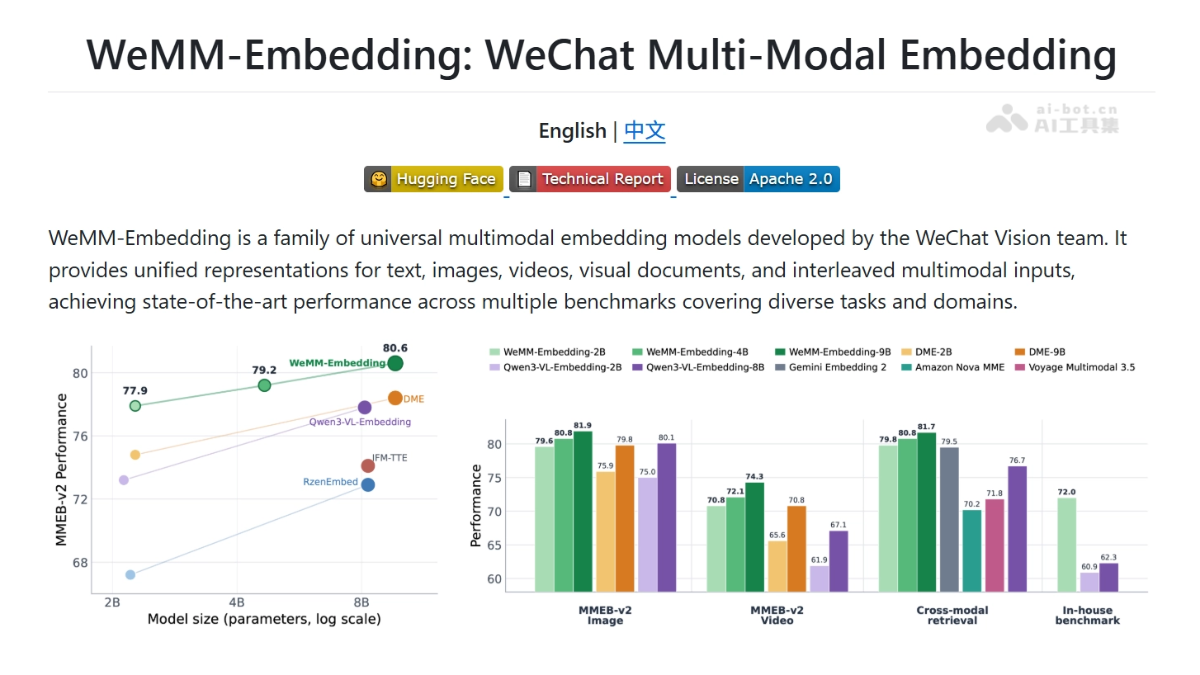
WeMM-Embedding is a general multimodal Embedding model family open-sourced by Tencent WeChat Vision Team, offering three specifications: 2B/4B/9B. The model uniformly encodes text, images, videos, visual documents, and interleaved multimodal inputs into a shared vector space, ranks first on the MMEB-v2 benchmark leaderboard, and has been deployed at large scale in WeChat Channels, Official Accounts, Search, and other recommendation and retrieval businesses.
Main Features of WeMM-Embedding
-
Unified Multimodal Encoding: Supports text, images, videos, visual documents, and arbitrarily interleaved multimodal inputs, uniformly mapped into a shared dense vector space.
-
Flexible Dimension Output: Based on Matryoshka representation learning, a single inference can output nested vectors from 64 to 4096 dimensions, and 256 dimensions can retain nearly 99% of the full-dimensional performance.
-
Multi-Task Adaptation: Covers scenarios such as retrieval, classification, question answering, visual grounding, cross-domain matching, Agent tool/GUI/memory retrieval, and more.
-
Efficient Inference Deployment: Supports multiple frameworks such as Transformers, Sentence Transformers, vLLM, and SGLang, making it easy to integrate into production environments.
Technical Principles of WeMM-Embedding
- Architecture Design: Uses the Qwen3.5 multimodal large language model as the backbone, by appending at the end of the input sequence
<embedding>special token, taking its final-layer hidden state and applying L2 normalization to obtain the output representation, naturally supporting arbitrarily interleaved multimodal inputs under causal attention. - Two-Stage Training Strategy: The first stage uses hundreds of millions of heterogeneous pairs to establish a general multimodal alignment space; the second stage performs fine-grained refinement on curated data by combining hard negative samples, reranker supervision, and cross-scale Embedding distillation, achieving progressive improvement from broad coverage to high precision.
- Data Construction and Curation: Uses a unified Pair-Based format to integrate six major categories of supervision data; balances semantic distribution through Semantic-ID-guided resampling, uses multimodal large models to automatically filter low-quality samples and correct text errors, and separately constructs explicit hard negatives for text, images, and videos to enhance discriminative ability.
- Training Objective System: Standard paired data uses InfoNCE contrastive learning and introduces duplicate-aware masking to avoid false negatives; graded relevance data uses a score-gap-weighted CoSENT ranking loss; Stage 2 introduces reranker scores to provide task-level fine-grained supervision, using the 9B model as a teacher to distill soft similarity distributions to smaller models via bidirectional KL divergence.

Follow WeChat and reply "Open Source" to jointhe AI Open-Source Project Communication Group
How to Use WeMM-Embedding
-
Environment Preparation: Clone the GitHub repository and run
pip install -r requirements.txtto install dependencies; it is recommended to usetransformers==5.2.0to ensure reproducible results. -
Obtain the Model: Download from Hugging Face
WeMM-Embedding-2B/4B/9Bmodel weights to local. -
Transformers Inference: Run
examples/transformers_inference.py, pass in the model path and text/image/video paths, and specify--dimensionto obtain the Embedding of the corresponding dimension. -
Sentence Transformers Inference: Run
examples/sentence_transformers_inference.py, you can directly use a Hugging Face model ID, and throughencode()uniformly encode multimodal inputs. -
Matryoshka dimensionality reduction: Take the first
ddimensions of the full-dimensional vector, then usetorch.nn.functional.normalizeto reapply L2 normalization, and you can obtain a low-dimensional representation. -
Service-oriented deployment: In production environments, use vLLM (
--runner pooling) or SGLang (--is-embedding) to launch the inference service, supporting high-concurrency calls.
Core advantages of WeMM-Embedding
-
Extreme parameter efficiency: A 2B model surpasses the previous leading 8B open-source baseline, redefining the performance-efficiency boundary of multimodal Embedding.
-
Truly unified multimodal representation: Natively supports text, images, videos, visual documents, and arbitrary interleaved combinations of inputs, with no need to design separate encoding pathways for different modalities.
-
Flexible Matryoshka dimensions: A single inference can output vectors from 64 to 4096 dimensions, and 256 dimensions can still retain nearly 99% of the full-dimensional performance, significantly reducing storage and retrieval costs.
-
Validated through large-scale business operations: It has achieved consistent improvements in 14 A/B tests across core businesses such as WeChat Channels, Official Accounts, and Search, and has been fully launched in the production environment.
-
Advanced progressive training: Through a two-stage strategy of “large-scale alignment + curated distillation,” combined with Semantic-ID data curation and cross-scale knowledge distillation, it achieves both broad coverage and high precision.
Project address of WeMM-Embedding
- GitHub repository:https://github.com/Tencent/WeMM-Embedding
- HuggingFace model library:https://huggingface.co/collections/tencent/wemm-embedding
- arXiv technical paper:https://arxiv.org/pdf/2608.24053
Comparison of WeMM-Embedding with similar competing products
| Comparison dimension | WeMM-Embedding | Qwen3-VL-Embedding |
|---|---|---|
| Developer | Tencent WeChat Vision Team | Alibaba Tongyi Qianwen Team |
| Open-source license | Apache 2.0 | Apache 2.0 |
| Model specifications | 2B / 4B / 9B | 2B / 8B |
| Supported modalities | Text, images, videos, visual documents, interleaved multimodal | Text, images, videos, visual documents, interleaved multimodal |
| Audio support | Not yet supported | Not yet supported |
| MMEB-v2 average score | 77.9 / 79.2 / 80.6 | 73.2 / 77.8 |
| MMEB-v3 average score | 56.0 / 58.2 / 59.5 | 50.9 / 53.5 |
| Dimensional flexibility | Matryoshka (64~4096 dimensions, multi-dimensional output in a single inference) | Fixed-dimensional output |
| Core architecture | Qwen3.5 + two-stage training (alignment + curated distillation) | Qwen3-VL + contrastive learning |
| Production validation | Already deployed at large scale in WeChat Channels, Official Accounts, Search, and E-commerce | Mainly aimed at the research/developer community |
Application scenarios of WeMM-Embedding
-
Cross-modal semantic retrieval: The model supports cross-modal retrieval in any direction, such as text-to-image search, image-to-text search, and text-to-video search, and is suitable for massive material library lookup and copyright monitoring on content platforms.
-
Personalized recommendation systems: Encode image-text and video content into unified vectors for candidate recall, user interest sequence modeling, and cross-domain content matching, and it has already been implemented in WeChat Channels, Official Accounts, and e-commerce recommendation scenarios.
-
Visual Document Understanding and Retrieval: Vectorize visual documents such as PDFs, charts, invoices, and screenshots to support intelligent document question answering, ticket archive retrieval, and enterprise knowledge base construction.
-
AI Agent Tools and Memory Retrieval: Provide Agents with tool invocation retrieval, GUI interface element localization, and long-range memory retrieval capabilities, supporting complex task planning and multi-step interaction.
-
Multimodal Content Classification and Moderation: Map image and video content into a semantic space to enable object recognition, scene classification, action detection, and similarity comparison and cluster analysis of violating content.