
What is WeKnora
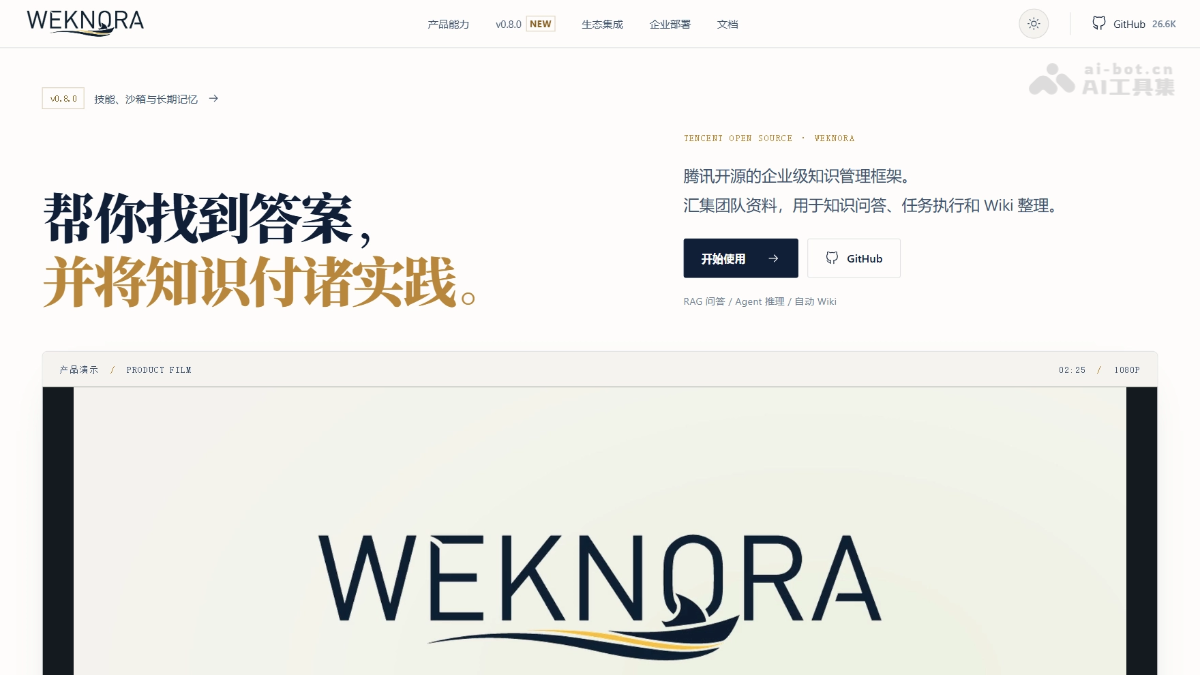
WeKnora is Tencent's open-source enterprise-grade knowledge management framework that supports private deployment. The framework is based on RAG technology, building materials such as PDF, Word, Feishu, and Notion into a searchable knowledge base, and providing intelligent Q&A with citation traceability; the built-in ReAct Agent can call MCP tools, skill sandboxes, and web search to execute multi-step tasks; it can automatically organize documents into interlinked Wiki pages and a knowledge graph. The system consists of a Go backend, a Vue frontend, and a Python document parsing service, and supports four deployment methods: Docker Compose, Helm, Lite single binary, and desktop application.
Main features of WeKnora
- Document ingestion: supports upload of 10+ formats including PDF, Word, Excel, images, and audio, as well as continuous synchronization with platforms such as Feishu, Lark, Notion, Yuque, GitLab, and RSS.
- Document understanding: the docreader service provides PDF layout analysis, OCR for scanned documents, table extraction, multimodal image description, and audio transcription.
- Intelligent chunking: supports fixed chunking, parent-child chunking, and adaptive strategies; chunks are editable and have version history, and indexes are automatically rebuilt after modifications.
- Hybrid retrieval: dual-path recall with vectors + BM25 keywords, RRF fusion ranking, optional Rerank reranking and query rewriting, and flexible replacement of vector databases (Qdrant/Milvus, etc.).
- RAG Q&A: streaming SSE answers include original-text citations, and clicking allows traceability and verification.
- Agent engine: built-in ReAct agent that can orchestrate multi-step tasks such as knowledge retrieval, web search, MCP tools, and data analysis.
- Skills and sandbox: space-level skill directory; skills can be installed from ClawHub, Git, etc., and scripts can be executed in Docker/E2B/Cube sandboxes to generate files.
- Automatic Wiki: generates interlinked topic pages and a knowledge graph from documents, supporting browsing, editing, and one-click version rollback.
- Multi-model support: the model abstraction layer is compatible with local Ollama models and OpenAI-compatible APIs, covering five categories: LLM, Embedding, Rerank, VLM, and ASR.
- Team collaboration: multi-tenant workspaces + four-level RBAC roles, supporting cross-space knowledge base sharing within an organization and an invitation mechanism.
- Multi-channel access: provides REST API, CLI, Go SDK, WeChat Mini Program, desktop client, Chrome extension, as well as IM integrations such as WeCom/Feishu/Slack/Telegram and web embedding.
- Security and governance: AES-256 encryption of sensitive credentials, audit logs, SSRF protection, OIDC single sign-on, and fine-grained API Key permissions.
- Observability: integrates Langfuse full-chain tracing, covering LLM calls, token statistics, and runtime task queue monitoring.
How to use WeKnora
- Deployment: choose any one of Docker Compose (
make start-all), Helm, Lite single binary (make run-lite), or desktop application to start the service, then visithttp://localhost。 - Prepare models: configure at least one chat model (LLM) and one embedding model (Embedding); you can use local Ollama (address
http://host.docker.internal:11434) or any OpenAI-compatible API. - Register an account: Open the frontend to register or log in (first-time registration automatically creates a personal workspace and sets you as Owner; Lite/desktop versions require no registration).
- Create a knowledge base: On the "Knowledge Base" page, create a new document- or faq-type knowledge base, and in the initialization wizard select the model for that base, test the connection, and save.
- Upload materials: Drag in files such as PDF, Word, images, and audio or paste a web page URL. Batch tagging and adjustment of parsing options are supported, and documents can be retrieved once asynchronous parsing is complete.
- Start Q&A: Go to the chat page, select a knowledge base, and ask questions. Quick Q&A is for everyday retrieval, while intelligent reasoning (Agent) is for multi-step tasks, web search, and file generation. All answers include traceable citations.
- Advanced configuration: As needed, connect Feishu/Notion/RSS data sources for continuous synchronization, configure skills and the MCP sandbox, enable automatic Wiki, or provide services externally via IM/web embedding/API Key.
WeKnora's core advantages
- More accurate hybrid retrieval: Vector + BM25 dual-path recall is fused via RRF and reranked, solving the problem of unstable recall with single vector retrieval.
- Strong document parsing capabilities: Supports PDF layout analysis, scanned document OCR, table extraction, image VLM descriptions, and audio transcription, and can integrate parsing engines such as MinerU/Docling.
- Completely model-neutral: The abstraction layer is compatible with both Ollama local models and 20+ OpenAI-compatible remote APIs. LLM/Embedding/Rerank/VLM/ASR can be freely replaced, with no vendor lock-in.
- Complete Agent capabilities: Built-in ReAct agent supports MCP tools, web search, and skill sandboxes (Docker/E2B/Cube) for executing scripts, and can also directly generate and preview files such as Word/PPT/PDF in conversations.
- Automatic knowledge accumulation: The original Wiki mode automatically organizes documents into interlinked pages and a knowledge graph, with version history that can be edited and rolled back, allowing the knowledge base to evolve on its own.
- Flexible deployment forms: From production-grade Docker Compose/Helm to a zero-dependency Lite single binary and desktop application, covering all scenarios from personal to enterprise use.
WeKnora's project addresses
- Project website:https://weknora.weixin.qq.com/
- GitHub repository:https://github.com/Tencent/WeKnora
Comparison of WeKnora with similar competitors
| Comparison dimension | WeKnora(Tencent) | RAGFlow(InfiniFlow) |
|---|---|---|
| Product positioning | Enterprise-grade knowledge management framework: the trinity of RAG Q&A + Agent tasks + automatic Wiki | A RAG engine focused on deep document understanding, emphasizing "high-quality in, high-quality out" knowledge extraction |
| Open-source license | MIT License, with no multi-tenant operation restrictions | Apache 2.0, also freely usable for commercial purposes |
| Technology stack | Go (Gin) + Vue 3 + Python docreader, with an optional single binary | Python backend (Go backend alignment refactor starting from v0.27) + self-developed document engine |
| Document parsing | Independent docreader microservice: PDF layout analysis, scanned document OCR, VLM image descriptions, ASR transcription, and can integrate MinerU/Docling | The self-developed DeepDoc model is the core competitiveness, with templated chunking visualization and manual intervention, excelling at complex PDF parsing |
| Retrieval engine | Vector + BM25 hybrid retrieval, RRF fusion + Rerank, with ParadeDB as a single database by default | Vector + BM25 hybrid retrieval + custom scoring + Rerank, based on the self-developed Infinity engine |
| Knowledge Accumulation | Automatic Wiki pages (interlinked + version rollback) + Neo4j knowledge graph | v0.27 introduced Knowledge Compilation: Wiki, Graph, Tree, PageIndex, mind map, timeline and other multi-forms; the old GraphRAG/RAPTOR has been deprecated |
| Agent Capabilities | Built-in ReAct engine + skill directory + sandbox file generation | Agentic RAG four-level thinking modes (Low/Medium/High/Ultra) + visual workflow orchestration |
| Sandbox and Skills | Skill directory (ClawHub/Git installation) + Docker/E2B/Cube session sandbox, can generate Word/PPT/PDF files | Multi-sandbox mechanism (local gVisor, Alibaba Cloud), code execution component + chart generation |
| Long-term Memory | Cross-session long-term memory (materials/preferences/facts/matters/interests, automatic extraction requires confirmation) | Memory management API (HTTP + Python), launched in December 2025 |
| Deployment Form | Docker Compose / Helm / Lite single binary / desktop application (Wails) | Mainly Docker deployment (docker run -p 9380:9380), no single binary form
|
| Channel Ecosystem | WeCom/Feishu/Slack/Telegram/DingTalk IM + WeChat Mini Program + web embedding + MCP Server | Chat channels such as Feishu/Discord/Telegram/Line + OpenClaw Skill integration |
WeKnora's Application Scenarios
- Enterprise Knowledge Management: Helps employees quickly search internal documents, rules and regulations, and operation manuals, improving knowledge retrieval efficiency and reducing training costs.
- Scientific Literature Analysis: Accelerates the retrieval and analysis of papers, research reports, and academic materials, helping researchers carry out research work efficiently.
- Product Technical Support: Provides product manual Q&A and technical document retrieval services, helping users quickly solve technical problems and improving customer service quality.
- Legal Compliance Review: Supports contract clause retrieval, regulatory policy queries, and case analysis, improving legal compliance efficiency and reducing legal risks.
- Medical Knowledge Assistance: Assists with medical literature retrieval, diagnosis and treatment guideline queries, and case analysis, improving the scientificity and accuracy of medical decisions.