
What is WebWeaver
WebWeaver is a novel dual-agent framework launched by Alibaba's Tongyi team, part of theTongyi DeepResearchfamily, used for open-ended deep research. WebWeaver simulates the human research process, dividing tasks into two agents: planning (exploration and outline generation) and writing (content synthesis). The core innovation of WebWeaver lies in dynamic outline optimization, treating the research outline as a "living document," cycling between search and outline refinement, allowing the research direction to dynamically evolve with new discoveries. WebWeaver's memory-based hierarchical synthesis method builds reports section by section, ensuring the report is coherent, accurate, and deeply grounded in sources. WebWeaver achieves a new state-of-the-art level in open-ended deep research benchmarks and has created the WebWeaver-3k dataset, enabling small models to achieve expert-level research capabilities.
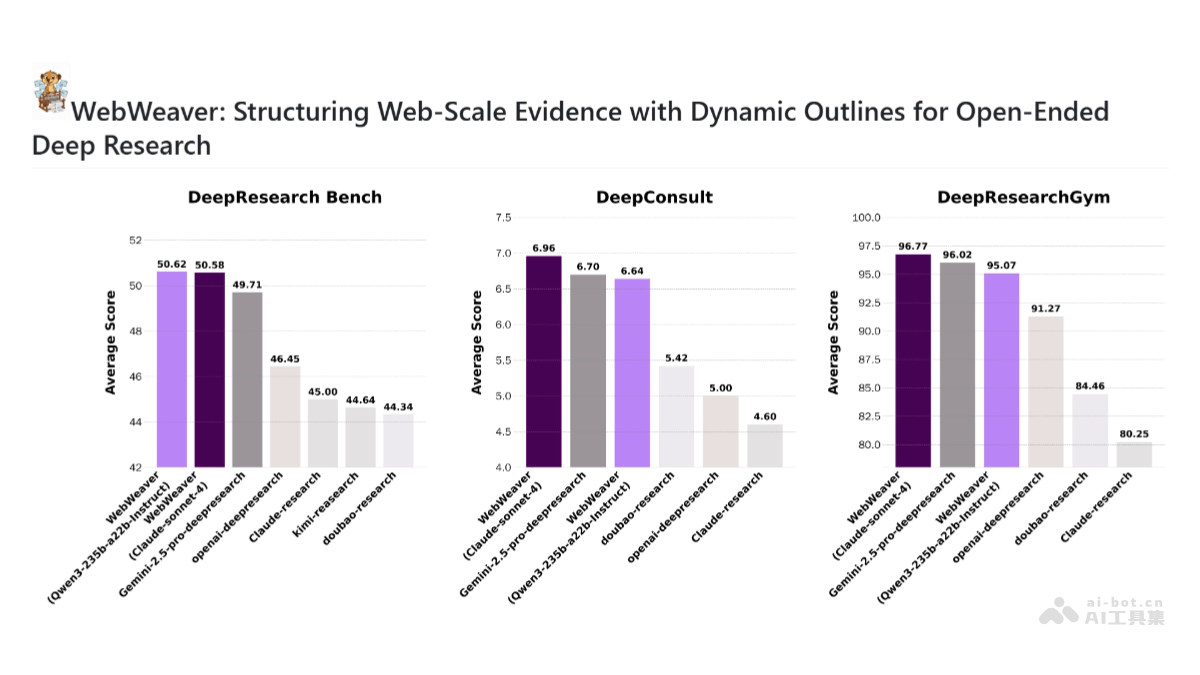
Main Features of WebWeaver
-
Efficient Information Retrieval and Integration: WebWeaver can quickly retrieve information related to the research topic from massive web pages, integrate it into a logical structure, and provide users with a comprehensive and accurate knowledge system.
-
Dynamic Outline Optimization: Treats the research outline as a "living document," continuously adjusting and optimizing the outline based on newly discovered information during the research process, allowing the research direction to flexibly adapt to new situations and avoid falling into fixed thinking.
-
Hierarchical Report Synthesis: WebWeaver constructs reports based on hierarchical synthesis, generating content section by section, with each part retrieving the most relevant evidence from the memory bank, ensuring the coherence and accuracy of the report and avoiding information loss in long-text generation.
-
Enhancing Small Model Capabilities: Through the WebWeaver-3k dataset, WebWeaver imparts complex skills to small models, enabling small models to possess expert-level research capabilities and lowering the threshold for high-quality research.
Technical Principles of WebWeaver
-
Dual-Agent Framework: WebWeaver consists of two agents: a planning agent responsible for exploration and generating the research outline, and a writing agent responsible for synthesizing the report content based on the outline. This division of labor simulates the human research process, improving research efficiency and quality.
-
Dynamic Loop Mechanism: The planning agent continuously performs web searches during the research process, comparing and optimizing search results against the research outline, forming a dynamic loop. This enables WebWeaver to promptly discover new information and incorporate it into the research, avoiding the problem in traditional methods where the outline is difficult to change once determined.
-
Application of Memory Bank: When generating reports, the writing agent retrieves the most relevant evidence from a carefully curated memory bank. The memory bank stores information retrieved from the web, preprocessed and tagged according to certain rules.
-
Reinforcement Learning and Optimization: WebWeaver continuously optimizes its search and generation strategies through reinforcement learning. During training, it adjusts its behavior based on feedback signals to improve search efficiency and report quality. The adaptive optimization mechanism enables WebWeaver to better handle different research topics and task requirements.
Project Address of WebWeaver
- GitHub Repository:https://github.com/Alibaba-NLP/DeepResearch/tree/main/WebAgent/WebWeaver
- arXiv Technical Paper:https://arxiv.org/pdf/2509.13312
Application Scenarios of WebWeaver
-
Academic Research: Quickly integrates literature materials, generates literature reviews and draft papers, helping researchers efficiently conduct subject research.
-
Enterprise Decision Support: Enterprises collect market and industry information to provide data support for market research, strategic planning, and investment decisions.
-
Education Sector: Teachers obtain teaching resources to assist with curriculum design, while students use them for learning assistance and graduation projects, enhancing teaching and learning outcomes.
-
Media and News Industry: Journalists and media personnel quickly gather news background and expert opinions, improving the quality of news reporting and special topic planning.
-
Government and Public Policy: Government departments collect socioeconomic information to provide a scientific basis for policy formulation, public affairs management, and emergency management.