
What is WebWalker
WebWalker is a tool developed by Alibaba's Natural Language Processing team for evaluating and improving the performance of large language models (LLMs) in web browsing tasks. By simulating web navigation tasks, it helps models better handle long-context information. WebWalker's core features include a multi-agent framework that can effectively manage memory and support models in maintaining memory during web browsing; a vertical exploration strategy that deeply explores a single page or a chain of related pages to obtain deeper information; and the WebWalkerQA dataset, which contains 680 challenging queries covering multilingual and multi-domain web content, used to test model performance.
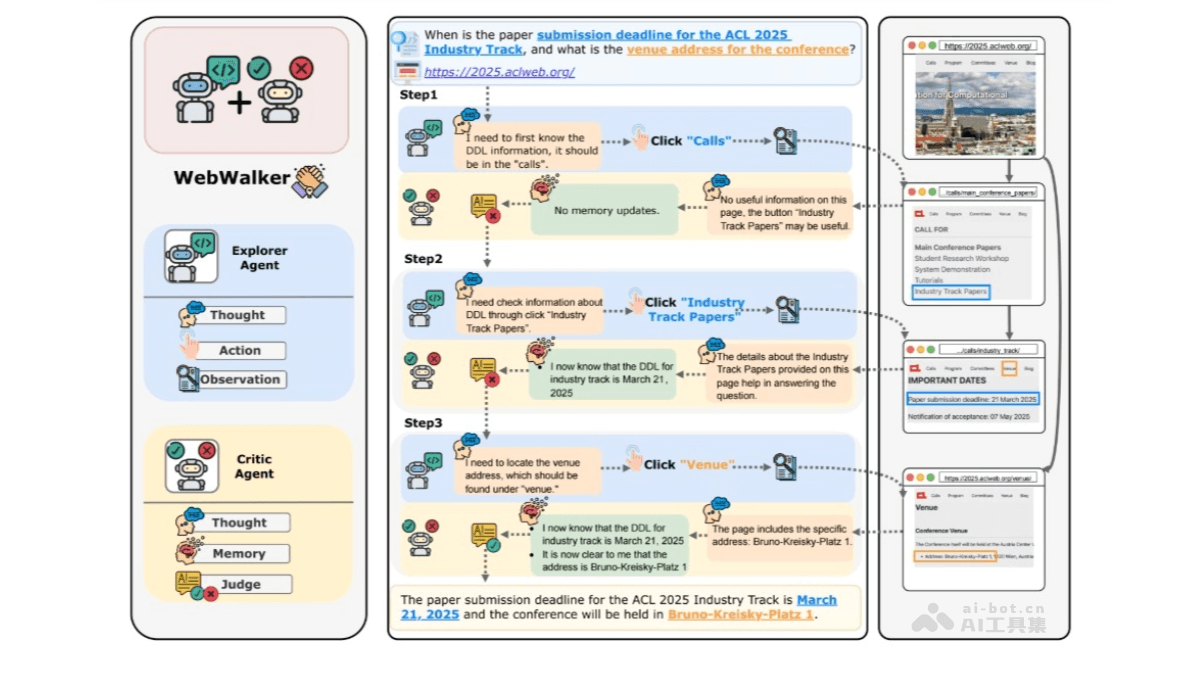
WebWalker's Main Features
- Multi-Agent Framework: WebWalker uses a multi-agent framework to effectively manage memory. The framework supports models in maintaining memory of previous interactions while browsing web pages, better handling tasks that require long-context information.
- Vertical Exploration: WebWalker emphasizes vertical exploration within pages, that is, deeply exploring a single page or a chain of related pages to find and answer the information needed for the question.
- WebWalkerQA Dataset: For testing and evaluation, WebWalker provides a dataset named WebWalkerQA, containing 680 queries from four real-world scenarios, covering more than 1,373 web pages. Test model performance.
- Performance Evaluation: WebWalker provides an online demo, supports users in trying web browsing, and allows submitting and comparing the performance of different methods through the HuggingFace Leaderboard.
WebWalker's Features and Advantages
- Multi-Source Information Retrieval: The questions in the dataset require models to retrieve information from multiple sources, increasing the complexity of the task.
- Multilingual Support: The WebWalkerQA dataset contains both Chinese and English, requiring models to handle multilingual web pages.
- Multi-Domain Coverage: The dataset covers multiple domains such as conferences, organizations, education, and games, testing model adaptability across different domains.
- Multiple Difficulty Levels: Questions are divided into three difficulty levels: easy, medium, and hard, accommodating models with different capabilities.
- Enhanced Information Retrieval Capability: WebWalker's vertical exploration method can deeply explore web content and obtain deeper information.
- Effective Memory Management: The multi-agent framework enables models to effectively manage long-context information, improving the ability to handle complex tasks.
- Strong Adaptability: WebWalker can adapt to different web page structures and content, enabling good performance in various web browsing tasks.
- Performance Improvement: Experimental results show that integrating WebWalker into a standard RAG system can improve model performance at all difficulty levels, especially in the multi-source category.
- Scalability: WebWalker can be integrated as a module into existing RAG systems to enhance their vertical exploration capability.
WebWalker's Project Address
- Project Official Website:https://alibaba-nlp.github.io/WebWalker
- GitHub Repository:https://github.com/Alibaba-nlp/WebWalker
- arXiv Technical Paper:https://arxiv.org/pdf/2501.07572
WebWalker's Application Scenarios
- Intelligent Information Retrieval System: WebWalker can be used to build intelligent assistants or information retrieval systems, helping users quickly extract the required information from complex web page structures.
- Multi-source information integration: WebWalker's vertical exploration strategy enables it to integrate information from multiple web pages, making it particularly suitable for scenarios that require multi-step interaction and deep exploration, such as academic research and market analysis.
- Data collection and analysis: WebWalker can be used to collect data from specific websites, such as prices and reviews, for statistical analysis.
- Content monitoring: It can monitor website updates and obtain new information in a timely manner, making it suitable for scenarios that require real-time monitoring of changes in web page content.