
What is WebDreamer
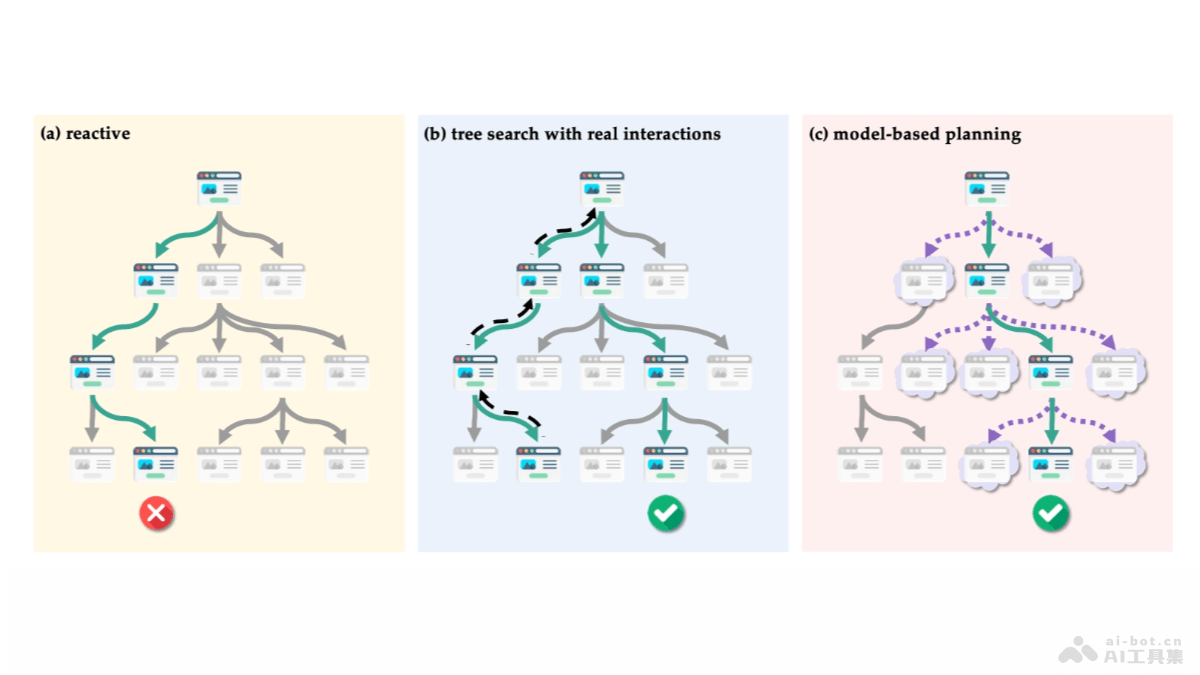
WebDreamer is a web agent based on model-based planning launched by the research teams of Ohio State University and Orby AI. It uses large language models (LLMs), especially GPT-4o, as a world model to predict interaction outcomes on websites. The framework simulates possible user behaviors and outcomes, helping web agents to effectively plan and make decisions in complex web environments. The core of WebDreamer lies in the concept of "dreaming": before actually taking actions, it uses LLMs to predict the outcome of each possible step and selects the action most likely to achieve the goal. This approach improves the agent's performance and safety, and reduces the need for actual website interactions.
Main Features of WebDreamer
- Model-Based Planning: Uses large language models (LLMs) as a world model to provide web agents with model-based planning capabilities, enabling them to execute tasks in complex web environments.
- Predicting Interaction Outcomes: Predicts the actions users may take on a website and their outcomes, such as changes to the webpage after clicking a button or entering text.
- Optimizing Decisions: Based on simulating different action paths, evaluates the pros and cons of each possible outcome to determine the best course of action.
- Improving Performance and Efficiency: Compared with reactive baselines, WebDreamer performs better when completing tasks, requires fewer interactions, and improves efficiency.
- Enhancing Safety: Reduces direct interaction with real websites and lowers the risk caused by irreversible operations, such as accidentally submitting a form or triggering a transaction.
- Multi-Functional Integration: Integrates with multiple agents as a plugin, supplementing the capabilities of tree search agents.
Technical Principles of WebDreamer
- Simulation Function (sim): Uses LLMs to simulate the outcome of each candidate action. The simulation function predicts the state changes after an action based on natural language descriptions, approximating a state transition function.
- Scoring Function (score): After simulating possible action trajectories, uses LLMs as a scoring function to evaluate how close each simulated trajectory is to completing the task goal.
- Candidate Action Generation: Adopts a two-stage method to generate candidate actions: first samples the top k actions, then uses LLM self-refinement to remove unnecessary actions for simulation.
- Iterative Simulation and Execution: The agent simulates multiple possible action trajectories at each decision point, selects the trajectory with the highest score, executes the corresponding initial action, updates the simulation based on actual results, and repeats this process until the task is completed.
- Partially Observable Markov Decision Process (POMDP): Treats web tasks as POMDPs, taking into account the complexity and partial observability of web environments.
- Model Predictive Control (MPC): Draws on the MPC method to iteratively simulate future trajectories and select actions, avoiding costly real-world exploration.
WebDreamer Project Address
- GitHub Repository:https://github.com/OSU-NLP-Group/WebDreamer
- arXiv Technical Paper:https://arxiv.org/pdf/2411.06559
Application Scenarios of WebDreamer
- Automated Web Tasks: Automates various web tasks, such as filling out forms, online shopping, data entry, etc., reducing manual intervention.
- Intelligent Search and Navigation: Helps agents search and navigate more effectively when multiple web pages need to be browsed to gather information or complete tasks.
- Virtual assistants: As virtual assistants for individuals or enterprises, automatically handle emails, scheduling, online bookings, etc.
- E-commerce: In e-commerce platforms, automate tasks such as product listing, price comparison, and inventory management.
- Customer service: Automate customer service processes, such as automatically answering frequently asked questions and handling return and refund requests, improving customer service efficiency.