
What is WeatherNext 2
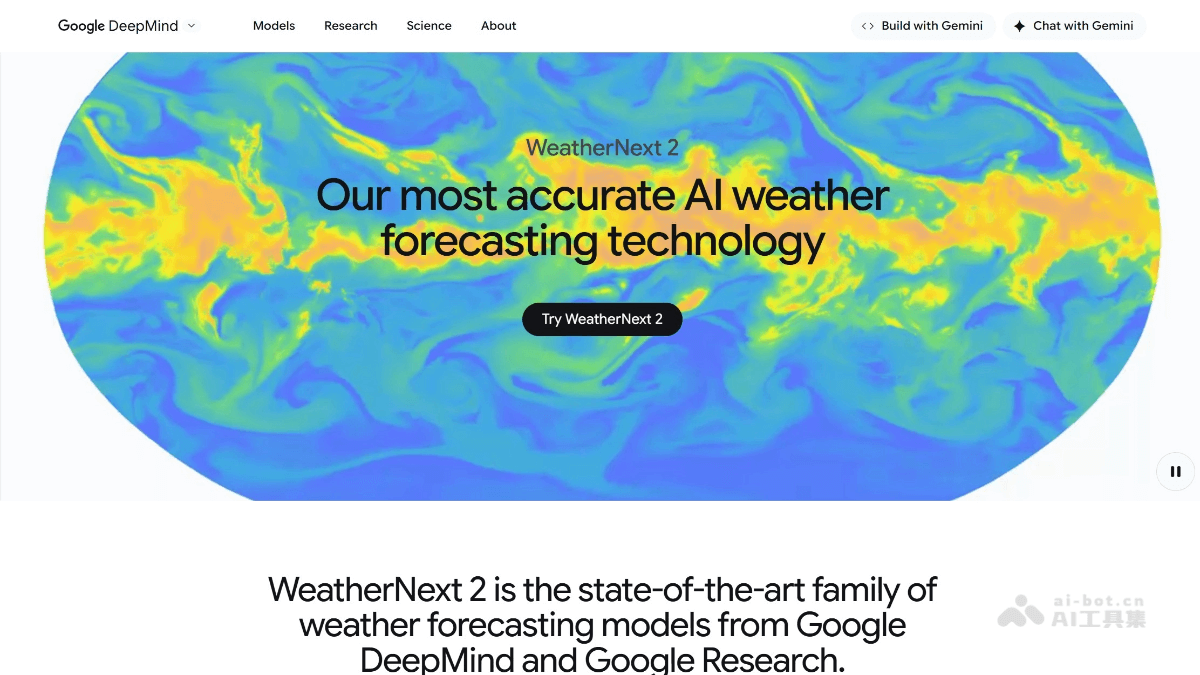
WeatherNext 2 is a new-generation AI weather forecasting model jointly launched by Google's DeepMind and Google Research. The model adopts the Functional Generative Network (FGN) architecture, runs about 8 times faster than the previous generation, and can generate fine-grained forecasts at hourly resolution. It can derive hundreds of possible weather scenarios from a single initial state, with each derivation taking less than one minute on a single TPU. In the 0 to 15-day forecast period, WeatherNext 2 comprehensively surpasses the previous generation on 99.9% of meteorological variables (such as temperature, wind speed, humidity, etc.).
Main features of WeatherNext 2
-
High-precision weather forecasting: It can generate fine-grained forecasts at hourly resolution, covering a forecast period from 0 to 15 days, and comprehensively surpasses the previous generation model on multiple meteorological variables such as temperature, wind speed, and humidity.
-
Fast computation: It adopts an innovative "Functional Generative Network" architecture, runs about 8 times faster than the previous generation, and a single forecast takes less than one minute on a single TPU.
-
Multi-scenario derivation: It can derive hundreds of possible weather development scenarios from a single initial state, providing more comprehensive references for meteorological research and disaster warning.
-
Low-probability event forecasting: It accurately predicts low-probability catastrophic weather events, such as typhoons and heavy rainfall, improving the ability to warn about extreme weather.
-
Data platform integration: The forecast data has been launched on the Earth Engine and BigQuery platforms, making it convenient for researchers and developers to obtain and use.
-
Cloud service support: Google Cloud's Vertex AI platform has launched an early access program for customized model inference, supporting users in making customized forecasts according to their own needs.
-
Multi-scenario applications: It has been integrated into Google Search, Gemini, Pixel Weather, and the Weather API of Google Maps Platform, and will be further applied to weather information in Google Maps in the coming weeks, providing users with more convenient weather query services.
Technical principles of WeatherNext 2
-
Noise injection in function space: FGN injects low-dimensional noise vectors (such as 32-dimensional) into the function space and applies the noise to the entire network through conditional normalization layers, thereby generating globally consistent variability. This mechanism enables the model to generate hundreds of possible weather scenarios from a single input while maintaining physical plausibility.
-
Graph neural network architecture: FGN adopts a graph neural network (GNN) encoder/decoder structure, mapping the latitude-longitude grid to a latent space on a spherical icosahedral grid, and uses a Graph-Transformer processor to operate on this grid. This architecture helps capture the spatial dependencies among complex meteorological variables.
-
Multi-stage training strategy: FGN training is divided into multiple stages, including pretraining with ERA5 data and fine-tuning with HRES-fc0 data. The final stage includes autoregressive training, where the model performs multi-step rollout forecasting and computes the loss to optimize forecasting performance.
-
Marginal and joint distribution forecasting: Although FGN is trained only on marginal distributions (such as single variables like temperature and wind speed), it can capture joint distributions through learning (that is, the complex interactions among multiple variables). This enables the model to generate more comprehensive and accurate weather forecasts.
-
High resolution and fast forecasting: The FGN model can generate refined forecasts at hourly resolution, and a single prediction takes less than one minute on a single TPU. This high-speed and high-resolution forecasting capability significantly improves the efficiency of weather forecasting.
Project address of WeatherNext 2
- Project official website:https://deepmind.google/science/weathernext/
Application scenarios of WeatherNext 2
-
Consumer weather services: WeatherNext 2 has been integrated into services such as Google Search, Gemini, and Pixel Weather to provide users with more accurate, high-resolution weather forecasts.
-
Developer and enterprise applications: Its forecast data has been launched on the Earth Engine and BigQuery platforms, and an early access program is provided through Google Cloud's Vertex AI platform for developers and enterprises to perform customized model inference. This enables enterprises and developers to build customized applications based on high-precision weather data, such as optimizing logistics routes and managing supply chains.
-
Meteorological agencies and disaster warning: By providing hundreds of possible weather scenarios, WeatherNext 2 can help meteorological agencies conduct multi-scenario analysis, identify extreme weather events in advance, and improve the efficiency of emergency response.
-
Energy and agriculture: The model can be used to optimize the utilization of renewable energy, such as the scheduling of wind and solar power, and improve grid stability. At the same time, its medium-range weather forecasting capability is also suitable for agricultural planning, helping farmers make planting and harvesting plans.
-
Scientific research and data sharing: The openness of WeatherNext 2 enables researchers to obtain high-precision weather data, further advancing meteorological research and innovation in related fields.