
What is Waver 1.0
Waver 1.0 is a new generation launched by ByteDancevideo generationmodel, based on the rectified flow Transformer architecture, supportstext-to-video(T2V)、image-to-video(I2V) and text-to-image (T2I) generation, all within a single framework without switching models. It supports resolutions up to 1080p and flexible video lengths of 2-10 seconds, excels at capturing complex motion, and the generated videos perform outstandingly in motion amplitude and temporal consistency. On Waver-Bench 1.0 and the Hermes motion test set, Waver 1.0 outperforms existing open-source and closed-source models. It supports video generation in multiple artistic styles, including hyper-realism, animation, clay, plush, and more.
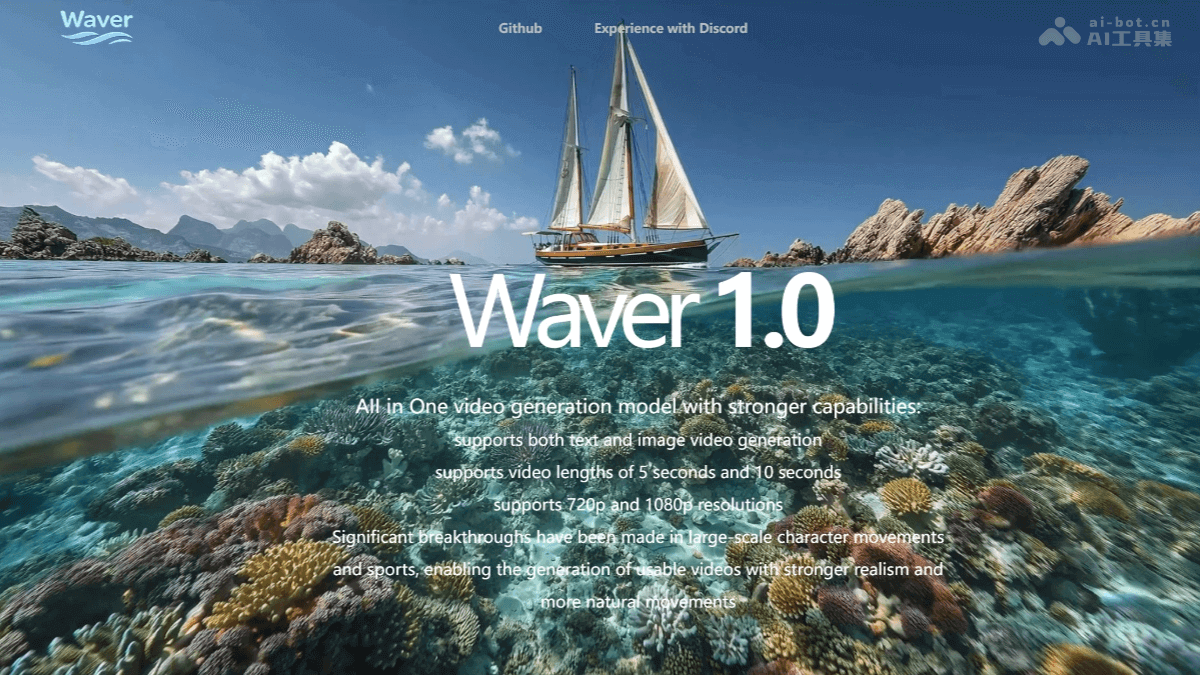
Main Features of Waver 1.0
-
Integrated generation: supports text-to-video (T2V), image-to-video (I2V), and text-to-image (T2I) generation, without switching models.
-
High resolution and flexible length: supports up to 1080p resolution and video lengths of 2-10 seconds, with flexible adjustment of resolution and aspect ratio.
-
Complex motion modeling: excels at capturing complex motion, and the generated videos perform outstandingly in motion amplitude and temporal consistency.
-
Multi-shot narrative: can generate coherent multi-shot narrative videos, ensuring a high degree of consistency in the core theme, visual style, and overall atmosphere.
-
Artistic style support: supports video generation in multiple artistic styles, such as hyper-realism, animation, clay, plush, and more.
-
Performance advantages: on Waver-Bench 1.0 and the Hermes motion test set, performance is better than existing open-source and closed-source models.
-
Inference optimization: adopts APG technology to reduce artifacts and improve the realism of generated videos.
-
Training strategy: through low-resolution video training, gradually increases resolution to optimize motion generation capability.
-
Prompt labels: distinguishes different types of training data through prompt labels, improving generation results.
Technical Principles of Waver 1.0
-
Model architecture: Waver 1.0 adopts a Hybrid Stream DiT architecture, uses Wan-VAE to obtain compressed video latent variables, uses flan-t5-xxl and Qwen2.5-32B-Instruct to extract text features, and builds the DiT model based on the rectified flow Transformer. Video and text modalities are fused through a dual-stream + single-stream approach.
-
1080p generation: Waver-Refiner adopts the DiT architecture and is trained through the flow matching method. First, low-resolution videos (480p or 720p) are upsampled to 1080p, then noise is added, using the noisy low-resolution video as input to output high-quality 1080p video. It uses a window attention mechanism to reduce inference steps and significantly improve inference speed.
-
Training method: training on low-resolution videos is crucial for learning motion. A large amount of computational resources is invested in training on 192p videos, then the resolution is gradually increased to 480p and 720p. Following the flow matching training setup in SD3, the sigma shift value is gradually increased during 480p and 720p video training.
-
Prompt labels: A prompt label method is used to distinguish different types of training data, assigning different labels to training data based on video style and video quality. During training, prompts describing the video style are added before the title, and prompts describing the video quality are added at the end of the training title. During inference, prompts describing poor quality (such as low definition or slow motion) are included in the negative prompt.
-
Inference Optimization: APG is extended to video generation to enhance realism and reduce artifacts. APG decomposes the update term in CFG into parallel and orthogonal components, and reduces the weight of the parallel component to achieve high-quality generation without excessive saturation.
Waver 1.0 Project Address
- Project Official Website:http://www.waver.video/
- Github Repository:https://github.com/FoundationVision/Waver
- arXiv Technical Paper:https://arxiv.org/pdf/2508.15761
Waver 1.0 Application Scenarios
-
Content Creation: It can be used for story creation, advertising, short dramas, etc., transforming text descriptions into vivid videos.
-
Product Display: It can transform product images into dynamic display videos, suitable for e-commerce livestreaming, product displays, virtual try-ons, etc.
-
Education and Training: It can transform teaching content or training documents into interactive videos, enhancing the learning experience.
-
Social Media: Quickly generate video content suitable for posting on social media to attract user attention.
-
Animation Production: Transform static images into animations, suitable for animation production, character driving, and special effects generation.
-
Game Development: Generate dynamic scenes and character animations for games, enhancing the game's immersion.