
What is WarriorCoder
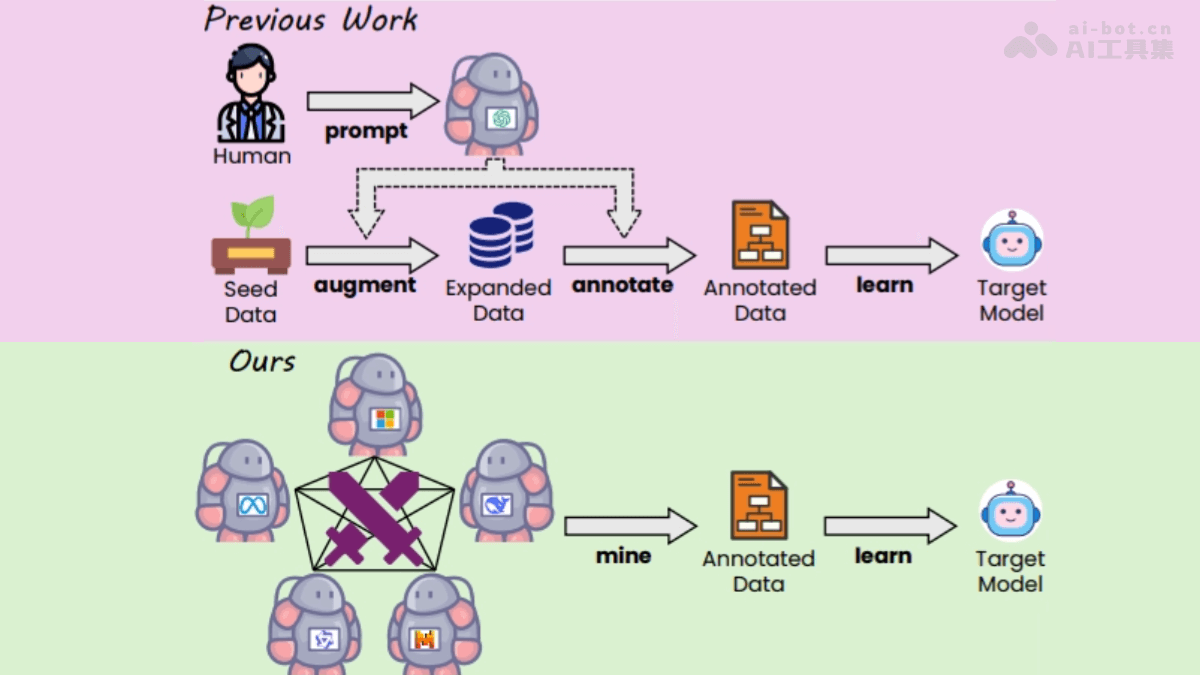
WarriorCoder is a code generation large language model (LLM) launched by the School of Computer Science and Engineering of South China University of Technology and Microsoft. It generates high-quality training data based on simulated adversarial competition between expert models to improve model performance. Unlike traditional methods, WarriorCoder does not rely on existing proprietary models or datasets. It mines instructions from scratch, evaluates adversarial results based on the Elo rating system and a judge model, and selects the optimal response as training data. WarriorCoder integrates the advantages of multiple open-source code expert models, avoiding manual participation and systematic bias in the data collection process. Experiments show that WarriorCoder achieves new SOTA performance on tasks such as code generation, code reasoning, and library usage, demonstrating strong generalization ability and data diversity.
Main features of WarriorCoder
- Code generation: Generate high-quality code snippets based on given instructions or requirements.
- Code optimization: Optimize existing code to improve its performance and efficiency.
- Code debugging: Help identify and fix errors or vulnerabilities in code.
- Code reasoning: Predict the output of code or infer the input from the output, enhancing understanding of code logic.
- Use of libraries and frameworks: Generate code related to specific programming libraries (such as NumPy, Pandas, etc.), improving the ability to call complex libraries.
- Multilingual support: Support multiple programming languages to meet the needs of different development scenarios.
Technical principles of WarriorCoder
- Expert adversarial framework: Build an arena where multiple advanced code expert models (such as open-source LLMs) compete against each other. In each round of competition, two models (attacker and defender) generate code according to specific instructions, and other models act as judges to evaluate the results. The target model learns from the winners in the competitions and gradually integrates the advantages of all expert models.
- Instruction mining: Mine the capabilities already mastered by expert models based on a completion-based method, avoiding reliance on private data. Use the model's generation ability to sample instructions from the distribution, avoiding pattern overfitting and data drift.
- Difficulty assessment and deduplication: Deduplicate the mined instructions, and the judge model evaluates their difficulty, retaining high-quality instructions (difficulty level "excellent" or "good").
- Elo rating system: Introduce the Elo rating system, combining local adversarial results and global performance to evaluate the model's comprehensive ability. Dynamically update Elo ratings to balance local randomness and global consistency, preventing weak models from winning due to accidental factors.
- Training and optimization: Use the responses of the winners in the competitions as training data, and train the target model based on supervised fine-tuning (SFT). Without relying on manual annotation or private LLMs, generate diverse, high-quality training data at low cost.
Project address of WarriorCoder
- arXiv technical paper:https://arxiv.org/pdf/2412.17395
Application scenarios of WarriorCoder
- Automated code generation: Quickly generate code based on natural language descriptions, improving development efficiency.
- Code optimization and refactoring: Provide optimization suggestions to improve code performance and readability.
- Code debugging and repair: Help locate errors and provide repair solutions, reducing debugging time.
- Programming education assistance: Generate sample code and practice exercises to support programming learning.
- Cross-language code conversion: Supports converting code from one language to another, facilitating technology stack migration.