
What is Wan-Streamer v0.2
Wan-Streamer v0.2 is an end-to-end omni-modal understanding and generation model for real-time duplex interaction launched by Alibaba Tongyi Lab. The model unifies "listening, seeing, speaking, and performing" into a single Transformer, natively supporting real-time understanding and synchronous generation of text, audio, and video, with an end-to-end response latency of only 550ms and an output resolution of 640×368@25FPS, enabling AI to listen, watch, and respond like a real person, achieving truly natural face-to-face video communication.
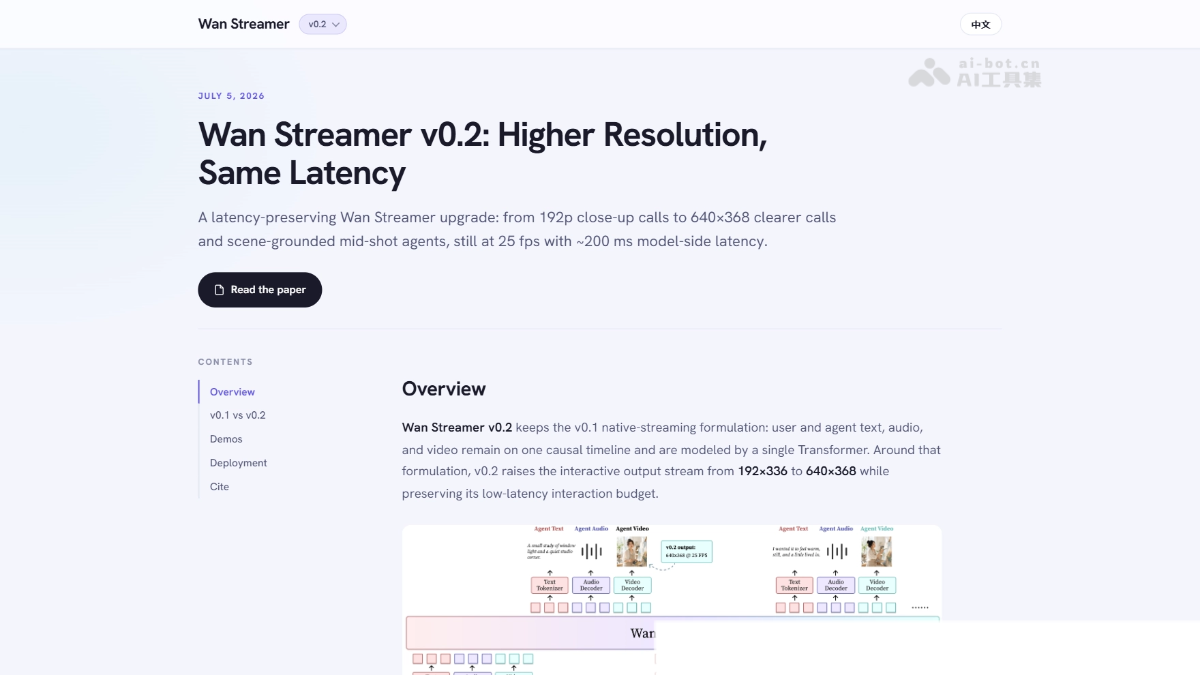
Main Features of Wan-Streamer v0.2
-
Real-time audio-video conversation: Supports video-call-style face-to-face interaction, with AI perceiving the user's audio and video in real time and synchronously generating responses.
-
Omni-modal understanding: Natively supports real-time understanding of text, audio, and video inputs without the need for external module assembly.
-
Synchronous audio-video generation: Synchronously outputs speech and high-definition video frames, achieving perfect synchronization between sound and picture.
-
Micro-expression and gesture generation: Can generate natural eye contact, body posture, gestures, and scene details.
-
Free role-playing: Supports real-time generation of any character for conversation through natural language description.
Technical Principles of Wan-Streamer v0.2
-
Native streaming architecture: Unifies user input and agent output onto the same causal timeline, without the need to wait for the entire utterance to finish.
-
Streaming unit closed loop: Completes a full loop of perception, understanding, generation, and decoding every 160ms, enabling speaking, listening, and responding simultaneously.
-
Thinker-Performer dual pathway: A single-card Thinker is responsible for low-latency perception and language reasoning, while a multi-card Performer with Ulysses parallelism is responsible for high-definition video generation.
-
Temporal overlapping scheduling: The computation windows of the single-card Thinker and multi-card Performer overlap, removing video generation cost from the latency-sensitive path.
-
End-to-end unified modeling: Unifies text, audio, and video inputs and outputs into a single Transformer, avoiding pipeline fragmentation.
How to Use Wan-Streamer v0.2
Currently, Wan-Streamer v0.2 is released as a research project. For specific access portals and API integration methods, please follow the subsequent official announcements from Tongyi Lab.
Core Advantages of Wan-Streamer v0.2
-
Extreme low latency: 550ms end-to-end, with only 200ms on the model side, significantly faster than mainstream real-time voice conversation models.
-
Omni-modal end-to-end: Natively supports synchronous audio-video understanding and generation, without the need for external modules such as ASR, LLM, and TTS.
-
High-definition output: 640×368@25FPS, supports micro-expressions, gestures, and scene details, no longer limited to a floating head.
-
Full-duplex interaction: Speaks, listens, and responds simultaneously, without waiting for the user to finish speaking before processing, making communication more natural.
-
Scalable architecture: The Thinker-Performer dual-pathway design improves image quality while maintaining extremely low latency.
Project Address of Wan-Streamer v0.2
- Project official website:https://wan-streamer.com/
- arXiv technical paper:https://arxiv.org/pdf/2607.04443
Comparison of Wan-Streamer v0.2 with Similar Competing Products
| Comparison dimension | Wan-Streamer v0.2 | GPT-4o Realtime |
|---|---|---|
| Developer | Alibaba Tongyi Lab | OpenAI |
| End-to-end latency | Approximately 0.55s (including 350ms network) | Approximately 0.23–0.8s |
| Model-side latency | Approximately 200ms | Approximately 230ms |
| Video output | 640×368 @ 25FPS | Not supported |
| Video perception | Supported | Supported |
| Audio output | Supported | Supported |
| Text output | Supported | Supported |
| End-to-end architecture | Native end-to-end Transformer | Cascaded pipeline (non-end-to-end) |
| Full-duplex interaction | Fully supported | Partially supported |
| External module dependencies | None (native unified modeling) | Requires assembly of ASR + LLM + TTS |
| Architecture design | Thinker-Performer dual pathway + Ulysses parallel | Single path |
Application scenarios of Wan-Streamer v0.2
-
Video call AI assistant: Open the camera for face-to-face communication, suitable for scenarios requiring a “sense of presence” such as spoken language practice, interview simulation, and psychological counseling.
-
Scenario-based education: The AI teacher can observe students’ facial expressions through the screen to judge their level of understanding and adjust the teaching pace in real time.
-
Immersive game NPC: Game characters have facial expressions, body language, and real-time reactions, engaging in truly “face-to-face” conversations with players.
-
Accessible interaction: Generate real-time video responses with precise lip movements and gestures for hearing-impaired users, and describe the surrounding environment for visually impaired users.
-
Virtual role-playing: Enables real-time conversations with historical figures, artistic characters, or custom roles, delivering an immersive cultural experience.