
The 2026 China OPC In-Depth Insight Report is a deep research outcome jointly launched by the WAIC FutureTech OPC Independent Pioneer Challenge Organizing Committee, D.Transformer Incubator, and the SustainX Complex Sociotechnical Systems Design Research Center at Tongji University. Based on 595 participating projects, 104 in-depth questionnaires, and 22 semi-structured interviews lasting over an hour and a half, the report systematically portrays the real survival state, organizational logic, and evolutionary trends of China's "One Person Company" (OPC) in the AI era.

Get the original PDF file of the 2026 China OPC In-Depth Insight Report for free
Scan the QR code to follow and reply with the keyword: 2026OPC
The Era Background and Core Drivers of OPC's Birth
From the five dimensions of technology, market, organization, capital, and cognition, explain the driving mechanisms behind OPC's accelerated rise in 2025-2026.
- Technology Foundation: The cost of generative AI queries has dropped by more than 280 times within two years (GPT-3.5-equivalent performance fell from $20 per million tokens to $0.07). AI is packaging professional skills into "plug-and-play" capabilities, and 85% of developers already frequently use AI tools for coding.
- Market Structure: Mobile internet user growth has slowed (1.276 billion, up only 1.4% year over year), leading platforms each have over 1 billion users, and the mass market has solidified. OPC's survival space exists in vertical gaps that are "small and fragmented, highly customized, and niche-scenario" based.
- Organizational Pain Points: Traditional bureaucracy has "organizational friction" (waiting, approvals, communication alignment, information decay). AI reduces the translation and coordination costs of cross-role collaboration, giving "short decision chains" an efficiency advantage. The median OPC founder spends only $39 per month on AI, achieving approximately the equivalent workload of 0.73 full-time junior-to-mid-level development engineers at 1.4% of traditional labor costs.
- Capital and Industry Environment: Cloud services, the API economy, and subscription models turn fixed costs into variable costs; the number of OPC communities nationwide increased from 95 to 618, covering 24 provinces and 75 cities, serving as "externalized public service organizations."
- Social Cognition: The new generation of entrepreneurs places greater emphasis on autonomy, sense of meaning, and time freedom, and "work" and "organization" are gradually becoming decoupled.
OPC Organizational Characteristics, Industry Classification, and Conceptual Definition
-
Team Form:
-
One-person teams account for 50.3%, and 2-3 person teams account for 34.8%; entrepreneurs account for 57%, students 15.5%, and employed workers 16%.
-
Those with a clear technical background account for 46.4%, and non-technical 18.3%—OPC is not equivalent to entrepreneurship by technical people.
-
Geographically highly concentrated in Shanghai (27.9%), Beijing (14.1%), and Shenzhen (14.1%).
-
The in-depth questionnaire presents two types of profiles: mature male technical independent founders vs. younger, gender-mixed, interdisciplinary mini-teams.
-
-
Tracks and Products:
-
TOP5 tracks: health/medical/psychology (15%), hardware/IoT/robotics (15%), education/training (12.3%), finance/legal/government (11.6%), enterprise services/SaaS (9.4%).
-
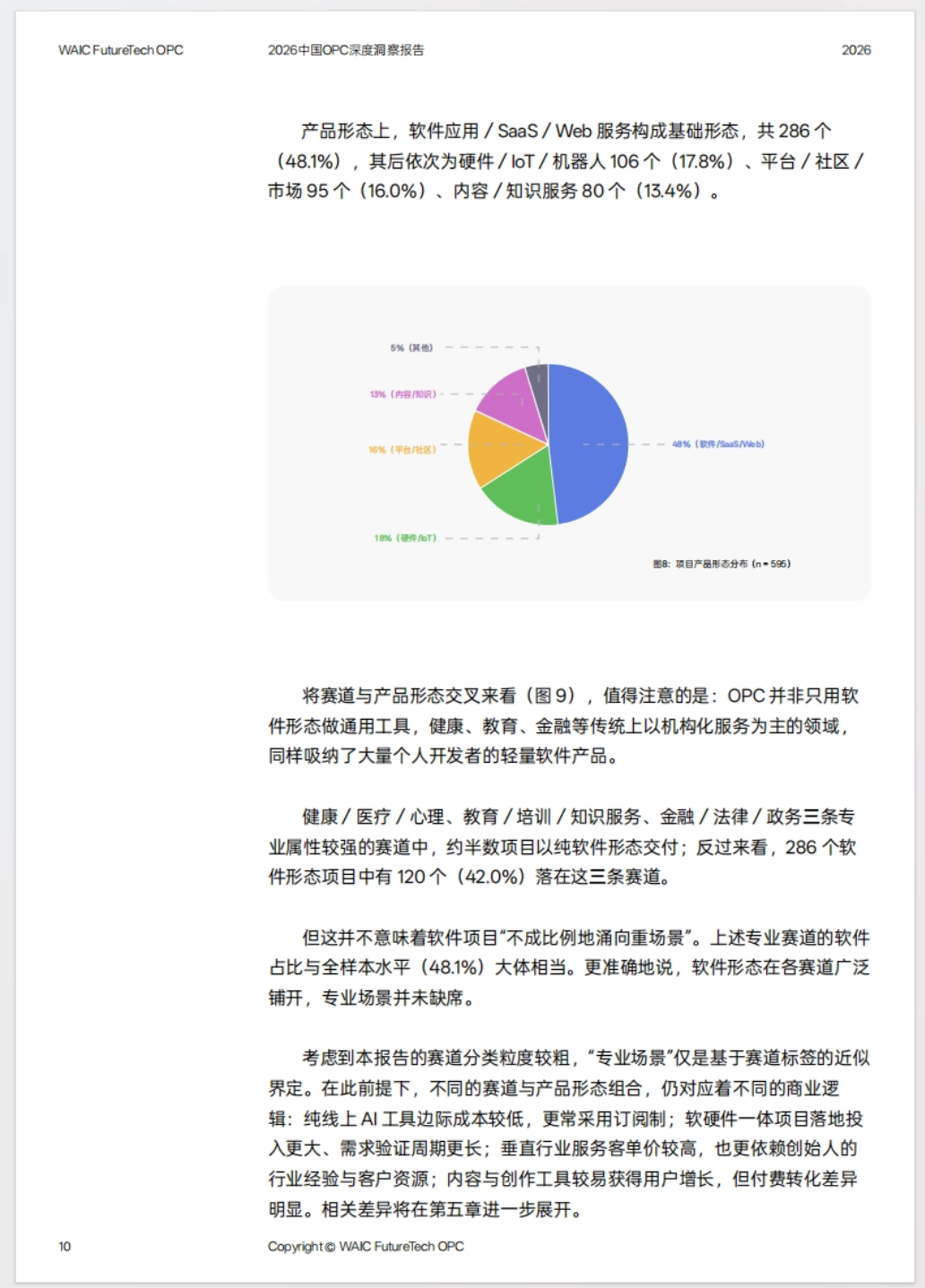
Product forms: software/SaaS/Web accounts for 48.1%, hardware/IoT 17.8%, platforms/communities 16%, and content/knowledge 13%.
-
Key finding: OPCs are not clustered in general AI tools, but have broadly entered traditional institutionalized service fields such as health, education, and finance.
-
-
Competition Results:
-
Projects with a Demo had a 43.0% advancement rate vs. 15.2% for those without; 2-3 person teams had a 44.9% advancement rate vs. 24.7% for solo teams.
-
However, city tier, customer type (toC/toB), and project track showed no significant association with advancement rate; after entering the semifinals, team size differences were no longer significant.
-
-
Definitions and Judgment Criteria:
-
Judgments varied significantly among judges (the strictest and the most lenient differed by nearly 60 percentage points); 64% of teams clearly identified with the OPC identity.
-
The report summarizes the core characteristics of OPC into four points: AI leverage, a very small core (mainly 1-3 people), flexible collaboration, and a low-cost closed loop.
-
Typical Starting Points and Paths of OPC Entrepreneurship
-
Three Major Entrepreneurial Origins:
-
Existing Business Extension Type(most common): relying on industry accumulation, it turns original services into AI-enabled, productized offerings; demand appears before the product, and the path to commercialization validation is the shortest.
-
Native Demand-Driven Type: the founder's own pain points give rise to the product, and it needs to complete the leap from "my problem" to "a type of person's problem."
-
Era Opportunity Follower Type: triggered by technological nodes (such as Vibe Coding); startups are fast but face high homogenization risk, and projects lacking industry knowledge are easily imitated quickly.
-
-
Manpower Composition and Collaboration Models:
-
Team Structure: three layers—extreme solo type, 3-4 person core type (most common; members are mostly former colleagues/classmates, with flexible division of labor and "indivisible"), and streamlined type within 10 people.
-
Talent Sources: classmates/fellow townspeople/friends (40 mentions) > past project collaboration (27) > colleagues/former colleagues (19).Trust is the core screening mechanism。
-
External Collaboration: "full-time core + flexible periphery"; AI is replacing some outsourcing (for example, UI design and content generation costs can drop to about 1/10).
-
Decision-Making Mechanism: short-chain and centralized, with single-person core decision-making being the most common; AI has already entered the decision-making loop, providing options and comparative opinions.
-
-
Four Development Paths:
-
Route A (short-term experiment): set a six-month to one-year exploration period and stop losses in due course.
-
Route B (long-term "small and beautiful"):60.6%teams hope to maintain a core team of 2-10 people for the long term and refuse blind expansion.
-
Route C (phased expansion):28.8%teams regard OPC as a low-cost validation stage and expand into a standard company after validation.
-
Route D (M&A exit): use OPC to validate direction and seek to merge into a large enterprise ecosystem (feasibility in the Chinese market remains uncertain).
-
OPC's AI Application Practices
-
AI Foundations: Native Trends and Tool Landscape:
-
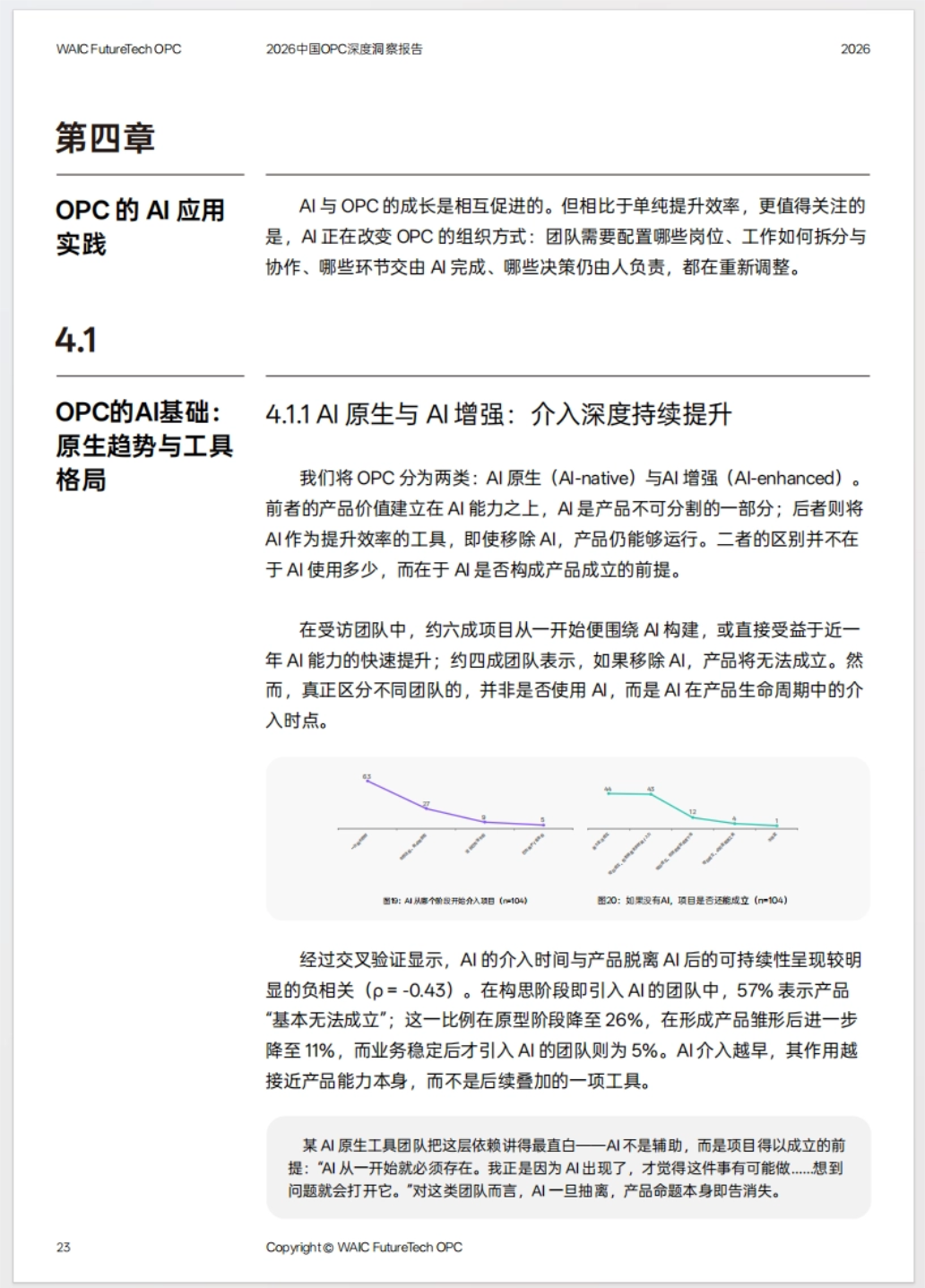
About 60% of projects were built around AI from the start; the earlier AI is involved (at the ideation stage), the stronger the product's dependence on AI (57% believe it "basically could not exist").
-
Programming priority: 83% of teams use AI coding/development agents, far higher than general conversation (57%), agent orchestration (24%), and image/video generation (18%).
-
Model Ecosystem: Core development still relies mainly on overseas products such as Claude Code, Codex, and Cursor; domestic models (DeepSeek, Kimi, etc.) have risen but do not yet dominate core R&D.
-
-
Tiers of Human Efficiency Improvement:
-
Entry Level: AI fills a single function (copywriting, posters, social media), replacing outsourcing or basic positions.
-
Advanced Level: AI is deeply integrated into core workflows, improving human efficiency severalfold ("one person doing the work of three to five").
-
Extreme Level: AI-driven across the entire process, integrating cross-domain capabilities, improving human efficiency tenfold to a hundredfold, and fundamentally changing organizational scale (case: 3.5 people replacing a traditional setup that required 10).
-
-
Full-Scenario Implementation Matrix:
-
Production and Development Layer: From assisted creation to full-process collaboration, AI coding drives a shift from "individual capability-driven" to "process-driven."
-
Operations and Supply Chain Layer: AI is integrated into SOPs, and internal operations systems are even built in-house to restructure business chains.
-
Marketing and Communication Layer: Covers an automated customer acquisition loop of "content production—customer reach—intelligent Q&A."
-
Organizational Collaboration Layer: AI participates in project management and knowledge management; team management shifts from "managing people" to "managing agents."
-
-
Usage Boundaries and Bottom Lines:
-
AI First: By default, AI completes the first execution, while humans are responsible for review and decision-making.
-
Human Irreplaceability: Business judgment, strategic choices, customer relationships, aesthetics, and bearing legal responsibility.
-
Cost Constraints: Tokens are becoming a new operating cost, with some teams consuming hundreds of millions of tokens per month; AI reduces labor costs but may raise operating costs.
-
OPC Demand Validation, Business Closed Loop, and Competitive Moats
-
Business Model Matrix:
-
Target customers: toC (47%) and toB/G (38%) coexist, and toB/G teams have significantly higher revenue tiers than toC.
-
Pricing models: subscription (75 mentions), project-based (41), per-use/per-volume (34), one-time purchase (25), commission/take rate (21), etc., are highly diverse.
-
Pricing Power: Cost advantage ≠ pricing ability; the first pricing decision is the earliest and most irreversible strategic action, locking in customer structure and market tier.
-
-
Demand Validation Paths:
-
Path A (Acquaintance Circle): What is initially obtained is not traffic, but trust and reusable endorsement.
-
Path B (Build in Public): Public building is exchanged for feedback, providing a low-cost forced iteration mechanism.
-
Path C (Social Media Organic Traffic): Success or failure does not depend on traffic scale, but on the density of match between content and target users.
-
-
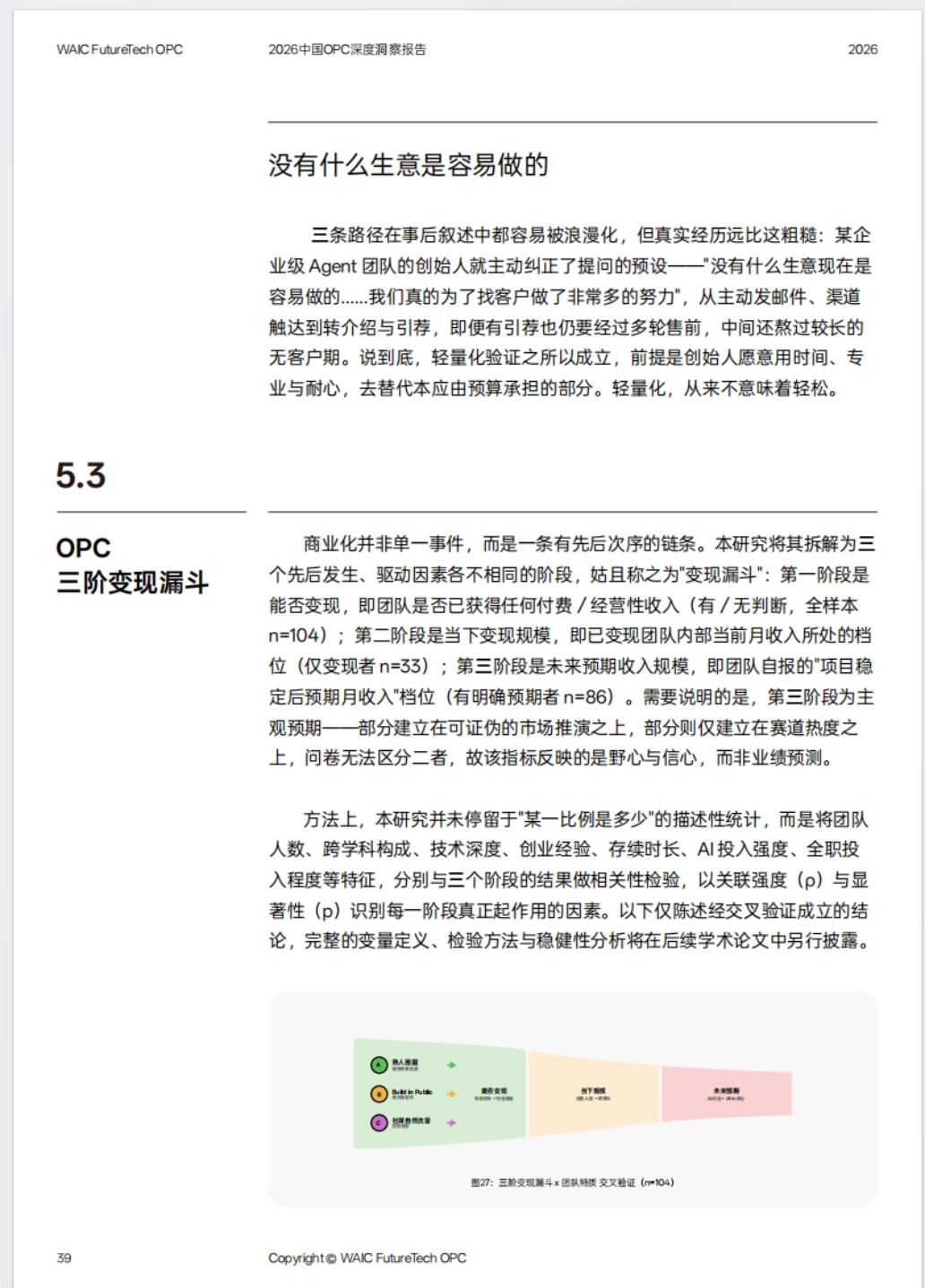
Three-Stage Monetization Funnel:
-
Whether monetization is possible(Yes/No): Depends on duration of existence and industry experience; no significant correlation with team size or technical depth.
-
Current scale(Revenue tier): Depends on team size and interdisciplinary composition.
-
Future expectations: Depends on AI investment intensity and full-time commitment—"daring to think" is cheap and ubiquitous, while "being able to do" is what's scarce.
-
-
Six core competitive moats:
-
Industry insight: Choose niche tracks that big companies are unwilling to enter, and accumulate non-replicable proprietary judgment.
-
Implementation experience: Proactively choose things that are messier, dirtier, and more reliant on tacit knowledge; difficulty itself is the filter.
-
Product taste: Aesthetics is judgment rather than surface styling, concerning "what kind of experience is worth delivering."
-
User relationships: From data accumulation to community co-building, turning users from users into co-builders.
-
Cost structure: Compress per-capita efficiency into price; a lightweight organization is itself a structural advantage.
-
Organizational vitality: The misaligned space between big companies' "not wanting to do" and "being unable to do," OPC's dynamic decision-making advantage.
-
OPC value assessment system
-
Core underlying commercialization indicators:
-
Cash flow closed-loop capability (determines survival and the right to refuse), total paying customers (direct reflection of real demand), customer stickiness and renewal rate, business extensibility, value of user time saved (a new indicator in the AI era).
-
-
AI efficiency and growth indicators:
-
Per-capita output (the core benchmark distinguishing it from traditional enterprises), Token consumption (usage efficiency matters more than total volume), human-machine control and collaboration relationship (human-machine dominance, collaboration radius).
-
-
Team personnel dimension:
-
Composite talent capability (comprehensive ability determines the project ceiling), open-source ecosystem influence (long-term value of technical OPC).
-
-
Assessment pitfalls to avoid:
-
User volume and traffic indicators cannot serve as the core valuation basis (free users may be a cost black hole).
-
Team size and concept hype: "few people" is becoming a formalized label, and 43.27% of teams believe the current scale is temporary.
-
OPC's real demands and support pain points
-
Existing support map:
-
Ranking of most helpful sources: competitions/hackathons/startup camps (19%) > media exposure (11%) = personal support (11%) > computing resources (10%) = accelerators/incubators/parks (10%).
-
Informal support effectiveness exceeds expectations: Events often evolve into long-term partnerships, providing confirmation that "this thing is worth continuing."
-
-
Core needs list:
-
Funding (33.1%, including equity investment and prize subsidies), market (33.1%, including channels/media/orders), team/community (14.8%), computing power (8.6%), mentoring/training (6.8%), physical space (3.1%).
-
-
Pain points in support system fit:
-
Venue support: From 'providing workstations' to 'providing interfaces', real OPCs may generate infrastructure needs beyond imagination (such as their own server rooms).
-
Policy adaptation: The current system uses 'headcount' as a proxy variable for strength, while the significance of OPC is precisely to break the fixed ratio between headcount and output; computing power subsidies tied to social security headcount and usage scale are disconnected from OPC's fluctuating characteristics.
-
Open scenarios: From 'giving scenarios' to 'giving the right scenarios', avoiding ineffective scenarios such as big-company outsourcing tests or boundary-first approaches.
-
-
Capital-side matching pain points:
-
Traditional VC pursues exponential curves, while some OPCs trade organizational restraint for profit margins; the two may not belong to the same asset class.
-
OPCs' capital needs diverge: teams that are already self-sustaining shift their needs from funding to resource enhancement; the 'customer as investor' model is an undervalued form.
-
-
Infrastructure supply pain points:
-
Computing power and models: Beyond cost, there are also systemic risks of bargaining power and version retirement.
-
Talent ecosystem: Screening core members is harder than finding a partner; there is a lack of reliable flexible talent platforms and outsourcing credit mechanisms.
-
Compliance and regulation: Data compliance and privacy protection remain a gray area, a real cost for lightweight organizations without legal teams.
-
Future evolution trends of the OPC industry
-
Long-term judgment on organizational forms:
-
OPC will becomea normalized organizational form, coexisting long-term with large enterprises and small and micro enterprises.
-
Technology expectations return to business reality: moving from conceptual hype to value creation, building business models around currently mature AI capabilities.
-
-
Industry differentiation assessment:
-
Industry shakeout: Projects without barriers or business models are eliminated first.
-
K-shaped divergence: Growth at both ends—platform enterprises + long-tail OPCs—while traditional mid-sized enterprises in the middle suffer the greatest impact。
-
Competitive high ground: From general capabilities to vertical value, niche tracks become the core battlefield.
-
-
Endgame predictions:
-
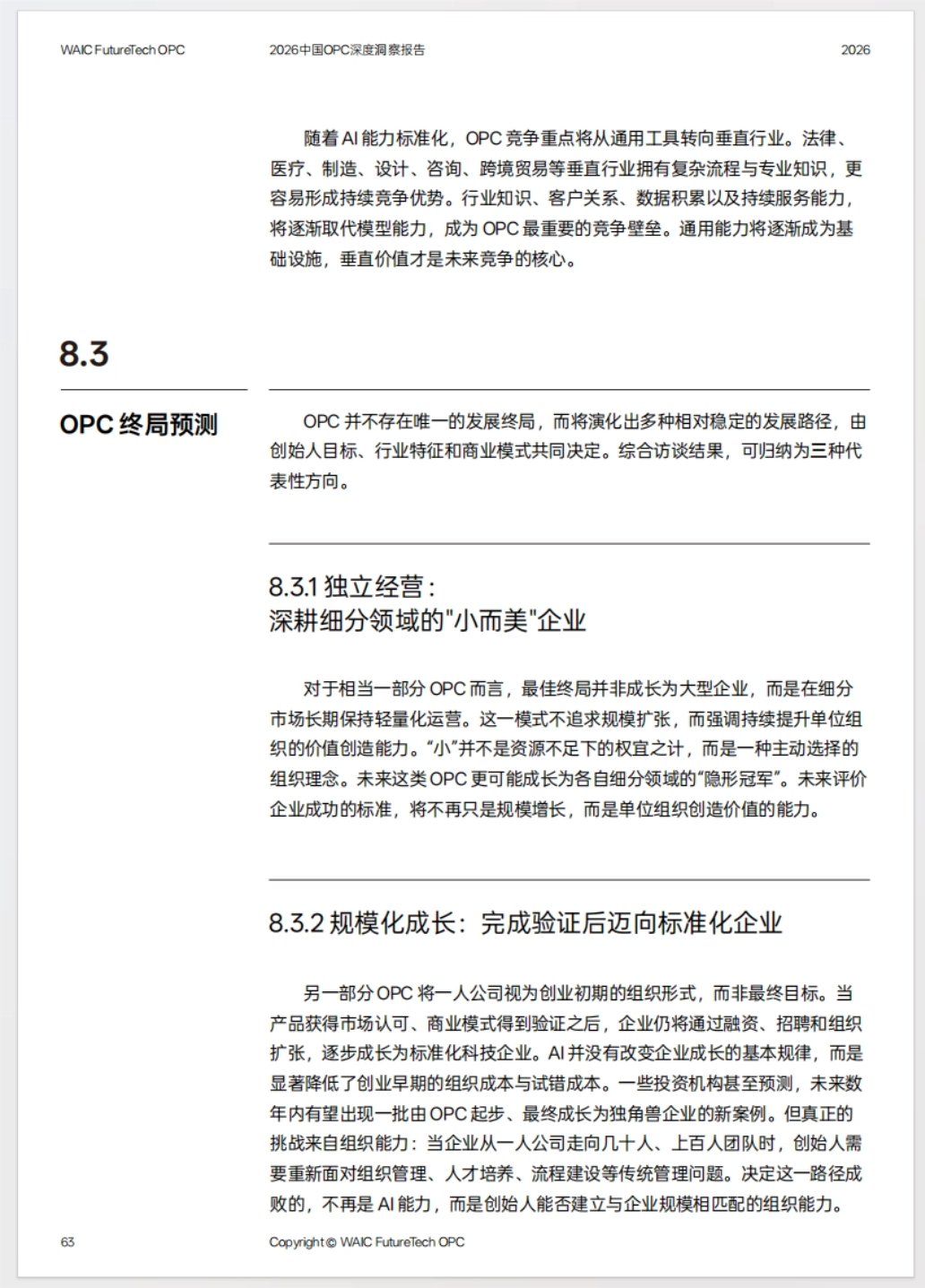
Independent operation: 'small and beautiful' hidden champions deeply cultivating niche fields.
-
Scaled growth: After completing validation, move toward becoming a standard company (the challenge lies in rebuilding organizational capabilities).
-
Integrating into the ecosystem: Being acquired or becoming part of a large enterprise's innovation system.
-
-
Trends in supporting derivative industries:
-
Elastic Collaboration Networks: Moving from organizational employment to on-demand collaboration, "capability networks" and interoperability between Agents are becoming the new infrastructure.
-
AI Operations and Security Services: AI Supervisor becomes a new role, and model routing technology achieves a dynamic balance between performance and cost.
-
OPC Service Ecosystem: A startup network where "OPCs serve OPCs," with business registration/tax/legal and other services evolving into new models suited to lightweight organizations.
-
-
Industry Risk Warnings:
-
AI alienation risk (technology amplifies malicious actors' capabilities), technology dependency risk (single-point fragility), homogenized competition risk (lower barriers ≠ weaker competition), policy adaptation risk (applying old frameworks to new species or "sprinkling pepper" style inclusive benefits).
-
Industry Development Recommendations
-
For OPC Entrepreneurs:
-
Business fundamentals first: When "building it" is no longer scarce, what is scarce is "selling it"; validate demand and cash flow first.
-
Pricing is strategy: The first pricing locks in the customer structure and market tier.
-
Human-machine relationship: Default to "AI First," with humans doing final review; what can be distilled should be distilled, and what cannot be distilled is the very reason the company exists.
-
-
For Policymakers:
-
Untie the headcount threshold: Loosen the social insurance headcount from being a "mandatory question" in support programs.
-
Precision drip irrigation: Do not scatter subsidies based on concept hype, nor shut OPCs out with thresholds higher than the stage where they are most needed.
-
Fill market gaps: Support open-source computing power ecosystems and provide affordable compliance tools and legal consulting.
-
-
For Industry Participants:
-
Investors: OPCs and traditional venture capital targets may not be the same class of assets; new forms such as "customer as investor" and single-round/convertible bonds can be explored.
-
Mature Enterprises: Take "long-tail customers" seriously; OPCs are both future competitors and potential acquisition targets.
-
Other Entrepreneurs: "OPCs serving OPCs" is itself a good business.
-
Conclusion
Get the original PDF of the "2026 China OPC In-Depth Insight Report" for free
Scan the QR code to follow and reply with the keyword: 2026OPC