
In the past, our interactions with large language models (LLMs) often felt like talking to a well-read but isolated "bookworm." It could quote classics and answer fluently, but its knowledge was limited to the moment its training data ended, and it could not interact with the real world to verify information or perform tasks.
A breakthrough in the field of artificial intelligence is changing this situation. This breakthrough is the ReAct framework. ReAct is the "Reasoning and Acting" abbreviation, not merely a technology, but a completely new concept that teaches AI how, like humans, to combinedeep thinkingwithpractical actionclosely when solving complex problems.
The framework was first proposed by Yao, Shunyu and others from the Google Brain team in 2022, and was officially published in 2023 at the International Conference on Learning Representations (ICLR), with the paper title "ReAct: Synergizing Reasoning and Acting in Language Models."
The core idea of ReAct
How ReAct works: the golden loop of thought-action-observation
The core mechanism of the ReAct framework is to imitate the cognitive process humans use when solving problems: we first think and analyze the problem, then take action, observe the result of the action, and then adjust our thinking based on the result, repeating this cycle until the problem is solved. ReAct structures this process into three key steps, forming a dynamic loop:
- Thought (Thought / Reasoning):
- What is this? In this step, the large language model will, like a strategist, internally think about and reason over the current task. It will analyze the problem, break down complex tasks, make the next plan, or determine what additional information it needs.
- For example: If you ask AI: "What is Apple's current stock price and its latest released product?", its first step of "thinking" might be: "This question contains two parts: 1. Query the real-time stock price; 2. Query the latest product. I need to use two different tools to complete it."
- Action (Action / Acting):
- What is this? Based on the plan made in the "thinking" stage, the model will decide on and execute a specific "action." This action is usually calling an external tool, such as a search engine, calculator, database query API, or any other function that can interact with the outside world.
- For example: Based on the above thinking, AI's first "action" might be:
Action: search("Apple Inc. stock price")。
- Observation (Observation):
- What is this? After executing the "action," the model will obtain a result from the external tool, and this result is the "observation." This observation result will be entered as new information into the next round of "thinking."
- For example: The result returned by the tool is:
Observation: "Apple (AAPL) stock price is $220.50 as of Sep 15, 2025.". After AI receives this information, it will enter the next cycle. It will update its state and continue thinking: "Okay, the stock price has been found. Now I need to query the latest product." Then it executes a new action:Action: search("Apple Inc. new product announcements 2025")。
This "thought → action → observation" loop will repeat continuously until AI believes all subtasks have been completed and it can give the final answer.
The fundamental difference between ReAct and traditional methods
To better understand the revolutionary nature of ReAct, it can be compared with two common approaches:
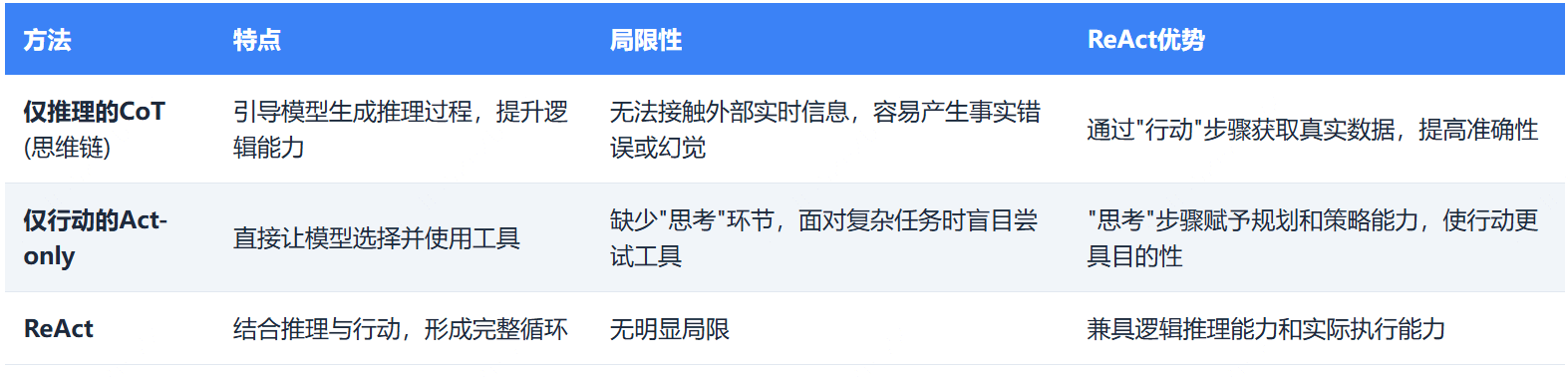
- Comparison with "reasoning-only" CoT (Chain-of-Thought):Chain-of-Thought (CoT) technology significantly improves a model's logical capabilities by guiding it to generate a step-by-step reasoning process before answering. However, CoT's reasoning takes place entirely in the model's "inner world" and cannot access external real-time information. Therefore, when dealing with problems that require the latest knowledge or precise calculation, it is prone tofactual errorsor hallucinations . For example, if you ask a model that only uses CoT "What is the weather like today?" it may fabricate a plausible-sounding but completely wrong answer based on its training data. Through its "action" step, ReAct allows reasoning to be based on real, real-time data obtained from external tools, greatly improving the accuracy and reliability of answers.
- Comparison with "action-only" Act-only:The "action-only" approach directly lets the model choose and use tools, but lacks the intermediate "thinking" step. This means that when faced with complex tasks, the model may blindly try tools like a headless fly, lacking planning and strategy, leading to low efficiency or task failure. ReAct's "thinking" step, by contrast, gives the model the ability to plan, reflect, and adjust strategies, making its actions more purposeful and logical.
Why is ReAct so important?
The introduction of the ReAct framework is not merely a technical optimization, but fundamentally expands the capability boundaries and application value of large language models.
Greatly improves the ability to solve complex tasks
By decomposing complex problems into a series of "thought-action-observation" substeps, ReAct enables AI to handle multi-step, dynamic tasks that were previously difficult to address. It is like giving AI a toolbox and an operating manual, allowing it to methodically complete a complex engineering project.
Effectively reduces AI's "confident nonsense"
"Hallucination" is a long-standing stubborn problem for large language models.
By forcing the model to obtain and verify information from authoritative external sources (such as Wikipedia APIs and search engines) through "actions" before answering, ReAct greatly reduces the occurrence of factual errors. It makes AI's answers no longer merely "sound right," but "actually right."
Revolutionarily enhances AI's interpretability and credibility
Traditional large language models are often criticized as a "black box": we only see the input and output, but do not understand their internal decision-making process.
The "thought" traces produced by the ReAct framework are like a detailed work log, clearly showing every step of reasoning and every decision the AI goes through to arrive at the final answer. This transparency allows us to understand, review, and debug AI behavior, greatly enhancing trust in AI systems.
Quantitative results: outstanding performance on authoritative benchmarks
The superiority of ReAct is not empty talk; it has achieved impressive results on multiple industry-standard benchmarks:
- Knowledge-intensive tasks (HotpotQA & FEVER):In question-answering tasks requiring multi-step reasoning and fact-checking (such as HotpotQA) and fact-verification tasks (such as FEVER), ReAct effectively overcomes the hallucination problem in the Chain-of-Thought (CoT) method by interacting with external knowledge bases such as Wikipedia, and outperforms the action-only (Act-only) baseline models.
- Interactive decision-making tasks (ALFWorld & WebShop):In these complex tasks that simulate real-world interactions, ReAct performs particularly well.
- InALFWorld(a benchmark that simulates completing tasks in a virtual home environment), ReAct's success rate, compared with previous imitation learning and reinforcement learning methods,achieved an absolute success rate improvement of 34%, reaching an astonishing71%, while the success rate of the Act-only method was only 45%.
- InWebShop(a benchmark that simulates the online shopping process), ReAct also performs excellently,achieved an absolute success rate improvement of 10%, and its score (40%) is also significantly higher than Act-only (30.1%) and other baseline methods.
These data strongly demonstrate the enormous potential of the ReAct framework in improving AI's general problem-solving ability.
Application Scenarios of ReAct
The powerful capabilities of the ReAct framework quickly moved from academic papers to practical applications, empowering all walks of life.
- Next-generation intelligent question answering and search engines:When you ask a question that requires real-time information, such as "What clothes do I need to bring for a business trip to Shanghai in the next three days?", a ReAct-based system will first think (break it down into querying Shanghai weather and understanding the dressing index), then act (call the weather API), and finally synthesize the observed information (weather forecast) to give intelligent suggestions.
- Powerful personal intelligent assistants:Your AI assistant will no longer be limited to small talk and setting alarms. It can help you plan a complete trip, including thinking (needs flights, hotels, local activities), acting (calling the Ctrip API, querying Dianping), and ultimately generating a detailed itinerary for you.
- Efficient enterprise automation and customer service:Enterprise-level AI can handle complex customer requests, such as "Check the status of my order from last week, and apply the coupons in my account to items that have not yet shipped." The AI will think (needs to query the order, query the coupons, apply the coupons), and call the APIs of the internal order system and user account system in sequence to complete the operation, greatly improving service efficiency and customer satisfaction.
- Embodied intelligence: robots and autonomous driving:ReAct is key to achieving advanced robot control and autonomous driving. When a home robot receives the instruction "Help me take the snacks in the living room to the study," it will use the ReAct framework to reason (identify the living room, locate the snacks, plan a path, grasp, navigate to the study), and complete this complex task in the physical world through a series of sensor and actuator "actions."
- Scientific research and medical assistance:In the field of scientific research, AI can help researchers automatically retrieve, read, and summarize relevant papers, and execute data analysis code. In the medical field, it can assist doctors in analyzing cases, querying the latest medical literature and clinical guidelines, and providing decision support for diagnosis.

How to build a ReAct agent yourself?
For users with some programming background, with the help of powerful open-source frameworks, building a simple ReAct agent is not out of reach. The most mainstream tool at present is LangChain framework.
The Three Core Elements: Brain, Toolbox, and Commander
A ReAct agent mainly consists of three parts:
- Large Language Model (LLM):It is the agent's "brain," responsible for "thinking" and reasoning. For example, OpenAI's GPT series models.
- Tools:It is the agent's "hands and feet" or "external senses," the "actions" it can perform. A tool can be a search engine, a calculator, or any function that can be called by a program.
- Agent Executor (AgentExecutor):It is the agent's "commander," responsible for running the entire "thought-action-observation" loop, organically combining the brain and the toolbox to ensure the smooth execution of the task.
A Simple Python Code Example (Conceptual Explanation)
Below is a simplified Python code example using LangChain to build a ReAct agent, to help you understand its workflow.
# Import the necessary libraries
from langchain_openai import ChatOpenAI
from langchain.agents import tool, create_react_agent, AgentExecutor
from langchain import hub# Step 1: Define your toolbox (Tools)
# We create a tool named "search" that simulates searching for information online.
@tool
def search(query: str) -> str:
"""Use this tool when you need to look up real-time information or facts you are unsure about."""
# In a real application, this would call a real search engine API
if "Apple stock price" in query:
return "The current stock price of Apple Inc. (AAPL) is $220.50."
else:
return "Sorry, I couldn't find the relevant information."tools = [search] # Put all tools into a list
# Step 2: Prepare the "commander's" instruction manual (Prompt Template)
# We directly pull a standard prompt template optimized for ReAct from the LangChain Hub.
# This template has already taught the model how to perform the "thought-action-observation" loop.
prompt = hub.pull(“hwchase17/react”) # [[261]][[262]]# Step 3: Specify the "brain" (LLM)
llm = ChatOpenAI(model=”gpt-4o”, temperature=0)# Step 4: Create and assemble your agent (Agent)
# Use`create_react_agent`function to assemble the brain, toolbox, and instruction manual.
agent = create_react_agent(llm, tools, prompt) # [[221]][[261]]# Use`AgentExecutor`to create the final "commander."
agent_executor = AgentExecutor(agent=agent, tools=tools, verbose=True) # [[222]][[262]]# Step 5: Assign the task and observe the execution process
response = agent_executor.invoke({
"input": "I want to know what Apple Inc.'s current stock price is?"
})print(response[“output”])
When you run this code,verbose=Truewill let you see output in the terminal similar to this, clearly showing the internal workflow of ReAct:
> Entering new AgentExecutor chain…
Thought: The user wants to know Apple Inc.'s stock price. This is real-time information, so I should use the search tool to look it up.
Action: search
Action Input: "Apple stock price"
Observation: The current stock price of Apple Inc. (AAPL) is $220.50.
Thought: I have already obtained the answer through the search tool, so now I can answer the user directly.
Final Answer: The current stock price of Apple Inc. (AAPL) is $220.50.Finished chain.
This simple example vividly demonstrates how the ReAct framework combines reasoning with action to solve problems in a transparent and efficient way.
The ReAct framework is not just a technical iteration; it represents an important shift in the direction of artificial intelligence development. By giving models the ability to "think and act," ReAct is breaking down the barriers between the virtual world and the physical world, and between static knowledge and dynamic information.
Make AI more powerful, able to solve unprecedented complex problems;
Make AI more reliable, reducing errors and hallucinations by interacting with the real world;
It makes AI more transparent, allowing us to trust it and collaborate with it at a deeper level.
It is foreseeable that as ReAct and its derivative technologies continue to mature, we will usher in a new era of intelligence driven by more powerful, more trustworthy, and more action-capable AI.