
What is VRAG-RL
VRAG-RL is a vision-perception-driven multimodal RAG reasoning framework launched by Alibaba Tongyi's large model team, focusing on enhancing the retrieval, reasoning, and understanding capabilities of vision-language models (VLMs) when processing visually rich information. Based on defining a visual perception action space, it allows the model to progressively acquire information from coarse-grained to fine-grained, more effectively activating the model's reasoning ability. VRAG-RL introduces a comprehensive reward mechanism, combining retrieval efficiency and model-based outcome rewards to optimize the model's retrieval and generation capabilities. In multiple benchmark tests, VRAG-RL significantly outperforms existing methods, demonstrating strong potential in the field of understanding visually rich information.
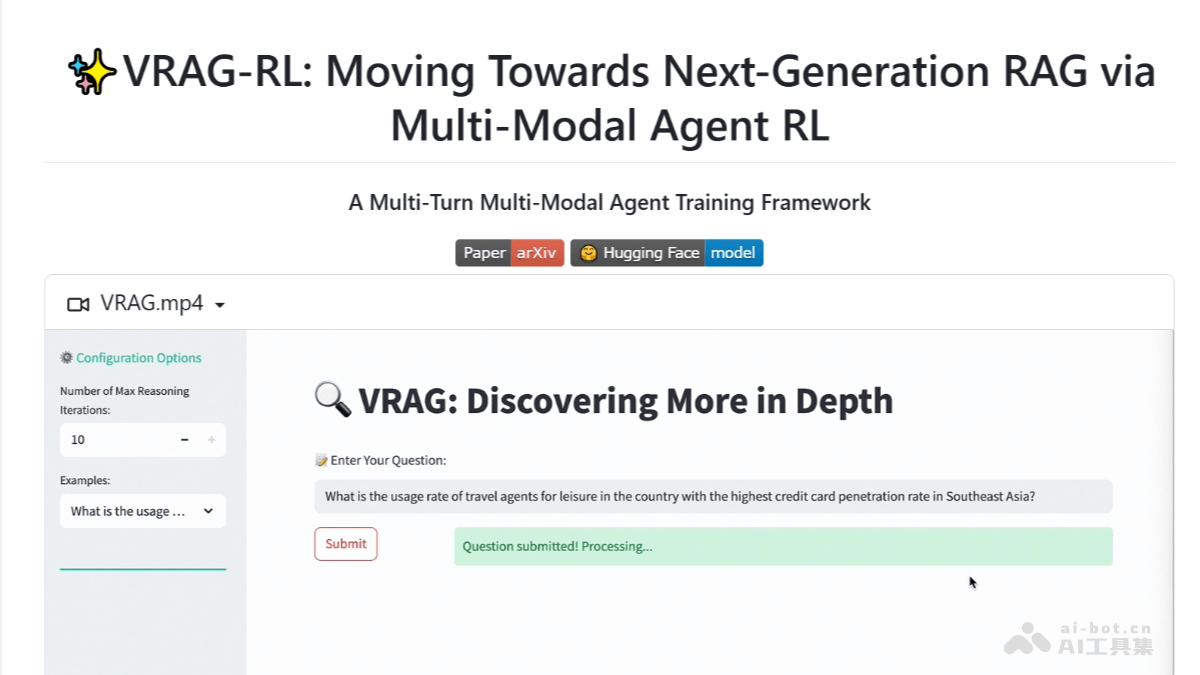
Main Features of VRAG-RL
- Visual Perception Enhancement: Based on defining a visual perception action space (such as cropping, zooming), it allows the model to progressively acquire information from coarse-grained to fine-grained, more effectively activating the model's reasoning ability.
- Multi-turn Interactive Reasoning: Supports multi-turn interaction, allowing the model to continuously interact with search engines and progressively optimize the reasoning process.
- Comprehensive Reward Mechanism: Combines retrieval efficiency and model-based outcome rewards to comprehensively guide the model in optimizing reasoning and retrieval capabilities, making the model closer to real-world application scenarios.
- Scalability: The framework has good scalability, supports the integration of multiple tools and models, and facilitates user customization and extension.
Technical Principles of VRAG-RL
- Visual Perception Action Space: Defines a set of visual perception actions, including selecting regions of interest, cropping, and zooming. The actions allow the model to progressively acquire information from coarse-grained to fine-grained, more effectively focusing on information-dense regions.
- Reinforcement Learning Framework: Uses reinforcement learning (RL) to optimize the model's reasoning and retrieval capabilities. Based on interaction with search engines, the model autonomously samples single-turn or multi-turn reasoning trajectories and continuously optimizes based on samples.
- Comprehensive Reward Mechanism: Designs a comprehensive reward function, including retrieval efficiency rewards, pattern consistency rewards, and model-based outcome rewards. The reward mechanism focuses on the final result, optimizes the retrieval process, and enables the model to more effectively obtain relevant information.
- Multi-turn Interactive Training: Based on a multi-turn interactive training strategy, the model progressively optimizes the reasoning process through continuous interaction with the external environment, improving the stability and consistency of reasoning.
- Data Expansion and Pre-training: Based on a multi-expert sampling strategy to expand training data, ensuring that the model learns effective visual perception and reasoning capabilities during the pre-training stage.
Project Address of VRAG-RL
- GitHub Repository:https://github.com/Alibaba-NLP/VRAG
- HuggingFace Model Library:https://huggingface.co/collections/autumncc/vrag-rl
- arXiv Technical Paper:https://arxiv.org/pdf/2505.22019
Application Scenarios of VRAG-RL
- Intelligent Document Q&A: Quickly retrieve and understand information from documents such as PPTs and reports, and answer questions efficiently.
- Visual Information Retrieval: Quickly locate and extract relevant visual information from a large number of charts and images.
- Multimodal Content Generation: Combines visual and textual information to generate summaries, reports, etc., with both illustrations and text.
- Education and Training: Assists teaching and helps students better understand and analyze visual materials.
- Intelligent Customer Service and Virtual Assistants: Handle user questions involving visual content and provide accurate answers.