
What is VQAScore
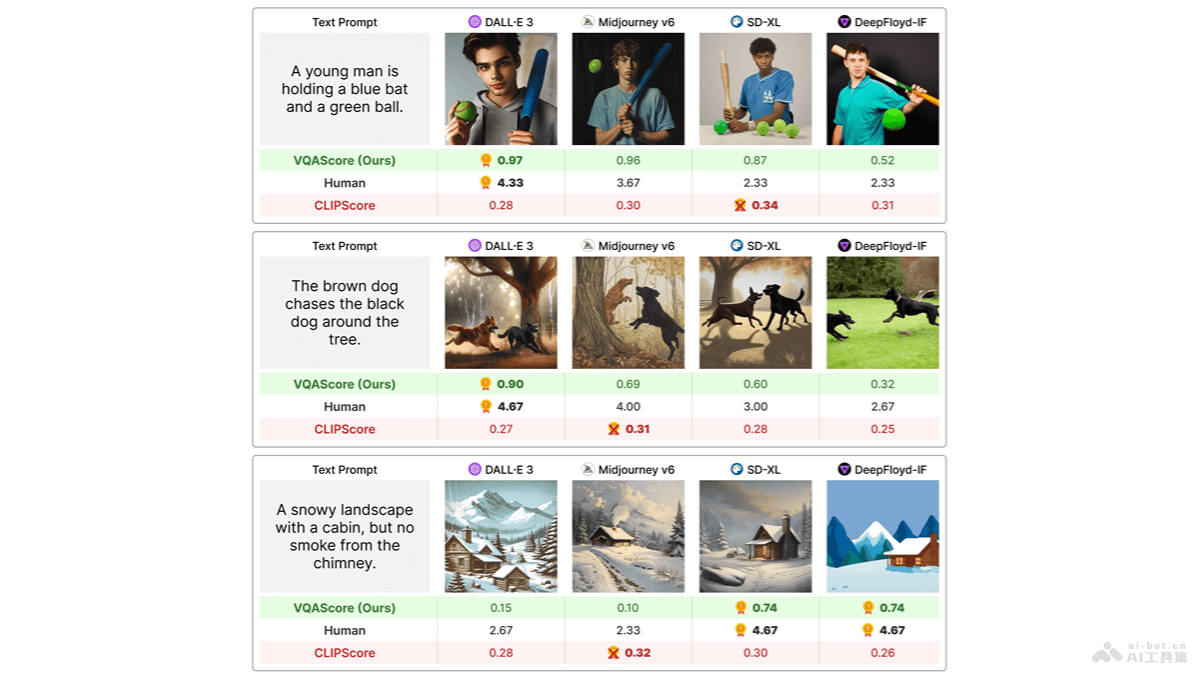
VQAScore is an evaluation method jointly launched by CMU and Meta that measures the quality of images generated from text prompts based on a visual question answering (VQA) model. VQAScore uses a computational model to evaluate the degree of alignment between an image and a text prompt by calculating the probability that the model answers "yes" to the question "Does this figure show {text}?". The core advantage of VQAScore is that it requires no additional human annotation and directly uses existing VQA models, providing more precise evaluation results in the form of probability values, surpassing traditional evaluation metrics such as CLIPScore. VQAScore has been applied in multiple projects such as Imagen3 for automatic evaluation and optimization of the latest generative models.
Main Features of VQAScore
- Evaluating the degree of alignment between images and text prompts: VQAScore measures whether a generated image matches a given text prompt based on calculating the probability of a "yes" answer.
- Automated evaluation: Provides an automated method to evaluate image generation models without manual scoring, facilitating large-scale and rapid evaluation.
- Improving evaluation accuracy: Addresses the shortcomings of existing evaluation methods when handling complex text prompts and provides more accurate evaluation results.
- Supporting multiple generation tasks: VQAScore can evaluate text-to-visual generation tasks for videos and 3D models.
- Benchmarking and model improvement: Based on the GenAI-Bench benchmark set, VQAScore helps researchers identify the limitations of models and guide model improvements.
Technical Principles of VQAScore
- Question templating: Converts the text prompt into a simple yes-or-no question, for example: "Does this figure show {text}? Please answer yes or no."
- Joint encoding of image and text: Uses a VQA model to take the image and the question (already converted into a token sequence) as input for joint encoding.
- Predicting the probability of the answer: The decoder of the VQA model outputs a probability distribution over the predicted answer ("yes" or "no").
- Calculating the alignment score: VQAScore is defined as the probability that the model predicts the "yes" answer, and the probability reflects the degree of alignment between the image and the text prompt.
- Bidirectional encoder-decoder architecture: The CLIP-FlanT5 model used by VQAScore is based on a bidirectional encoder-decoder architecture, which supports image embeddings that depend on the question content and vice versa, helping to better understand and process complex text prompts.
- No additional data fine-tuning required: VQAScore uses image and question-answer pairs during training, and no additional fine-tuning for specific datasets is required during evaluation.
VQAScore Project Addresses
- Project Website:linzhiqiu.github.io/papers/vqascore
- GitHub Repository:https://github.com/linzhiqiu/t2v_metrics
- arXiv Technical Paper:https://arxiv.org/pdf/2404.01291
- Online Demo:https://huggingface.co/spaces/zhiqiulin/VQAScore
Application Scenarios of VQAScore
- Image generation model evaluation: Evaluates the accuracy and quality of images generated by models such as DALL-E, Imagen, and Stable Diffusion based on text prompts.
- Video generation model evaluation: Evaluates the performance of text-to-video generation models, such as the ability to generate video content based on a script or description.
- 3D model generation evaluation: Evaluates text-to-3D model generation tasks, for example, generating 3D objects or scenes based on descriptions.
- Multimodal learning research: In the field of multimodal learning, VQAScore can serve as a research tool to help researchers understand how models process and generate cross-modal content.
- Automated testing and quality control: In automated testing workflows for images, videos, and 3D content, VQAScore serves as a quality control metric.