
What is Voyage Multimodal-3
Voyage Multimodal-3 is an advanced multimodal embedding model launched by Voyage AI. It can process interleaved text and images and capture key visual features from screenshots of PDFs, slides, tables, etc., without the need for complex document parsing. The Voyage Multimodal-3 model performs excellently in multimodal retrieval tasks, with an average retrieval accuracy 19.63% higher than the best existing models. It supports text and content-rich images, has an architecture similar to modern vision-language transformers, can uniformly process text and visual data, and provides more accurate semantic search and document understanding capabilities.
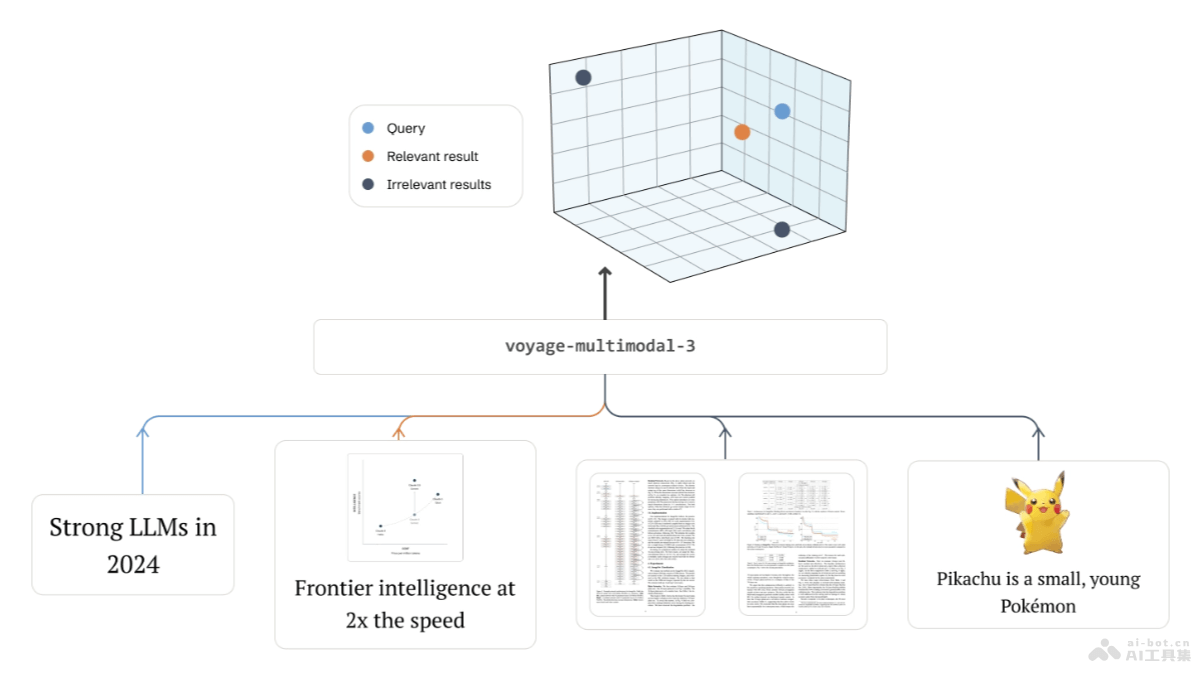
Main features of Voyage Multimodal-3
- Multimodal data processing: Processes and understands text, images, and mixed-type data, such as screenshots of PDFs, slides, and tables.
- Vectorization of interleaved text and images: Supports vectorization of data with interleaved text and images, improving data flexibility and processing efficiency.
- Capture of key visual features: Captures key features from various visual content, such as font size, text position, and whitespace.
- No complex document parsing required: Eliminates the need for complex document parsing, improving processing efficiency and accuracy.
- Semantic search and RAG support: Provides seamless retrieval-augmented generation (RAG) and semantic search capabilities for documents containing rich visual and textual content.
Technical principles of Voyage Multimodal-3
- Transformer architecture: The architecture of Voyage Multimodal-3 is similar to modern vision-language transformers, using a Transformer encoder to process data.
- Unified encoder: Directly vectorizes data from both text and image modalities in the same Transformer encoder, ensuring that text and visual features are treated as part of a unified representation.
- Feature extraction: Based on advanced feature extraction techniques, it captures key features of text and visual content, such as font size and text position.
- Modality fusion: By fusing features from different modalities, the model can better understand and associate textual and visual information.
- Mixed-modality search: Optimizes mixed-modality search, reduces the modality gap phenomenon, and improves retrieval quality.
Project address of Voyage Multimodal-3
- Project official website:voyage-multimodal-3
- GitHub repository:https://github.com/voyage-ai/voyage-multimodal-3
Application scenarios of Voyage Multimodal-3
- Intelligent document retrieval: In fields such as law, finance, and healthcare, retrieves complex documents containing text and charts, such as contracts, research reports, and medical records.
- Knowledge base search: For knowledge bases containing rich visual and textual information, provides more accurate semantic search to help users quickly find the information they need.
- Education and academic research: In academic research, helps researchers quickly retrieve academic papers and materials containing charts, formulas, and text.
- E-commerce: On e-commerce platforms, used for image search to help users find related products by uploading images or descriptions.
- Content recommendation systems: Combines users' historical behavior and preferences to recommend related content containing images and text, such as news articles and blog posts.