
What Is Voxtral TTS
Voxtral TTS is an open-source text-to-speech model from Mistral AI, based on a 4-billion-parameter architecture, supporting 9 languages. The model features ultra-low latency of 90 milliseconds and 6x real-time generation speed, and can achieve zero-shot voice cloning with only 3-5 seconds of audio. The model can be deployed on edge devices, requiring only 3GB of memory after quantization, with API pricing at $0.016 per thousand characters. Voxtral TTS completes the final piece of Mistral's end-to-end speech AI platform, suitable for scenarios such as voice customer service, real-time translation, and audiobooks, and outperforms competitors in multiple evaluations. ElevenLabs。
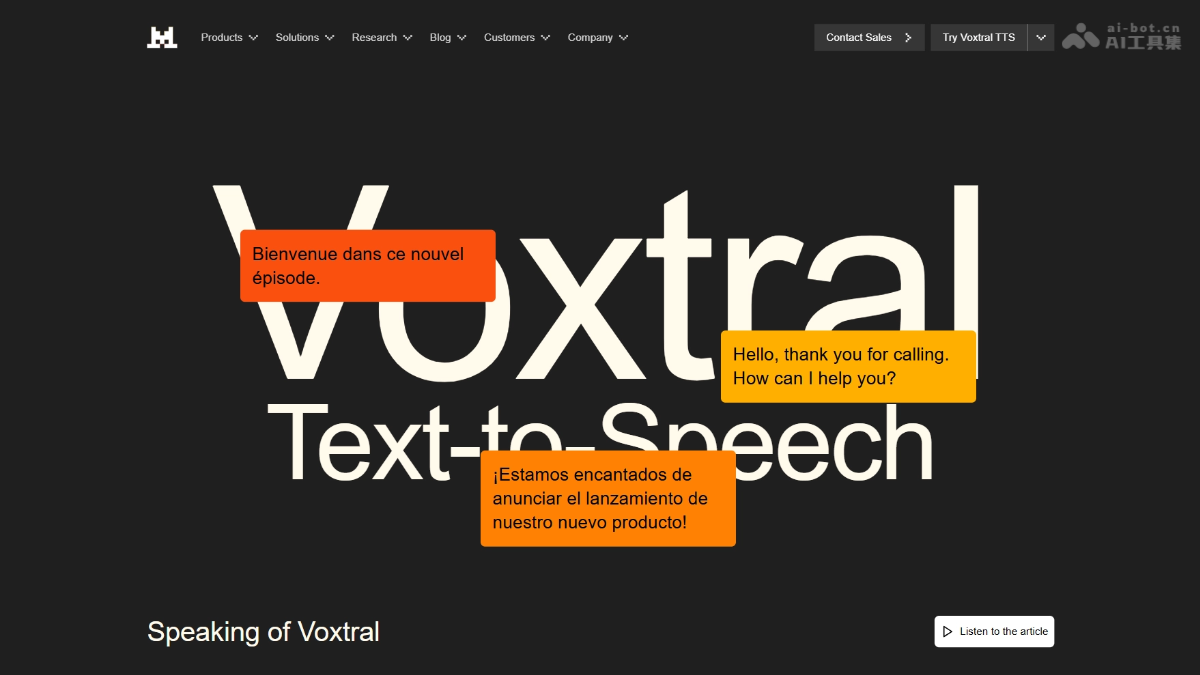
Voxtral TTS's Main Features
-
Multilingual Speech Synthesis: Supports text-to-speech generation in 9 languages: English, French, German, Spanish, Dutch, Portuguese, Italian, Hindi, and Arabic.
-
Zero-Shot Voice Cloning: Only 3-5 seconds of reference audio is needed to clone any speaker's voice, supporting cross-lingual timbre transfer.
-
Emotional Style Control: The model can adjust the emotional state of generated speech (such as anger, happiness, sadness) as well as parameters like speed, intonation, and volume.
-
Ultra-Low Latency Real-Time Generation: Time to first audio is only 90 milliseconds, with a real-time factor of 6x, suitable for real-time conversation scenarios.
-
On-Device Deployment: The model can run on edge devices such as smartwatches and phones, requiring only about 3GB of memory after quantization.
Voxtral TTS's Technical Principles
- Three-Module Cascaded Architecture: The model consists of a 3.4B-parameter Transformer language model, a 390M-parameter flow-matching acoustic model, and a 300M-parameter neural audio codec, with a total parameter count of approximately 4 billion.
- Text to Discrete Representations: Based on the Ministral 3B backbone network, it uses streaming BERT-style masked language modeling to convert input text into discrete speech tokens.
- Flow-Matching Spectrogram Generation: The model uses flow-matching technology to replace traditional diffusion models, quickly converting discrete tokens into continuous mel spectrograms for faster inference speed.
- Neural Audio Coding: Through a 300M-parameter codec, the spectrogram is reconstructed into high-quality audio waveforms, ensuring output naturalness.
- Edge-Optimized Deployment: Supports INT8/INT4 quantization compression, reducing the model size to 3GB memory usage, suitable for running on edge devices such as smartphones.
Key Information and Usage Requirements for Voxtral TTS
- Release Date: Officially released by Mistral AI on March 26, 2026.
- Model Scale: Total parameter count is approximately 4 billion, including a 3.4B Transformer language model, a 390M flow-matching acoustic model, and a 300M neural audio codec.
- Supported Languages: A total of 9 languages: English, French, German, Spanish, Dutch, Portuguese, Italian, Hindi, and Arabic.
- Performance Metrics: Time to first audio is 90 milliseconds, real-time factor is 6x, and voice cloning requires only 3-5 seconds of reference audio.
- Licensing: Open-source weights use the Creative Commons license, and API pricing is $0.016 per thousand characters.
- Hardware Requirements: Local deployment requires at least 3GB of memory (quantized version), supporting edge devices such as smartwatches, smartphones, and laptops.
Voxtral TTS's Core Advantages
- Open Source and Customizable: The model weights are fully open source, allowing enterprises to deploy locally and fine-tune according to their needs, avoiding the data privacy risks of relying on third-party cloud services.
- Ultra-low latency and high performance: First audio time is only 90 milliseconds, with a real-time factor of 6x, significantly outperforming similar competitors and meeting the needs of real-time conversation scenarios.
- On-device deployment capability: After quantization, it requires only 3GB of memory and can run on edge devices such as smartphones and smartwatches, without the need for a cloud connection.
- Zero-shot voice cloning: Only 3-5 seconds of audio is needed to clone any speaker's voice, supporting cross-language timbre transfer and greatly reducing the cost of voice customization.
How to use Voxtral TTS
- Online experience: Visit the Mistral Studio console or the Le Chat platform, directly enter text and select voice parameters to generate audio.
- API call: Register a Mistral account to obtain an API key, send text and an optional reference audio URL through the REST API, and receive the generated audio file.
- Open-source local deployment: Download the model weights from Hugging Face, load them with PyTorch or the transformers library, and run inference locally on a GPU or CPU.
Voxtral TTS project address
- Project official website:https://mistral.ai/news/voxtral-tts
- HuggingFace model repository:https://huggingface.co/mistralai/Voxtral-4B-TTS-2603
- Technical paper:https://mistral.ai/static/research/voxtral-tts.pdf
Comparison of Voxtral TTS with similar competitors
| Dimension | Voxtral TTS | ElevenLabs | OpenAI TTS |
|---|---|---|---|
| Open-source nature | Fully open source, can be deployed locally | Closed source, API service only | Closed source, API service only |
| Latency performance | 90 milliseconds to first audio, 6x real-time | Flash v2.5 has lower latency | Moderate latency |
| Voice cloning | 3-5 second zero-shot cloning | Supported, leading performance | Limited support |
| Pricing | $0.016 per thousand characters | Higher pricing | Usage-based billing |
| Deployment method | Cloud API + local edge devices | Cloud API only | Cloud API only |
Application scenarios of Voxtral TTS
- Real-time voice interaction: The model supports building low-latency intelligent customer service, voice assistants, and conversational robots, enabling natural human-computer dialogue with 90-millisecond response.
- Cross-language content localization: Translate content such as videos and podcasts into 9 target languages while preserving the original speaker's timbre characteristics, reducing multilingual production costs.
- Personalized audio content: The model can clone specific voices to generate audiobooks, news broadcasts, and educational training audio, meeting brand customization needs.
- Immersive entertainment experience: Provide emotionally controllable dynamic voices for game NPCs and interactive narratives, enhancing player immersion.
- Accessibility assistive tools: Read text information aloud for visually impaired users, or reconstruct personalized digital voices for people with speech impairments.