
What is Voost
Voost is an innovative virtual try-on and try-off model launched by NXN Lab, developed based on a unified and scalable Diffusion Transformer (DiT) framework. It can simultaneously handle virtual try-on and try-off tasks, generating high-quality image results. By jointly learning these two tasks, Voost leverages a bidirectional supervision mechanism, enabling each pair of clothing-person data to provide supervision signals for generation in both directions, significantly enhancing the reasoning ability of the relationship between clothing and body, without relying on task-specific networks, auxiliary losses, or additional labels.
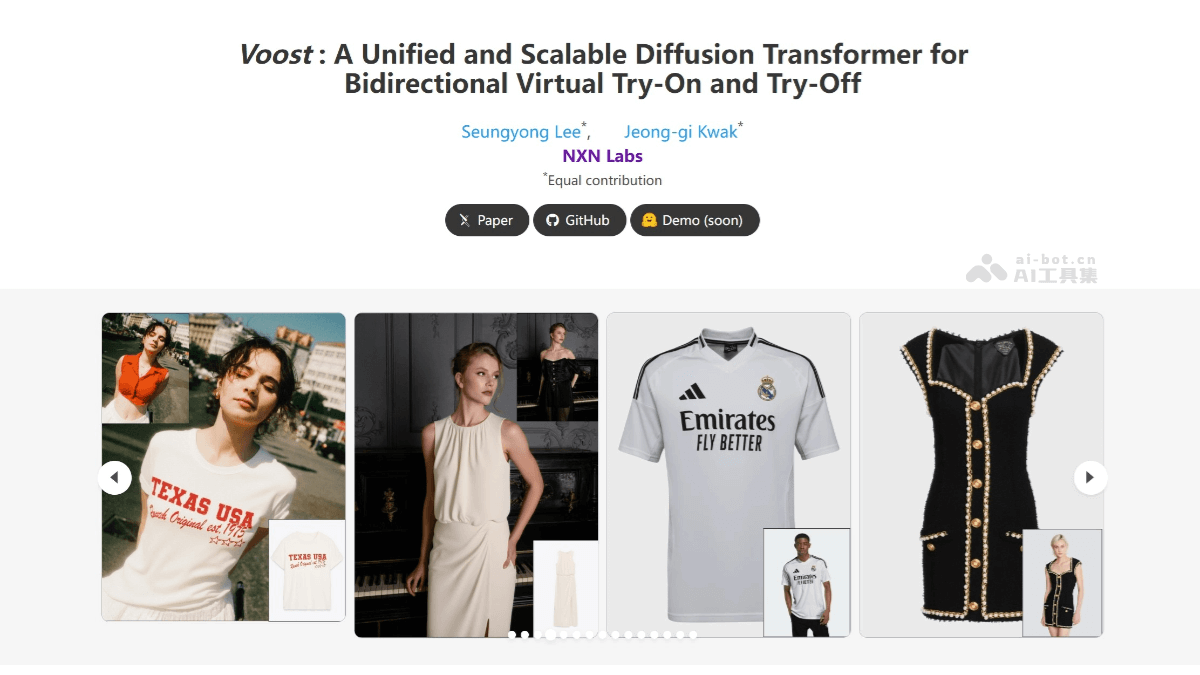
Voost's Main Features
-
Bidirectional Virtual Try-On and Try-Off: Voost can simultaneously handle virtual try-on and try-off tasks, generating high-quality image results, allowing users to view the effects of wearing target clothing and after taking off clothing.
-
Unified Framework: Through a single Diffusion Transformer (DiT), it jointly learns virtual try-on and try-off tasks, without relying on task-specific networks, auxiliary losses, or additional labels, simplifying the model structure and improving efficiency.
-
Enhanced Relationship Reasoning: Leveraging a bidirectional supervision mechanism, each pair of clothing-person data can provide supervision signals for generation in both directions, enhancing the reasoning ability of the relationship between clothing and body.
-
Improved Robustness: Introducing attention temperature scaling technology to enhance the model's robustness to resolution changes or mask changes; adopting a self-correcting sampling strategy to improve the stability and accuracy of generated results through bidirectional consistency verification.
-
High-Quality Generation: In multiple benchmark tests, Voost has achieved the best performance in clothing alignment accuracy and visual fidelity, demonstrating excellent generalization ability and generating realistic try-on and try-off images.
-
Flexible Conditional Input: Supports flexible conditional input, allowing conditioning on generation direction and clothing category, enhancing the model's flexibility and adaptability, suitable for various clothing categories and human poses.
Voost's Technical Principles
-
Unified Diffusion Transformer Framework: Voost adopts a single Diffusion Transformer (DiT) to jointly learn virtual try-on and try-off tasks, through a bidirectional supervision mechanism, enabling each pair of clothing-person data to provide supervision signals for generation in both directions, enhancing the reasoning ability of the relationship between clothing and body.
-
Bidirectional Supervision Mechanism: By jointly modeling virtual try-on and try-off tasks, Voost uses bidirectional supervision signals to improve the model's understanding of the correspondence between clothing and body, without additional labels or task-specific networks.
-
Attention Temperature Scaling: Introducing attention temperature scaling technology to adjust attention weights, enhancing the model's robustness to resolution changes or mask changes, ensuring stability and consistency under different input conditions.
-
Self-Correcting Sampling Strategy: Utilizing bidirectional generation results for cross-consistency verification, improving the stability and accuracy of generated results through a self-correcting sampling strategy, ensuring visual consistency and realism of generated images.
Voost's Project Address
- Project Official Website:https://nxnai.github.io/Voost/
- Github Repository:https://github.com/nxnai/Voost
- arXiv Technical Paper:https://arxiv.org/pdf/2508.04825
Voost's Application Scenarios
-
E-commerce Platforms: Provide users with a virtual try-on feature to help them see more intuitively how clothing looks when worn, enhance the shopping experience, reduce return rates caused by unsuitable sizes or styles, and increase the platform's conversion rate.
-
Fashion Design: Designers can use Voost to quickly preview the effect of clothing designs on different body models, evaluate the feasibility of designs in advance, optimize the design process, and reduce design costs.
-
Personalized Customization: Provide consumers with a personalized virtual fitting experience. Consumers can choose different clothing styles, colors, and combinations according to their needs, enabling customized services and meeting personalized needs.
-
Clothing Display: Brands and merchants can use Voost to display clothing online, attract more user attention through the virtual try-on feature, and enhance brand influence and product exposure.
-
Virtual Fitting Room: Provide virtual fitting solutions for offline clothing stores, reduce customer waiting time for trying on clothes, improve fitting efficiency, and offer customers a richer try-on experience.