
What is VoiceCraft
VoiceCraft is a neural codec language model open-sourced by a research team at the University of Texas at Austin, focusing on zero-shot speech editing and text-to-speech (TTS) tasks. The model adopts a Transformer architecture and, through an innovative token rearrangement process combined with causal masking and delay stacking techniques, can achieve efficient zero-shot generation within existing audio sequences. VoiceCraft demonstrates excellent performance on speech editing and TTS tasks across various accents, styles, and noise conditions, generating speech that is natural and even difficult to distinguish from the original voice.
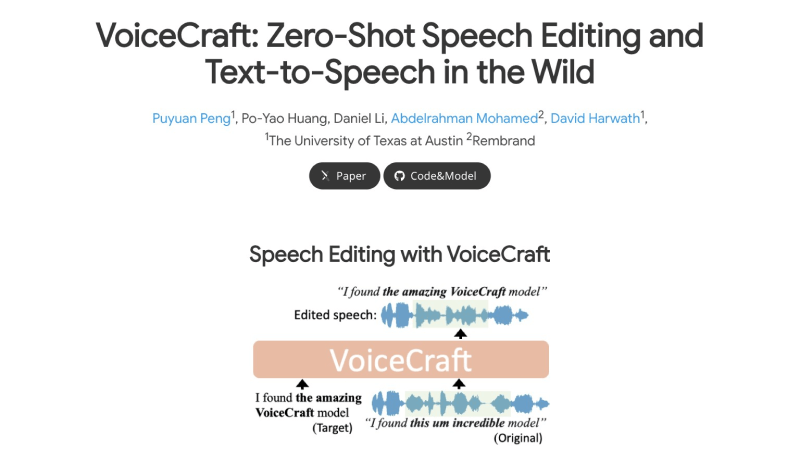
VoiceCraft Official Website Entry
- Official project homepage:https://jasonppy.github.io/VoiceCraft_web/
- GitHub source code repository:https://github.com/jasonppy/VoiceCraft
- Research paper:https://jasonppy.github.io/assets/pdfs/VoiceCraft.pdf
VoiceCraft Features
- Speech Editing: VoiceCraft can edit existing speech recordings without targeted training, such as inserting, deleting, or replacing words, and the edited speech sounds natural and is difficult to distinguish from the original recording.
- Text-to-Speech Conversion: The model can generate speech similar to a target voice based only on text and a short voice sample, without having been exposed to the target voice during training.
- High-Quality Speech Synthesis: When synthesizing speech, VoiceCraft can maintain the naturalness and clarity of the speech, making the synthesized speech sound close to real human voice.
- Diverse Data Adaptability: The model has been evaluated on challenging datasets with various accents, speaking styles, recording conditions, and background noise and music, showing good adaptability and consistent performance.
How VoiceCraft Works
- Neural Codec Architecture: VoiceCraft adopts the Transformer architecture, a deep learning model that relies on the self-attention mechanism and can process sequence data and capture long-distance dependencies within the sequence. The Transformer architecture has proven its efficiency in the field of natural language processing (NLP), and VoiceCraft applies it to the processing of speech signals.
- Token Rearrangement Process: VoiceCraft introduces a special token rearrangement process, which includes two main steps—causal masking and delay stacking. This process allows the model to take context information into account when generating speech, thereby generating more natural and coherent speech sequences.
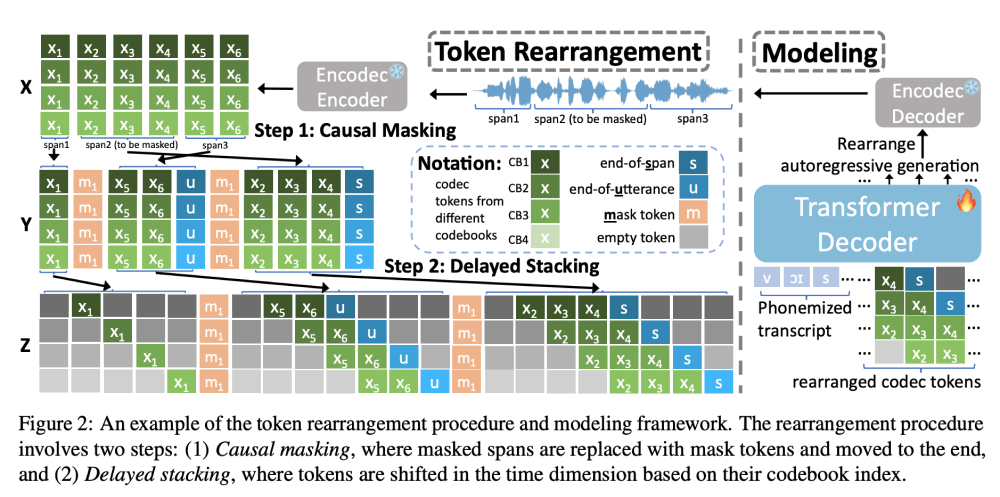
- Causal Masking: This step involves quantizing the input speech signal into a series of encoder tokens and masking these tokens according to causality (i.e., without affecting future outputs). This means that when predicting masked tokens, the model can only rely on unmasked tokens.
- Delay Stacking: Building on causal masking, the delay stacking step further adjusts the time dimension of the encoder tokens to ensure that when predicting the encoder token at the current time step, the model can effectively utilize information from previous time steps.
- Autoregressive Sequence Prediction: VoiceCraft uses an autoregressive sequence prediction method during training and inference. This means that the model generates one token at a time and uses all previously generated tokens as context information at each time step to predict the next token.
- Multi-Codebook Modeling: To improve efficiency and generation quality, VoiceCraft uses residual vector quantization (RVQ) technology to encode speech signals into a sequence of multiple codebooks. These codebooks capture different features of speech, enabling the model to model speech signals more finely.
- Inference and Generation: In the inference stage, VoiceCraft autoregressively generates the corresponding speech sequence based on the input text and audio information (for zero-shot TTS tasks, this also includes a short reference recording of the target voice). For speech editing tasks, the model generates speech matching the target text based on the original audio and the edited text target, while preserving the original features of the unedited parts.
Application Scenarios of VoiceCraft
- Audiobook Production: VoiceCraft can be used to create high-quality audiobooks, telling stories or book content through generated natural and fluent speech, providing listeners with an immersive auditory experience.
- Video Content Creation: In internet video production, VoiceCraft can be used to quickly generate narration or character dialogue, especially in animations, educational videos, or advertisements, which can save dubbing costs and improve production efficiency.
- Podcast Audio Editing: For podcast creators, VoiceCraft provides powerful audio editing tools that can easily correct errors or change content without rerecording the entire podcast, thereby speeding up the content publishing process.
- Multilingual Content Production: VoiceCraft's cross-language capability enables it to generate content for listeners of different languages, helping to overcome language barriers and achieve global content distribution.