
What is VoiceCanvas
VoiceCanvas is an open-source multilingualvoice synthesisplatform. It provides high-quality text-to-speech services based on AI technology, supports more than 50 languages, and integrates multiple voice services such as OpenAI TTS, AWS Polly, and MiniMax. VoiceCanvas provides personalvoice cloningfeatures. Users can create personalized voices by uploading a few seconds of audio samples. VoiceCanvas is suitable for content creators, educators, and enterprise users, significantly improving the efficiency of voice content production.
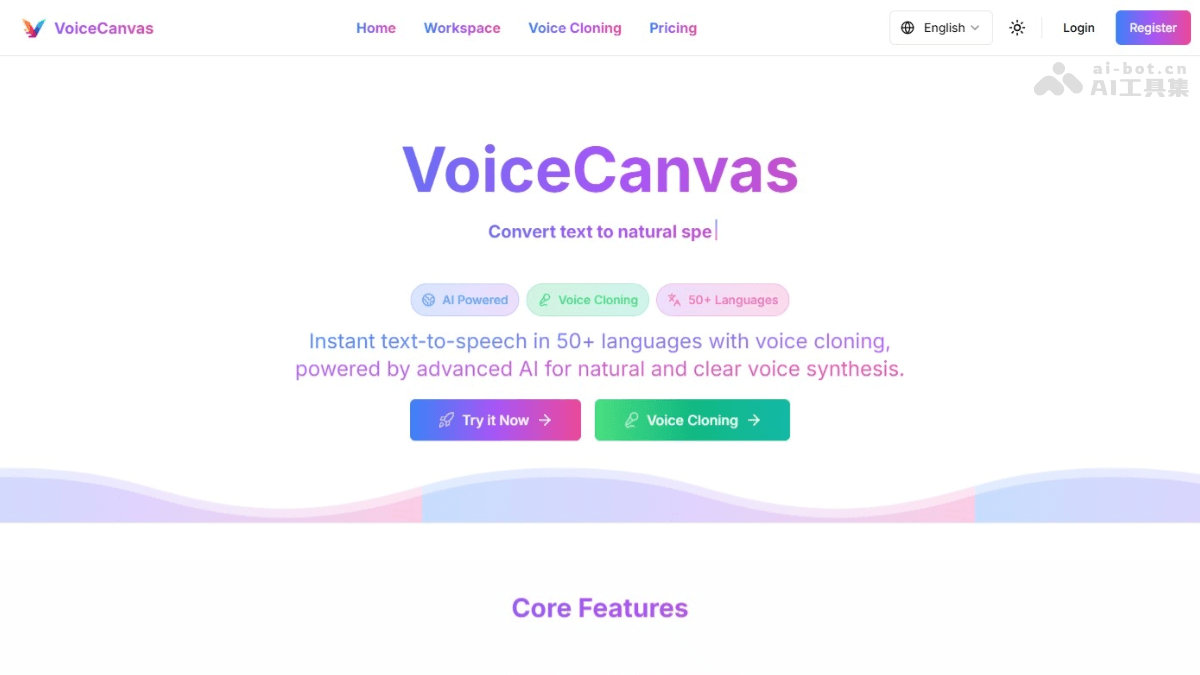
Main features of VoiceCanvas
- Multilingual support: Supports voice synthesis in more than 50 languages, meeting different language needs.
- Voice synthesis: Integrates OpenAI TTS, AWS Polly, and MiniMax to provide high-quality voice output.
- Voice cloning: Upload audio samples to clone personalized voices.
- File processing: Supports text file upload and audio file download, and can process long texts.
- User system: Supports registration, login, and third-party login (Google, GitHub). The interface supports multiple languages and theme switching.
Technical principles of VoiceCanvas
- Voice synthesis technology:
- Deep learning-based voice generation: VoiceCanvas uses deep learning models to convert text into natural speech. These models are trained on large amounts of voice data, learning the rhythm, intonation, and pronunciation rules of language to generate speech close to human speech.
- Integration of multiple voice services: To ensure voice quality and stability, VoiceCanvas integrates multiple voice services. OpenAI TTS provides high-quality natural speech and supports multiple voice styles. AWS Polly supports multiple languages and multiple voice choices. MiniMax optimizes Chinese voice synthesis and supports voice cloning.
- Voice cloning technology:
- Voice feature extraction: After users upload a few seconds of audio samples, the system extracts voice features (such as timbre, intonation, rhythm, etc.) based on deep learning algorithms. The features are encoded as input parameters for the model.
- Personalized voice generation: Based on the extracted features, the system uses deep learning models to generate speech highly similar to the user's voice. This process requires large amounts of data and complex model training to ensure the naturalness and consistency of the cloned voice.
VoiceCanvas project address
- Project official website:https://voicecanvas.org/
- GitHub repository:https://github.com/ItusiAI/Open-VoiceCanvas
Application scenarios of VoiceCanvas
- Content creation: Used for dubbing and narration production for videos, podcasts, and audiobooks, supporting multilingual versions.
- Education: Generates voice explanations for online courses and assists language learning, improving teaching effectiveness.
- Enterprise and business: Produces customer service voice, multilingual content, and brand promotion, supporting international business.
- Entertainment and games: Provides voiceovers for game characters and provides voice feedback in interactive entertainment.
- Personal use: Generates voice diaries and voice messages, helping visually impaired people obtain information.