
What is VLN-R1
VLN-R1 is a new embodied AI framework jointly launched by the University of Hong Kong and Shanghai AI Laboratory. It is based on a large vision-language model (LVLM) to directly convert first-person video streams into continuous navigation actions. The framework builds the VLN-Ego dataset based on the Habitat 3D simulator, and uses a long short-term memory sampling strategy to balance historical and current observations. The framework training is divided into two stages: supervised fine-tuning (SFT) aligns the model's text prediction of action sequences with expert demonstrations, and reinforcement fine-tuning (RFT) optimizes multi-step future actions based on a temporal decay reward (TDR) mechanism. VLN-R1 performs strongly on the VLN-CE benchmark, proving the effectiveness of LVLM in embodied navigation, enhancing task-specific reasoning ability, and achieving high data efficiency.
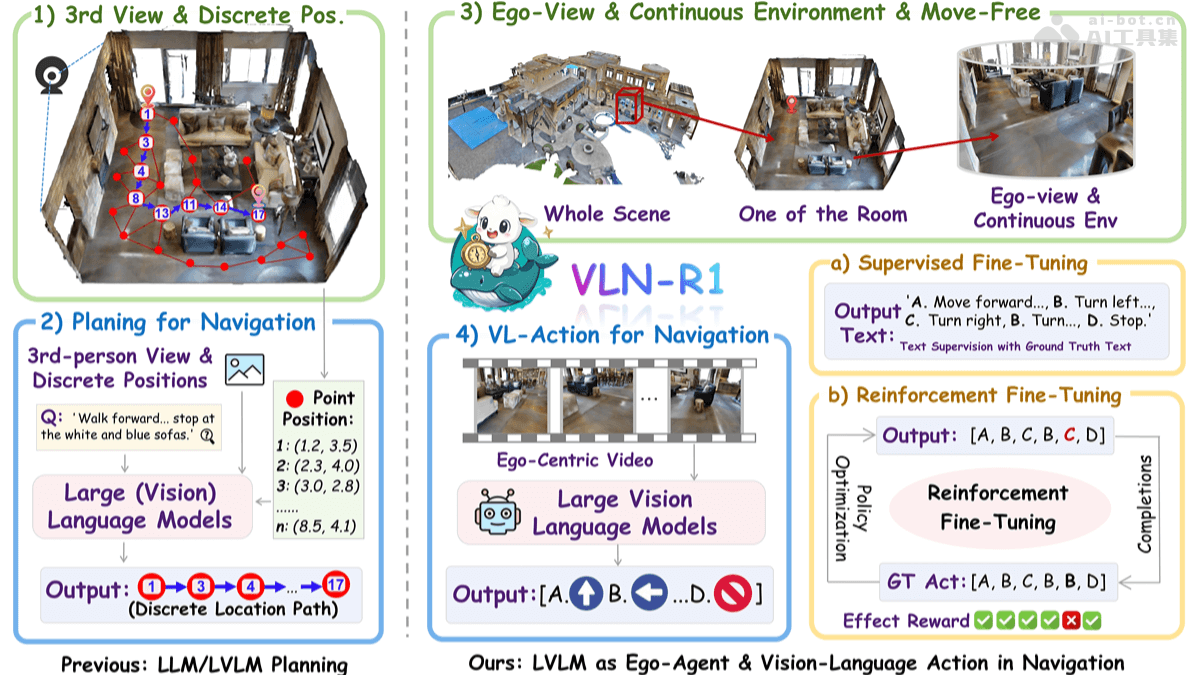
Main Features of VLN-R1
- Continuous Environment Navigation: Directly processes first-person video streams, allowing the agent to move freely in continuous 3D environments, not limited to predefined nodes.
- Action Generation: Generates four basic action commands (FORWARD, TURN-LEFT, TURN-RIGHT, STOP), achieving precise navigation control.
- Data-Efficient Training: Based on supervised fine-tuning (SFT) and reinforcement fine-tuning (RFT), it achieves efficient model training with limited data, improving navigation performance.
- Cross-Domain Adaptation: Based on reinforcement fine-tuning (RFT), the model can quickly adapt to new navigation tasks and environments, even with only a small amount of data.
- Task-Specific Reasoning: Based on the temporal decay reward (TDR) mechanism, it optimizes the prediction of multi-step future actions, enhancing long-term navigation performance.
Technical Principles of VLN-R1
- Dataset Construction: The VLN-Ego dataset is generated based on the Habitat 3D simulator and contains first-person video streams and corresponding future action predictions, providing rich data for model training.
- Long Short-Term Memory Sampling: When processing video input, it uses a long short-term memory sampling strategy to dynamically balance the importance of historical frames and sensitivity to real-time input, ensuring that the model considers both short-term relevance and does not lose long-term contextual information during navigation.
- Supervised Fine-Tuning (SFT): Based on minimizing the cross-entropy loss between the model's predicted text and expert demonstration text, it aligns the model's action sequence prediction with real actions, ensuring that the model can accurately understand language instructions and generate corresponding actions.
- Reinforcement Fine-Tuning (RFT): A reinforcement learning method based on group relative policy optimization (GRPO), it uses a temporal decay reward (TDR) mechanism to evaluate and optimize the prediction of multi-step future actions, enhancing the model's performance in long-term navigation tasks.
- Large Vision-Language Model (LVLM): Based on advanced LVLMs (such as Qwen2-VL) to process visual and language input, it achieves direct mapping from first-person video streams to navigation actions, improving the model's generalization ability and adaptability.
Project Address of VLN-R1
- Project Official Website:https://vlnr1.github.io/
- GitHub Repository:https://github.com/Qi-Zhangyang/GPT4Scene-and-VLN-R1
- arXiv Technical Paper:https://arxiv.org/pdf/2506.17221
Application Scenarios of VLN-R1
- Home Service Robots: Enables home service robots to navigate freely at home according to the owner's natural language instructions, completing tasks such as cleaning and fetching objects, improving life convenience.
- Industrial Automation: In factory workshops, it helps robots navigate flexibly according to operator instructions, completing material handling and equipment maintenance, improving production efficiency.
- Smart Warehousing: Enables warehouse robots to navigate precisely between shelves according to instructions, efficiently complete cargo storage and retrieval, and optimize warehouse management.
- Healthcare: Supports robots in hospitals or nursing homes to navigate according to instructions from medical staff or patients, complete tasks such as medicine and meal delivery, and reduce the burden on medical staff.
- Intelligent Transportation: Helps autonomous vehicles navigate in complex urban environments according to traffic signals and instructions, enhancing driving safety and flexibility.