
What is vLLM
vLLM is an open-source large language model (LLM) inference and deployment framework from the Sky Computing Lab at UC Berkeley, designed to provide users with fast, low-cost model serving. Through innovative memory management techniques and advanced scheduling algorithms, vLLM significantly improves model inference throughput and reduces hardware costs. It supports a variety of hardware platforms and open-source models and can seamlessly integrate into existing systems. It has become a widely adopted LLM deployment solution in academia and industry, promoting the popularization and application of large language models.
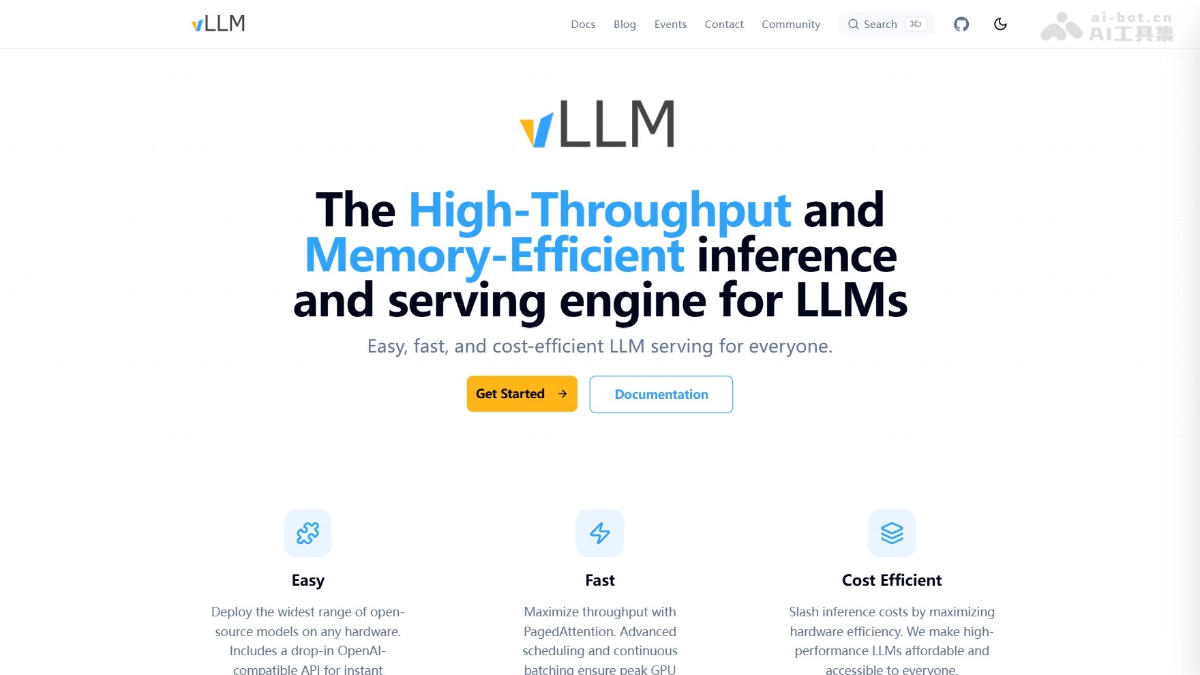
Main features of vLLM
-
Efficient inference: Through PagedAttention technology and continuous batching, it maximizes throughput and significantly improves inference efficiency.
-
Cost optimization: Efficiently utilizes hardware resources, reduces inference costs, and makes high-performance LLMs more affordable.
-
Broad compatibility: Supports multiple hardware platforms (such as NVIDIA, AMD, Intel, etc.) and open-source models, with strong adaptability.
-
Easy integration: Provides an OpenAI-compatible API, making it easy to quickly connect with existing systems.
-
Flexible deployment: Supports multiple decoding algorithms (such as parallel sampling, beam search, etc.) to meet the needs of different application scenarios.
-
Quantization support: Integrates quantization technologies such as GPTQ and AWQ to further optimize performance and resource utilization.
How to use vLLM
-
Install vLLM: Quickly install via
pip install vllm, or compile from source to get the latest features. -
Configure the environment: Select appropriate dependencies (such as CUDA) according to the hardware to complete environment configuration.
-
Load the model: Use the vLLM API to load supported pretrained models, for example
LLM(model="meta-llama/Llama-2-7b-chat-hf")。 -
Run inference: Call the
generatemethod and set sampling parameters (such as temperature, Top-P) to generate text. -
Use the OpenAI-compatible API: Start the API server via
vllm-serveto achieve seamless integration with the OpenAI interface. -
Debug and optimize: Adjust parameters as needed, and optimize performance by referring to the documentation and community support.
-
Deploy to production: Use Docker containerized deployment to ensure environment consistency and quickly launch to production.
vLLM project address
- Project official website:https://vllm.ai/
- GitHub repository:https://github.com/vllm-project/vllm
Application scenarios of vLLM
-
Natural language processing tasks: vLLM can be used for NLP tasks such as text generation, machine translation, and question-answering systems, providing efficient and flexible inference support.
-
Content creation: vLLM can help creators quickly generate creative content such as articles, stories, and scripts, improving creation efficiency.
-
Intelligent customer service: Supports integration into customer service systems to automatically answer user questions, improving service quality and response speed.
-
Education: Assists teaching, generates practice questions, explains knowledge points, or provides students with personalized learning suggestions.
-
Enterprise applications: Used for internal enterprise knowledge management, document generation, and data analysis to improve work efficiency.