
What is ViTPose
ViTPose is a human pose estimation model based on the Transformer architecture. Using a plain Vision Transformer as the backbone network, it extracts features by splitting the input image into patches and feeding them into Transformer blocks, then decodes the features into heatmaps through a decoder to achieve precise localization of human keypoints. The ViTPose series models come in various scale versions, such as ViTPose-B, ViTPose-L, ViTPose-H, etc., which can be selected according to different needs. It performs excellently on datasets such as MS COCO, demonstrating the strong potential of plain Vision Transformers for pose estimation tasks. In addition, ViTPose+, as an improved version, extends to multiple body pose estimation tasks, covering different types of keypoints such as animals and humans, further improving performance and scope of application.
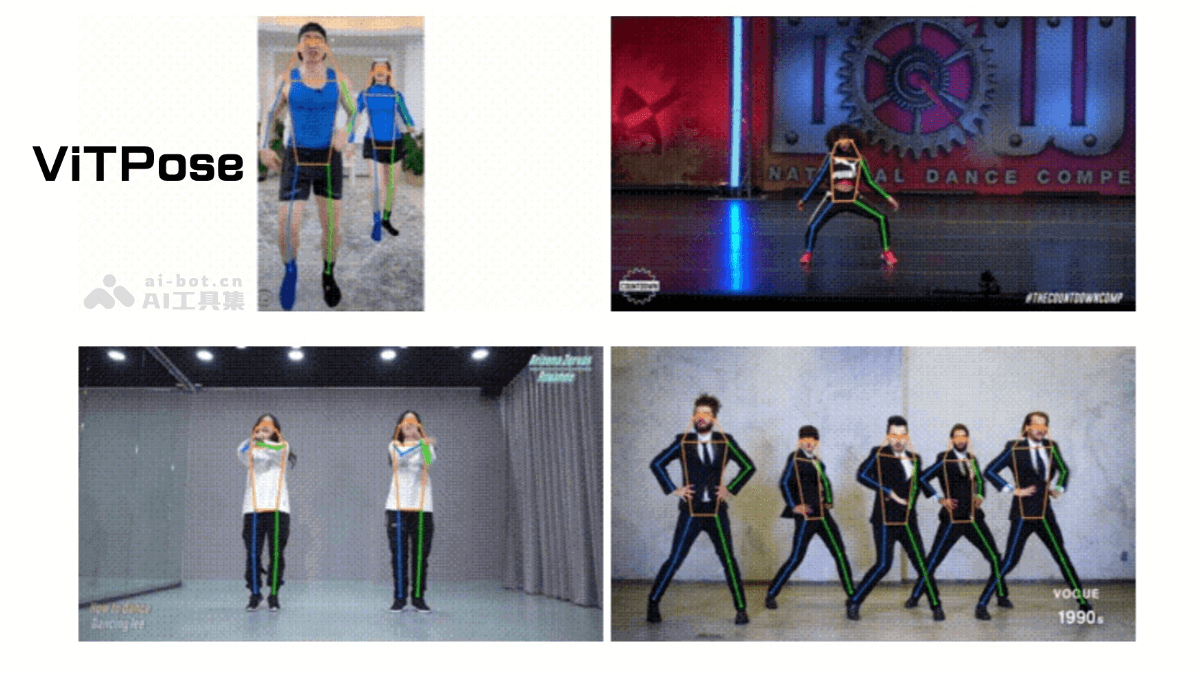
Main Features of ViTPose
- Human Keypoint Localization: It can identify keypoints of the human body in images, such as joints, hands, feet, etc., and is widely used in fields such as motion analysis, virtual reality, and human-computer interaction.
- Simple Model Architecture: It uses a plain Vision Transformer as the backbone network for feature extraction, then decodes the features into heatmaps through a simple decoder to achieve precise keypoint localization. Its model structure is simple and easy to implement and extend.
- Strong Scalability: By adjusting hyperparameters such as the number of Transformer layers and heads, the model can be scaled from 100M to 1B parameters, adapting to task requirements of different scales while maintaining high performance.
- High Flexibility: It is flexible in training paradigms, supports different pretraining and fine-tuning strategies, as well as multiple input resolutions and attention types, and can handle various pose estimation tasks.
- Transferable Knowledge: The knowledge of large models can be easily transferred to small models through simple knowledge tokens, further improving the practicality and flexibility of the model.
Technical Principles of ViTPose
- Vision Transformer: ViTPose uses a standard, non-hierarchical Vision Transformer as the backbone network for feature extraction. The input image is first split into multiple patches, and each patch is embedded into a high-dimensional space to form tokens. These tokens are then processed through multiple Transformer layers, each containing Multi-head Self-Attention (MHSA) and a Feed-Forward Network (FFN).
- Feature Extraction: After processing through the Transformer layers, the final output feature map has rich semantic information and can capture keypoint features of the human body in the image.
- Heatmap Prediction: ViTPose's decoder decodes the feature map output by the encoder into a heatmap. Each pixel value in the heatmap represents the probability that the position is a certain keypoint. There are two choices for the decoder:
- Standard Decoder: Uses transposed convolution for upsampling, then generates the heatmap through a prediction layer.
- Simple Decoder: Directly uses bilinear interpolation for upsampling to generate the heatmap.
- Model Transfer: The knowledge of ViTPose can be easily transferred to small models through simple knowledge tokens, further improving the practicality and flexibility of the model.
- SOTA Performance: ViTPose has achieved new SOTA (State of the Art) and Pareto frontiers on multiple pose estimation datasets.
ViTPose's project address
- Github repository:https://github.com/ViTAE-Transformer/ViTPose
- arXiv technical paper:https://arxiv.org/pdf/2204.12484
ViTPose's application scenarios
- Human pose estimation: Mainly used to identify key points of the human body in images, such as joints, hands, feet, etc., and is widely used in fields such as motion analysis, virtual reality, and human-computer interaction.
- Animal pose estimation: ViTPose+ extends to animal pose estimation tasks and can be used for wildlife behavior research, pet behavior analysis, etc.