
What is Vision Search Assistant
Vision Search Assistant (VSA) is a framework that combines vision-language models (VLMs) and web agents to enhance the model's ability to understand unknown visual content. Based on internet retrieval, it enables VLMs to process and answer questions about unseen images. VSA performs excellently in open-set and closed-set question-answering tests, significantly outperforming other models including LLaVA-1.6-34B, Qwen2-VL-72B, and InternVL2-76B. Vision Search Assistant can be widely applied to existing VLMs, enhancing their ability to handle new images and events.
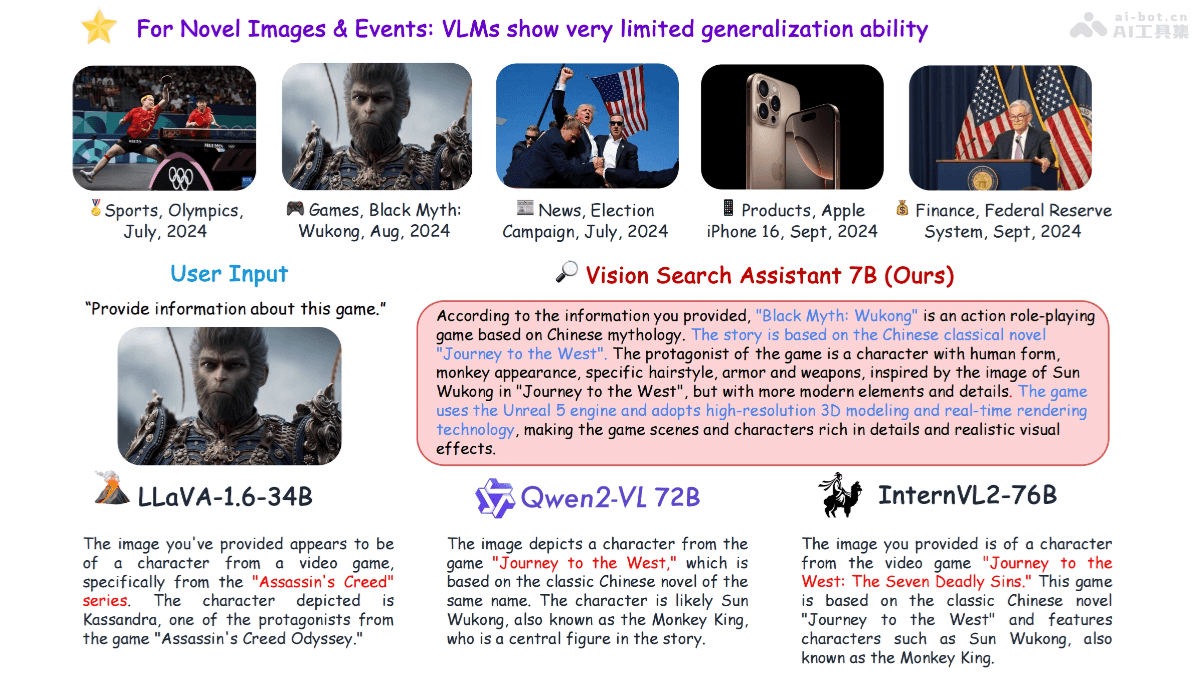
Main Features of Vision Search Assistant
- Visual Content Formulation: Identifies key objects in the image, generates descriptions, and considers the correlations between objects. This process is called Correlated Formulation.
- Web Knowledge Search: Based on an iterative algorithm called "Chain of Search," it generates multiple sub-questions, uses web agents to search for relevant information, and acquires web knowledge related to the user's question and image content.
- Collaborative Generation: Combines the original image, the user's question, correlated formulations, and knowledge obtained through web search to generate the final answer using the VLM.
- Multimodal Search Engine: Transforms any VLM into a multimodal automatic search engine capable of understanding and responding to visual content.
- Real-Time Information Access: Utilizes the real-time information access capability of web agents to enable VLMs to obtain the latest web data, improving the accuracy of responses.
- Open-World Retrieval-Augmented Generation: Based on internet retrieval, it expands the ability of VLMs to handle new visual content, enabling them to process and answer questions about unseen images or new concepts.
Technical Principles of Vision Search Assistant
- Visual Content Recognition and Description: Uses VLM to analyze the input image, identify key objects in the image, and generate text describing the objects.
- Correlation Analysis: Generates descriptions for individual objects, analyzes the correlations between objects, and produces a textual representation that comprehensively considers these relationships, namely the correlated formulation.
- Sub-Question Generation: Based on the user's question and correlated formulation, VSA uses a large language model (LLM) to generate a series of sub-questions. The sub-questions guide the search process to find more specific information.
- Web Search and Knowledge Integration: Executes sub-question searches based on web agents, analyzes web pages returned by search engines, extracts and summarizes relevant information, and forms web knowledge.
- Iterative Search Process: Uses the "Chain of Search" algorithm to progressively refine the search through an iterative process, obtaining richer and more accurate web knowledge.
Project Address of Vision Search Assistant
- Project Website:cnzzx.github.io/VSA
- GitHub Repository:https://github.com/cnzzx/VSA
- arXiv Technical Paper:https://arxiv.org/pdf/2410.21220
Application Scenarios of Vision Search Assistant
- Image Recognition and Search: Users upload an image, and it recognizes the content in the image and provides relevant information, such as identifying historical figures, landmarks, animal and plant species, etc.
- News Event Analysis: Analyzes news images and provides detailed reports including event background, participant information, event impact, etc., helping users quickly understand the full picture of news events.
- Education and Learning: In the field of education, assist learning, such as explaining scientific concepts, historical events, or providing visual aids in language learning.
- E-commerce: On e-commerce platforms, image-based search helps users find the products they want to buy, or provides detailed product information and reviews.
- Travel planning: Users upload images of travel destinations to obtain information such as introductions to attractions, travel guides, and cultural background, assisting users in planning their itineraries.