
What is Virse
Virse is an AI creative workspace for professionaldesignteams. Built on an infinite canvas, the platform integrates 50+ generative models, learns users' visual preferences to form a six-dimensional aesthetic profile, and uses it for personalized retrieval and content generation, keeping style stable across multiple rounds of revisions. Materials, versions, and relationships on the canvas are all preserved as transferable team assets, serving brands, e-commerce, and creative agencies.
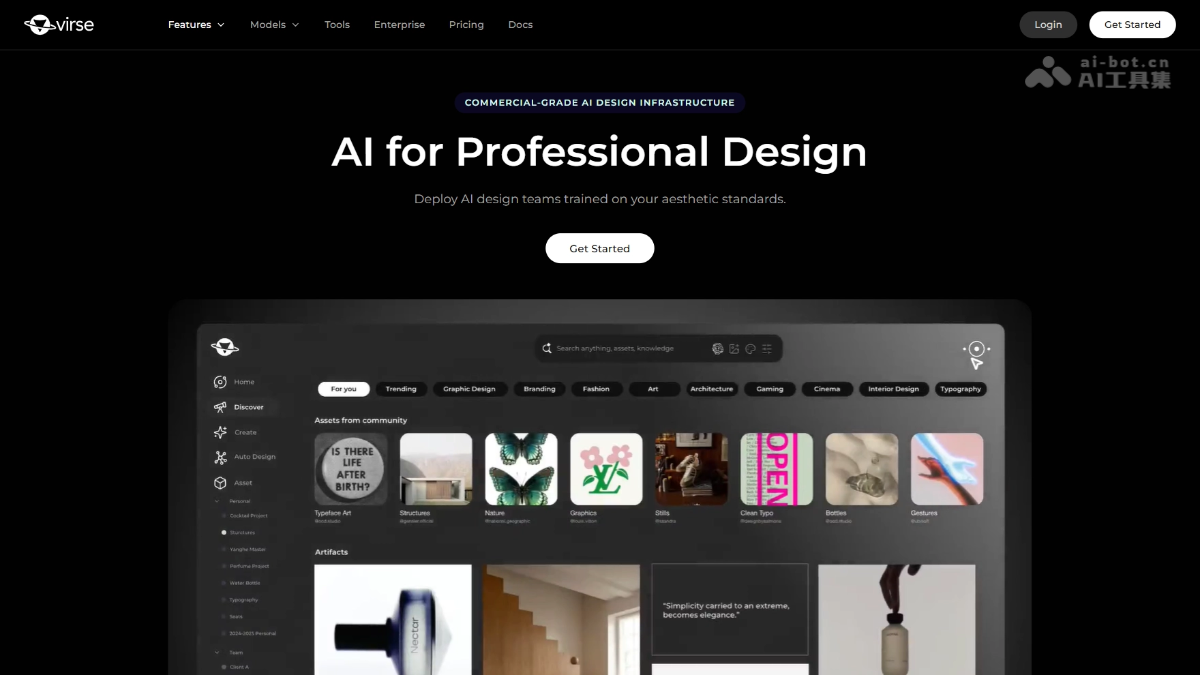
Virse's Main Features
-
Infinite Canvas Workspace: Text, images, search results, and generated materials are placed in the same space, where different models can be invoked to continue modifying and expanding.
-
50+ Multi-Model Invocation: Various models such as image generation/editing and video production/editing are unified on one canvas and invoked on demand.
-
LAMM Aesthetic Memory System: A six-dimensional aesthetic profile is built through image comparison choices, and continuously learns and updates your preferences during use.
-
Personalized Retrieval: When searching reference images and material libraries, the system adjusts ranking results according to your aesthetic profile.
-
Preset Style Directions: Built-in styles such as editorial feel, product photography, fashion editorial, and concept design can be overlaid with reference images to continue generating.
-
Local Modification and Image Extension: After generation, detailed fine-tuning is supported without altering the entire image, and images can be directly converted to video.
-
Agent Mode: Give a canvas node an instruction and it automatically executes a multi-step process; multiple Agents can collaborate around the same project with divided tasks.
-
Project Handover and Asset Preservation: What is handed over is not just the final image; reference materials, historical versions, and material relationships are all retained, and the team shares the same set of visual standards.
How to Use Virse
-
Register and Log In: Visit Virse's official website https://www.virse.ai/ to create an account and enter the workspace.
-
Create a New Canvas: Click "New Canvas" to get an infinitely expandable creative space, supporting both personal and shared modes.
-
Create a Node: Select a node type on the canvas; each type handles a category of tasks, and the most commonly used is the image node.
-
Configure Generation Parameters: In the bottom workspace, select the model, resolution, aspect ratio, and number of images, set the "aesthetic" style, or upload/select reference images.
-
Enter Instructions to Generate: Describe the desired image in the input box and click "Generate" to get a result; if unsatisfied, you can regenerate.
-
Connect Nodes to Build a Workflow: Drag a line from the connection handle on the right side of a node, select the next node type, and the new node will automatically use the previous node's output as input.
-
Expand Creative Formats: Continue connecting to a video node to make images move, or connect an Agent node to process design tasks in batches.
-
Invoke Agent Mode: Give the Virse Agent multi-step instructions, and it will automatically read the canvas context and execute them in batches.
-
Preservation and Handover: All versions, reference images, and connection relationships are retained on the canvas, and can be directly shared for team collaboration or handed to colleagues to continue creating.
Virse's Core Advantages
-
LAMM Aesthetic Memory System: Through continuous learning, it builds a personal six-dimensional aesthetic profile, making it the only "aesthetic memory layer" among similar tools.
-
Stability across multiple rounds of revisions: The remembered canvas context and style encoding keep characters, products, and visual styles consistent across multiple rounds of generation, directly addressing the pain point of "tweaking one spot but changing the whole image."
-
Unified orchestration of 50+ models: Image, video, and text models converge on a single canvas and are called on demand, so you are not locked in by the capabilities of a single model.
-
The canvas is the context: Assets, versions, and connection relationships can all be read and used by the Agent, enabling true multi-step automated execution.
-
Personalized retrieval: It searches reference images and your own asset library in combination with your aesthetic profile, finding images by "whether they look like your style" rather than by keywords.
-
Team asset accumulation and handover: Reference materials, historical versions, and asset associations are retained and handed over along with the canvas, so whoever takes over can continue along the creative thread.
-
One standard shared across the whole team: The brand visual system only needs to be encoded once, and designers, agencies, and partners all follow the same aesthetic standard.
Comparison of similar competitors to Virse
| Comparison dimension | Virse | FLORA |
|---|---|---|
| Product positioning | AI creative workbench, focused on "aesthetic memory + design asset accumulation" | Infinite-canvas AI creation platform, focused on "model connection + reusable workflows" |
| Founding team | Zhao Yifan (Cornell + former Tencent) + Angela Chen (Red Dot Award designer) + Dr. Brown Tian Yun | Weber Wong (former Menlo Ventures investor, NYU technology + art program) |
| Funding stage | Angel round (ZhenFund, etc.) | Cumulative funding of $52 million, far larger in scale than Virse |
| Core differentiation | LAMM Aesthetic Memory System: six-dimensional aesthetic profile, personalized retrieval, style encoding | Multi-user real-time collaboration, brand asset library, reusable workflow templates |
| Canvas logic | The canvas is the context; node connection relationships can be read by the Agent to execute multi-step tasks | The canvas is a model orchestration interface; nodes connect different generation models in series |
| Memory capability | Strong: aesthetic preferences, brand rules, and project context continuously accumulate and are reused across projects | Medium: mainly reuse of workflows and brand materials, with no personal aesthetic learning layer |
| Agent capability | Multiple Agents share the canvas context and divide work (visual exploration/batch production) | Mainly workflow automation |
| Target users | Brands, design studios, e-commerce teams, creative agencies | Professional creators + team collaboration scenarios |
Virse application scenarios
-
Batch production of e-commerce product images: Upload product images and material references, and let the Agent batch-replace different materials/scenes to generate complete sets of product images (such as the usage by toolant tools and footwear clients), with consistent style throughout.
-
Brand advertising campaign production: Start from reference images to explore visual directions, and once determined, continuously produce key visuals with an encoded aesthetic style, and extend them into video assets with one click.
-
Packaging and Product Design: Connect line art/concept sketches to render photorealistic effect images, make multiple rounds of local detail adjustments without excessively changing the overall design, and the accumulated version chain can be delivered directly to clients for confirmation (such as Jiaguwen OCD's alcoholic beverage packaging).
-
Team Collaboration and Project Handover: The canvas fully preserves reference materials, historical versions, and associations. When a designer is replaced or the project is handed over to an agency, there is no need to realign brand standards, and the successor can continue advancing along the existing thread.
-
Reference Footage/Asset Library Search and Reuse: Use an "aesthetic profile" to search your accumulated asset library by visual similarity, quickly finding past work that matches the current project's style and avoiding reinventing the wheel.