
What is Violin
Violin is an open-source end-to-end AI video translation tool by University of Oxford postdoctoral researcher Kevin Lin, breaking down language barriers for high-quality video content. It integrates three major capabilities: Whisper speech recognition, large language model translation, and TTS speech synthesis. It can automatically translate and dub videos in any language into 33 target languages, with output audio highly aligned to the lip movement rhythm of the visuals. The project is open-sourced under the MIT license and supports three usage methods: CLI command line, FastAPI web interface, and Claude Code Skill. It includes 6 built-in translation styles such as academic, children's, and news, meeting multi-scenario needs from education to entertainment.
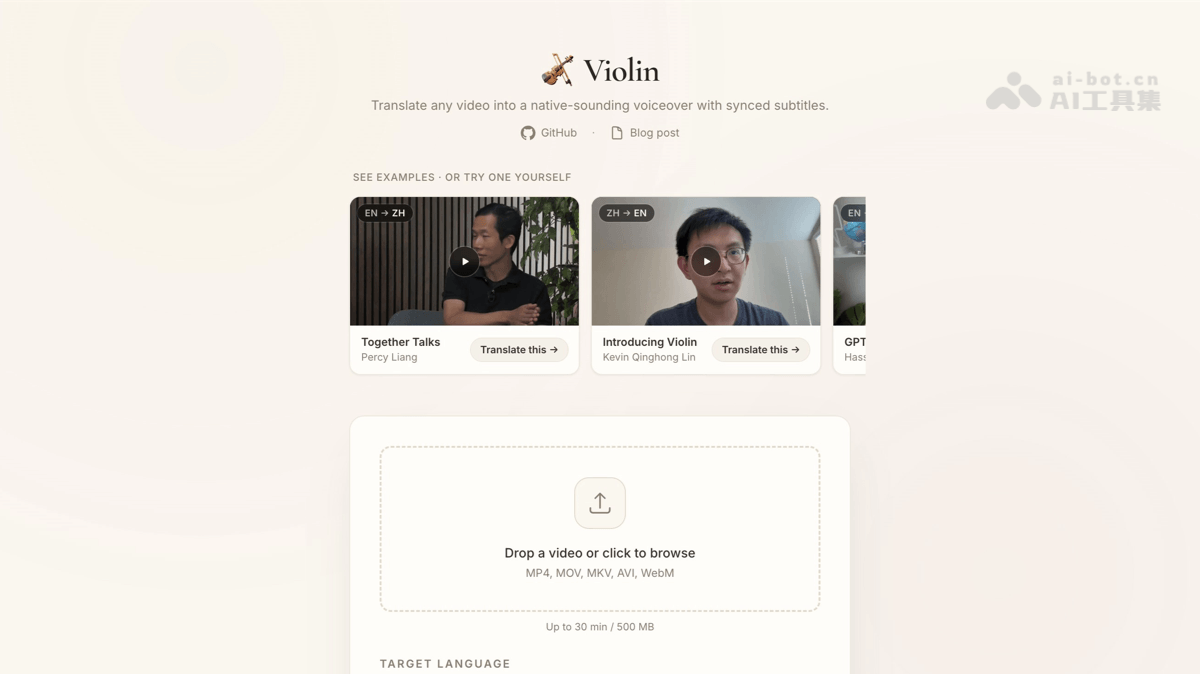
Violin's main features
-
Fully automatic translation and dubbing pipeline: One-click completion of speech recognition (Whisper) → text translation (LLM) → speech synthesis (TTS) → audio-video alignment, outputting natural and fluent target-language videos.
-
33 target language support: Covers mainstream languages such as Chinese, English, Japanese, Korean, French, and German, with native-level voice libraries preset for high-frequency languages.
-
6 translation style switches: Supports styles such as standard, children's, academic, casual, storytelling, and news broadcasting, allowing the same video to be adapted to different audiences.
-
Video dialogue Q&A: Users can directly ask questions about video content, and the system intelligently answers by combining subtitles and sampled frames, acting as a "video second brain".
-
Natural language voice selection: No need to manually select voices; describe the desired vocal characteristics in plain language, and the LLM automatically matches the optimal voice from the voice library.
-
Flexible multi-backend switching: Connects to Together AI by default (DeepSeek V4 Pro + Cartesia Sonic 3), with one-click switching to service providers such as OpenAI or ElevenLabs.
How to use Violin
-
CLI command line: After installation, run
violin lecture.mp4 lecture_zh.mp4 --language Chineseto complete single-file translation. -
FastAPI web application: Start locally
violin-apiservice, operate through a browser-based visual interface, while exposing a REST API for third-party calls. -
Claude Code Skill: After installing the Violin Skill, directly call translation tasks with natural language instructions in a Claude Code session.
-
Custom configuration: Override default parameters (such as model provider, voice, translation style) through a YAML configuration file; only declare the key-values that need to be modified.
-
Production deployment: The project provides ready-made
docker-compose.yml+Caddyfile, allowing rapid deployment to your own server or cloud platform.
Violin's project address
- GitHub repository:https://github.com/shang-zhu/violin
- Online experience:https://www.violin-ai.com/
Violin's core advantages
-
End-to-end automation: No need to manually split audio or align timelines; the entire process is automatically completed by AI, greatly lowering the barrier to video localization.
-
Lip movement rhythm alignment: Output audio matches the lip movement rhythm of the original visuals, providing a natural viewing experience and avoiding the "audio-visual misalignment" problem of traditional dubbing.
-
Multi-style semantic adaptation: The same source video can generate translated versions with different levels of semantic depth, such as children's, academic, and news versions, for multiple uses from one source.
-
Open source and extensible: The MIT license allows commercial use and secondary development, and the clear code structure makes it easy to integrate into your own content production pipeline.
-
Enterprise-grade deployment support: Built-in Docker and reverse proxy configuration, supporting private deployment to meet data security and high-frequency call needs.
Comparison of Violin with Similar Competing Products
| Comparison Dimension | Violin (Open Source) | HeyGen Video Translate | Rask AI |
|---|---|---|---|
| Product Positioning | End-to-end open-source AI video translation pipeline, supporting private deployment | AI digital human + video creation platform, with video translation as an ancillary capability | Audio dubbing and localization platform, focused on high-volume video translation |
| Open Source License | MIT (commercial use and secondary development permitted) | Closed source | Closed source |
| Language Support | 33 target languages | 175+ languages | 135+ languages |
| Lip Sync | Supported, optimized for aligning audio and on-screen lip rhythm in real footage | Supported (Good), but the engine is designed for digital humans and performs weaker on occlusion and rapid movement in real human face footage | Supported (Fair), and only unlocked on Creator Pro ($150/month) and above plans |
| Voice Cloning | Supports natural language voice selection + preset native-level timbres | Supports Instant Clone (30-second sample) and Professional Clone | Supported, can preserve the original speaker's timbre |
| Translation Style Adaptation | Built-in 6 styles: standard / children's / academic / casual / storytelling / news broadcast | No clearly provided multi-style semantic adaptation | No clearly provided multi-style semantic adaptation |
| Video Conversational Q&A | Supported, allows asking questions about video content and answering based on subtitles and sampled frames | Not supported | Not supported |
| Deployment Method | Local CLI / Docker / FastAPI self-hosting / Claude Code Skill | SaaS cloud, private deployment not possible | SaaS cloud, private deployment not possible |
| Usage Method | Command line, Web UI, API, Claude Code plugin | Web visual editor + REST API | Web upload translation + REST API (enterprise plan) |
Violin's Application Scenarios
-
Online Education Localization: Translate high-quality courses from platforms such as Coursera and YouTube into Chinese or other languages, lowering the learning barrier.
-
Cross-border E-commerce Marketing: Quickly generate multilingual versions of product introduction videos, adapting to different regional markets such as Amazon and TikTok Shop.
-
International Conferences and Speeches: Provide real-time or offline multilingual subtitles and dubbing for academic conferences and industry summits, expanding their reach.
-
Children's Content Adaptation: Switch adult-oriented popular science videos to "children's style," automatically generating age-appropriate explanations and timbres.
-
Internal Enterprise Training: Multinational companies translate unified training materials into the native languages of employees in various locations, ensuring consistency in information delivery.