
What is VILA-U
VILA-U is a unified foundation model that integrates video, image, and language understanding and generation. Based on a single autoregressive next-token prediction framework, it handles both understanding and generation tasks, simplifies the model architecture, and achieves near state-of-the-art performance in visual language understanding and generation. VILA-U's success is attributed to its ability to align discrete visual tokens with text inputs during pretraining, as well as autoregressive image generation techniques, which can achieve image quality similar to diffusion models on high-quality datasets. The model provides an efficient solution for multimodal tasks without relying on additional components such as diffusion models.
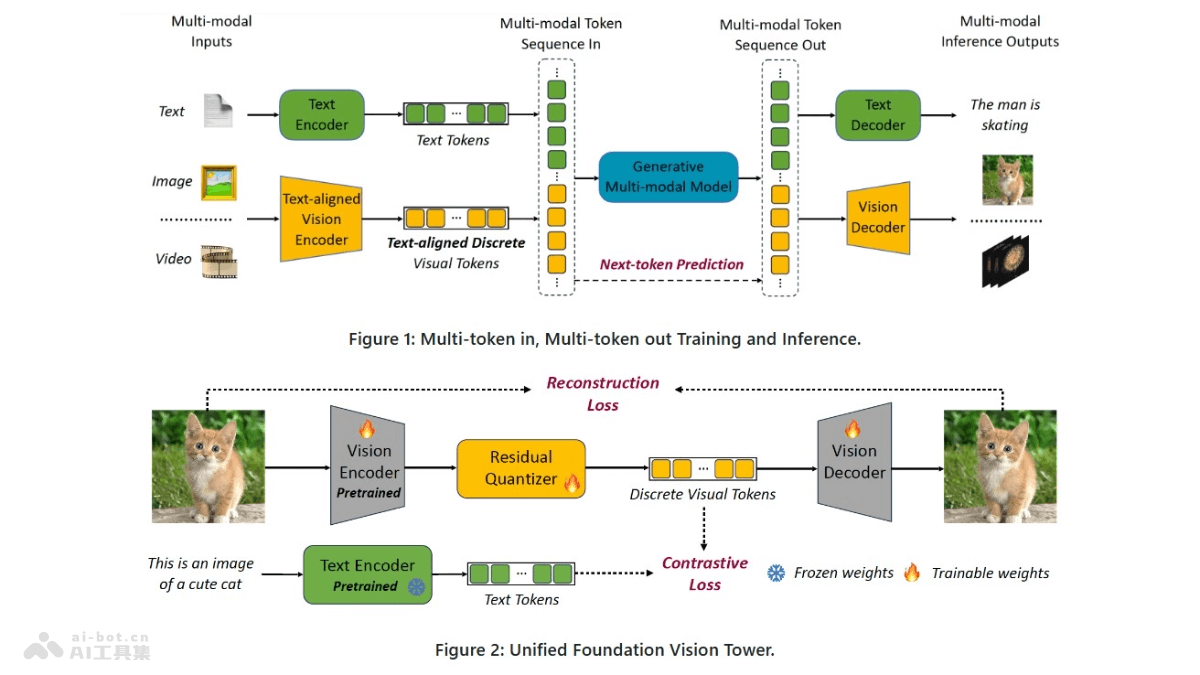
Main Features of VILA-U
- Visual Understanding: VILA-U can understand image and video content, including language descriptions of images and videos, visual question answering, etc.
- Visual Generation: Generates images and videos based on text prompts, enabling conversion from language to visual content.
- Multimodal Learning: VILA-U combines visual and language modalities, simultaneously processing both types of data in understanding and generation tasks.
- Zero-Shot Learning: VILA-U demonstrates zero-shot learning capabilities in visual language tasks, being able to complete specific tasks without task-specific training.
Technical Principles of VILA-U
- Unified Autoregressive Framework: VILA-U uses a unified autoregressive next-token prediction framework to process visual and language data, simplifying the model and improving efficiency.
- Vision Tower: A module that converts visual inputs into discrete tokens, aligned with text inputs based on vector quantization (VQ) and contrastive learning, enhancing visual perception capabilities.
- Multimodal Training: During the pretraining phase, VILA-U uses a dataset mixing images, text, and videos, and trains with a unified next-token prediction objective, helping the model learn the associations between vision and language.
- Residual Vector Quantization: Quantizes vectors at multiple depths to increase representation capability while maintaining a reasonable number of tokens for easy processing by language models.
- Depth Transformer: Used to handle the depth structure introduced by residual quantization, autoregressively predicting depth residual tokens to refine feature estimation.
VILA-U Project Address
- Project Website:hanlab.mit.edu/projects/vila-u
- GitHub Repository:https://github.com/mit-han-lab/vila-u
- HuggingFace Model Library:https://huggingface.co/collections/mit-han-lab/vila-u-7b-6716f7dd5331e4bdf944ffa6
- arXiv Technical Paper:https://arxiv.org/pdf/2409.04429
- Online Experience Demo:https://vila-u.mit.edu/
Application Scenarios of VILA-U
- Image and Video Generation: Generates corresponding image or video content based on given text descriptions, with wide applications in entertainment, game design, film production, and digital art.
- Content Creation Assistance: Artists and designers generate creative materials, or use it as a source of inspiration during the creative process.
- Automated Design: In advertising, marketing, and brand promotion, quickly generates attractive visual content, improving design efficiency.
- Education and Training: Used to create educational materials, such as visualizing complex scientific concepts or historical events, enhancing the learning experience.
- Assisting People with Disabilities: For people with visual or reading impairments, convert text into images or videos to help users better understand and absorb information.