
What is VikingDB
VikingDB is a high-performance vector database launched by Volcano Engine, specifically designed for processing massive high-dimensional vector data. VikingDB supports multiple data write methods such as real-time synchronization and asynchronous writes, features self-developed efficient indexing algorithms such as HNSW and IVF, can achieve millisecond-level retrieval of tens of billions of vectors, and is compatible with dense and sparse vector retrieval. VikingDB provides a SaaS console, APIs, and SDKs in multiple languages, supports automatic elastic scaling, and is widely used in multimodal search, intelligent recommendation, RAG scenarios, memory bank construction, and other fields, helping enterprises achieve efficient data management and intelligent application development.
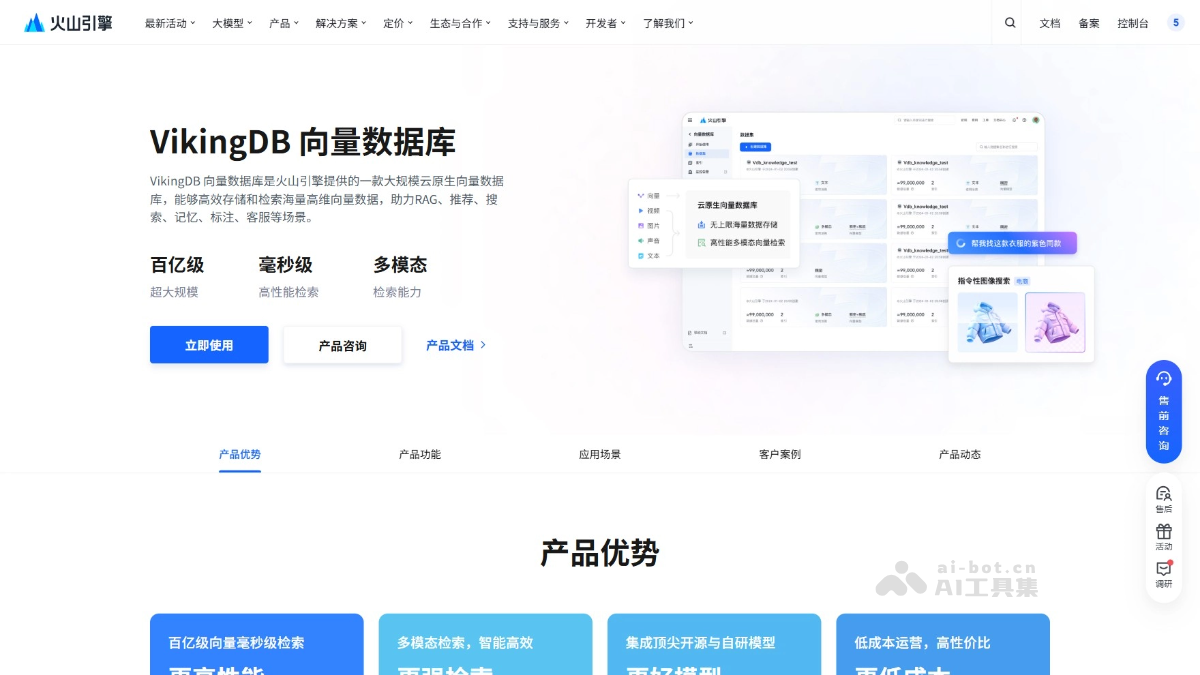
Main Features of VikingDB
- Rich Data Write Methods: Supports real-time synchronization, asynchronous writes, single-record page writes, and large-scale batch data writes, meeting data write needs in different scenarios.
- Streaming Index Updates: Based on self-developed indexing algorithms such as HNSW, IVF, and DiskANN, combined with a bypass streaming update architecture, it ensures second-level data real-time performance under arbitrary loads.
- Diverse Retrieval Capabilities: Supports millisecond-level retrieval of tens of billions of vectors, and is compatible with vector, scalar, hybrid, and multimodal data retrieval, meeting complex query needs.
- Scalable Cloud Service: Provides access via SaaS console, API, and Python/Java/Go SDKs, supports automatic capacity awareness and elastic scaling, and enables rapid construction of the full process from data to retrieval.
- High Performance and Low Cost: Through deeply optimized indexing algorithms and quantization technology, it achieves retrieval of tens of billions of vectors within 10ms and reduces storage costs.
- Knowledge Base and Memory Bank: Provides knowledge base and memory bank features, supports complex semantic retrieval and long-term memory storage for large models, and is suitable for personalized interaction scenarios.
How to Use VikingDB
- Register and Log In: Visit the Volcano Engine official website:https://www.volcengine.com/product/VikingDB,注册并登录账号,进入 VikingDB console.
- Create a Vector Database Instance: Create a VikingDB instance in the console, and configure parameters such as instance name, storage capacity, and performance specifications.
- Data Preparation and Vectorization: Organize the data to be processed, and use an Embedding model (such as Doubao or other open-source models) to convert the data into vector form.
- Connect to VikingDB: Install and initialize the SDK provided by VikingDB (such as Python, Java, Go), and connect to the created database instance.
- Write Data: Use the SDK to write vector data into VikingDB, supporting multiple write methods such as real-time synchronization and asynchronous writes.
- Retrieve Data: Use the SDK for vector retrieval, scalar retrieval, or hybrid retrieval to obtain the most similar results.
- Monitoring and Optimization: Monitor instance performance metrics in the console, and adjust configurations as needed to optimize performance and cost.
Application Scenarios of VikingDB
- Multimodal Search: Supports scenarios such as video retrieval, material copyright, e-commerce product search and recommendation, and similar image search, achieving efficient content matching through vector retrieval.
- Intelligent Recommendation: Applied in intelligent recommendation systems, supports large-scale vector similarity search, and helps achieve personalized recommendations and content deduplication.
- RAG Scenarios: As a core component of RAG (Retrieval-Augmented Generation) scenarios, it provides efficient data retrieval support for large language models.
- Memory Bank: Supports long-term memory storage and retrieval for large models, suitable for personalized interaction in scenarios such as role-playing, smart hardware, education and teaching, and personal assistants.
- Multimodal Annotation: Based on the combination of vector retrieval and keyword retrieval, it enables efficient semantic annotation and supports annotation work for multimodal data.