
What is ViewExtrapolator
ViewExtrapolator is a new view extrapolation method jointly developed by the research teams of Nanyang Technological University and UCAS. It leverages the generative prior of Stable Video Diffusion (SVD) to synthesize novel views far beyond the training view range. This method is based on a redesigned denoising process of SVD, effectively optimizing views prone to artifacts in radiance field or point cloud rendering, and generating clearer, more realistic novel view images. ViewExtrapolator does not require fine-tuning SVD, is data- and computationally efficient, and can be widely applied to different 3D rendering techniques.
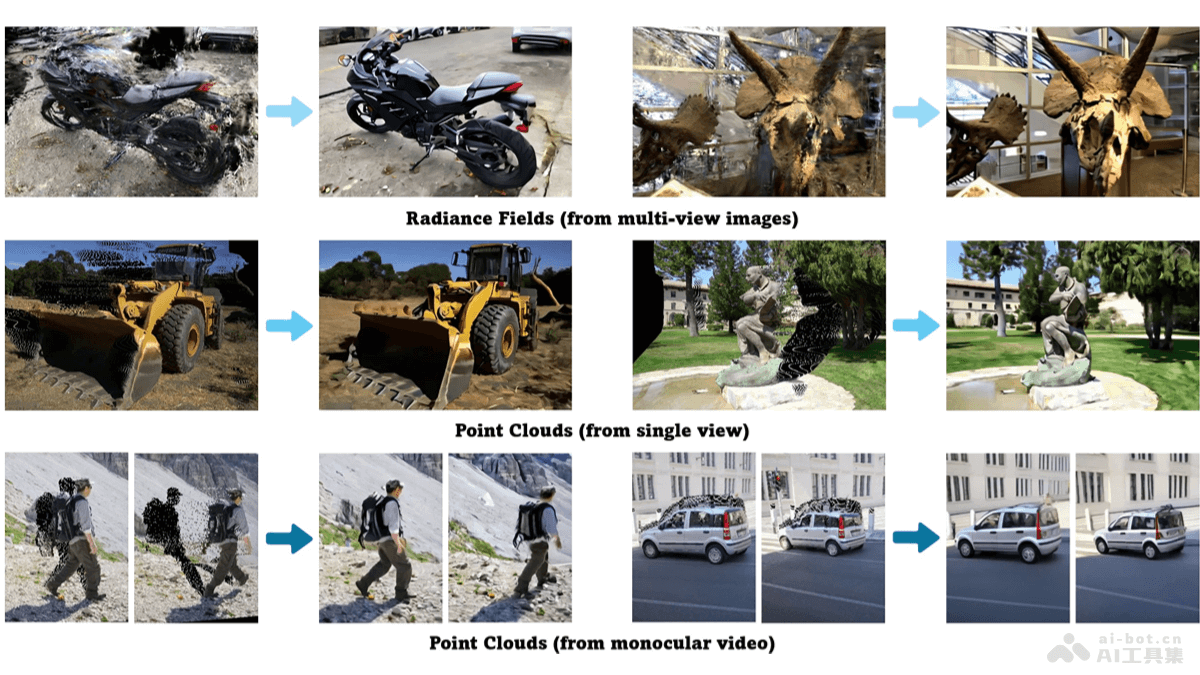
Main Features of ViewExtrapolator
- Novel View Extrapolation: Generates novel view images beyond the training view range, which is crucial for providing immersive 3D experiences and free exploration of reconstructed radiance fields.
- Artifact Reduction: Based on the generative prior of Stable Video Diffusion (SVD), it optimizes artifacts produced by radiance field or point cloud rendering, improving the visual quality of synthesized novel views.
- Data and Computational Efficiency: As an inference-stage method that does not require fine-tuning SVD, it is data- and computationally efficient, making novel view extrapolation more practical and accessible.
- Broad Applicability: It works with different 3D rendering methods, including point cloud rendering derived from single-view or monocular video, offering excellent generality and adaptability.
Technical Principles of ViewExtrapolator
- SVD Denoising Process: Based on the Stable Video Diffusion (SVD) model, the model generates videos by progressively denoising Gaussian noise.
- Guidance Annealing and Resampling Annealing: Introduces guidance annealing and resampling annealing techniques. By applying different levels of guidance at different stages of the denoising process, it effectively repairs unseen regions and improves visual quality.
- Multi-view Consistency: Using SVD's multi-view consistency, it generates natural video details for unobserved parts in radiance field or point cloud rendering, while preserving the original content, including camera motion and scene dynamics.
- No Training Required: Uses SVD's generative prior for novel view extrapolation, making it data- and computationally efficient.
- Flexibility in 3D Rendering: Whether it's a radiance field generated from multi-view images or a point cloud generated from a single view, ViewExtrapolator can handle it and effectively improve rendering quality.
ViewExtrapolator Project Address
- Project Website:kunhao-liu.github.io/ViewExtrapolator
- GitHub Repository:https://github.com/Kunhao-Liu/ViewExtrapolator
- arXiv Technical Paper:https://arxiv.org/pdf/2411.14208
Application Scenarios of ViewExtrapolator
- Virtual Reality (VR) and Augmented Reality (AR): In VR and AR applications, it generates novel views beyond pre-rendered views, enhancing user experience.
- 3D Content Creation: For 3D artists and game developers, it synthesizes complete 3D scenes from limited views, reducing manual modeling workload and accelerating the content creation process.
- Film and Video Production: In film production, it generates views that the camera did not actually capture, or is used to create complex special effects scenes.
- Digitization of Cultural Relics and Historical Sites: For the digital preservation of cultural relics and historical sites, it reconstructs complete 3D models from limited views, making research and display more comprehensive.
- Architectural and Interior Design Visualization: In the fields of architecture and interior design, it helps designers preview design effects from different angles, even if these angles are difficult to achieve in actual photography.