
What is VidTok
VidTok (Video Tokenizer) is an advanced video tokenizer open-sourced by Microsoft. It converts video content into a series of "video words" through efficient algorithms. It supports continuous and discrete tokenization, has flexible compression rates and diverse latent spaces, and is suitable for different application scenarios. VidTok adopts a hybrid model architecture design, combining convolutional layers and up/downsampling modules to reduce computational complexity while maintaining high-quality reconstruction. It introduces finite scalar quantization technology, solving the training instability and codebook collapse problems in traditional vector quantization.
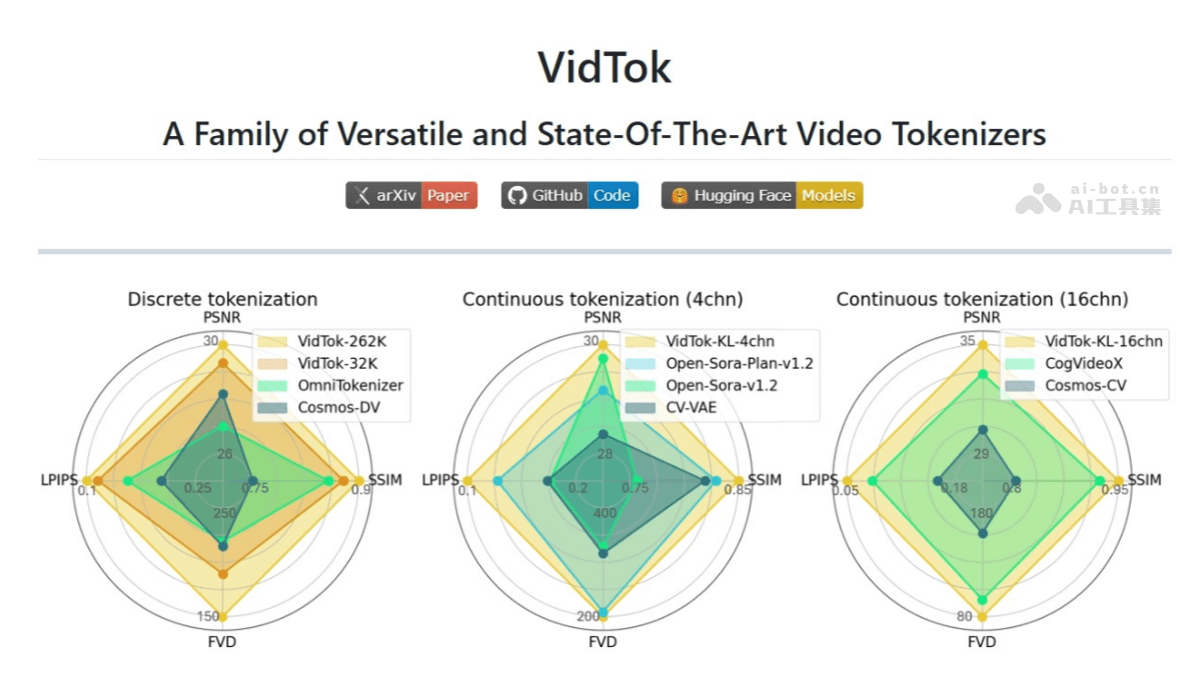
Main Features of VidTok
- Video tokenization: VidTok can convert raw high-dimensional video data (such as images and video frames) into more compact visual Tokens.
- Efficient compression: VidTok works under different compression rate settings, can effectively compress video data while maintaining video quality.
- Continuous and discrete tokenization: VidTok supports both continuous and discrete tokenization methods, adapting to different model and application needs.
- Causal and non-causal model support: VidTok supports causal and non-causal models. Causal models rely only on historical frames for Tokenization, while non-causal models can be based on historical frames and future frame information.
- Diverse latent space support: VidTok supports latent spaces of different sizes, adapting to different video compression rates and model complexity.
- High-performance reconstruction: VidTok performs excellently on multiple video quality evaluation metrics, including PSNR, SSIM, FVD and LPIPS, providing high-quality video reconstruction.
Technical Principles of VidTok
- Efficient hybrid model architecture design: VidTok adopts the classic 3D encoder-decoder structure, and innovatively combines 3D, 2D and 1D convolutions, effectively decoupling spatial and temporal sampling.
- Advanced quantization technology: VidTok introduces finite scalar quantization (FSQ) technology, which is a quantization method that does not require explicitly learning a codebook, significantly improving the model's training stability and reconstruction performance.
- Enhanced training strategy: VidTok adopts a staged training strategy, first pretraining the complete model on low-resolution videos, then fine-tuning only the decoder on high-resolution videos.
VidTok Project Address
- Github repository:https://github.com/microsoft/vidtok
- HuggingFace model library:https://huggingface.co/microsoft/VidTok
- arXiv technical paper:https://arxiv.org/pdf/2412.13061
Application Scenarios of VidTok
- Video generation: VidTok can be used for video generation models, such as Sora, Genie, etc. The model is based on the Tokenizer to convert raw high-dimensional video data into compact visual Tokens, and then uses these Tokens as targets to train the generation model.
- Efficient modeling of video content: Video generation and video-based world models are hot research directions in the field of artificial intelligence. Through efficient modeling of video content, VidTok provides an efficient intermediate medium for models to understand the world.
- Video data compression and representation: Since pixel-level video representation information is highly redundant, VidTok reduces the computational requirements during model training and inference through efficient compression and representation of video data.