
What is ViDoRAG
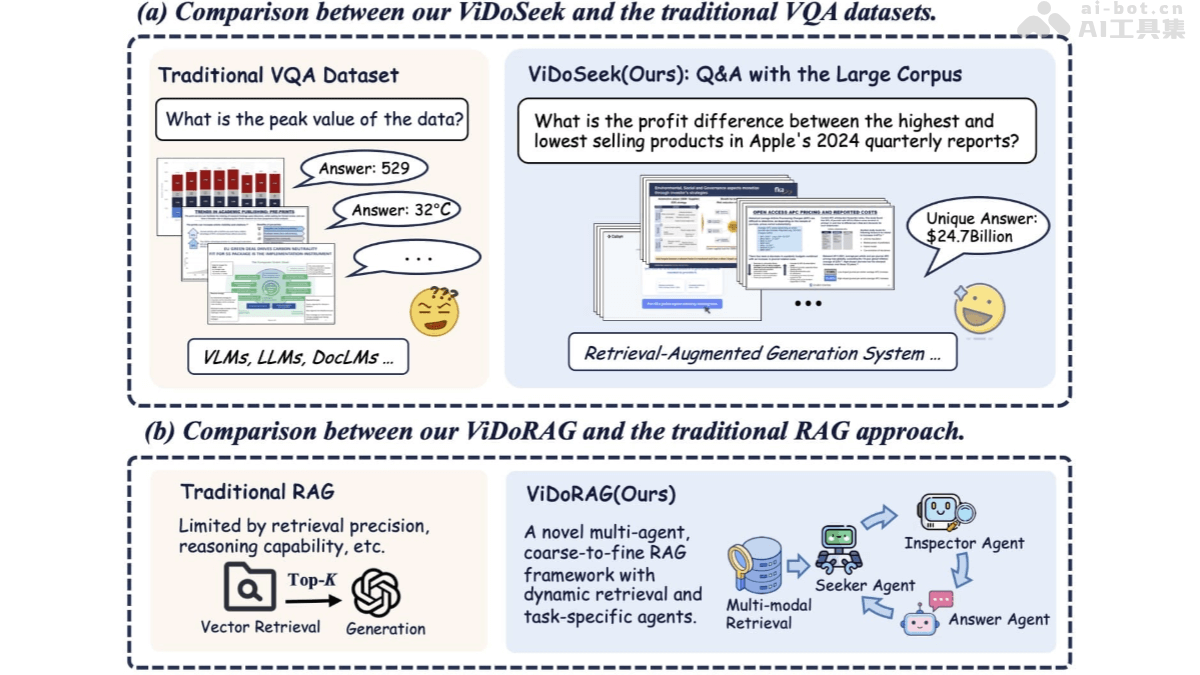
ViDoRAG is a visual document retrieval-augmented generation framework jointly launched by Alibaba Tongyi Lab, the University of Science and Technology of China, and Shanghai Jiao Tong University. Based on multi-agent collaboration and dynamic iterative reasoning, it addresses the limitations of traditional methods in retrieval and reasoning when handling complex visual documents. ViDoRAG uses a multimodal hybrid retrieval strategy based on Gaussian Mixture Models (GMM) to dynamically adjust the number of retrieval results and optimize the integration of textual and visual information. The framework includes three agents: Seeker, Inspector, and Answer, which are respectively responsible for rapid screening, detailed review, and final answer generation. Through iterative interaction, they gradually refine answers and improve generation quality and consistency. ViDoRAG significantly outperforms existing methods on the ViDoSeek benchmark dataset, with an average performance improvement of over 10%, demonstrating its efficiency and superiority in visual document retrieval and reasoning tasks.
Main Features of ViDoRAG
- Multimodal Retrieval: Integrates visual and textual information to achieve precise document retrieval.
- Dynamic Iterative Reasoning: Multi-agent collaboration (Seeker, Inspector, Answer Agent) gradually refines answers and improves reasoning depth and accuracy.
- Complex Document Understanding: Supports single-hop and multi-hop reasoning and handles complex visual document content.
- Generation Consistency Assurance: Ensures the accuracy and consistency of final answers based on the Answer Agent.
- Efficient Generation: Dynamically adjusts the number of retrieval results, reduces computational overhead, and improves generation efficiency.
Technical Principles of ViDoRAG
- Multimodal Hybrid Retrieval: Combines textual and visual retrieval results and dynamically adjusts the number of retrieval results based on Gaussian Mixture Models (GMM). GMM fits the similarity distribution between queries and the document collection, dynamically determines the optimal number of retrieval results (Top-K), avoids the noise and computational overhead caused by fixed-number retrieval, effectively integrates visual and textual information, improves retrieval accuracy, and reduces interference from irrelevant information.
- Dynamic Iterative Reasoning Framework:
- Seeker Agent: Responsible for rapidly screening relevant images or document fragments and providing global clues.
- Inspector Agent: Conducts detailed review of the screening results and provides feedback or preliminary answers.
- Answer Agent: Integrates the Inspector's preliminary answers and verifies consistency to generate the final answer.
- Coarse-to-Fine Generation Strategy: Starts from a global perspective and gradually focuses on local details. Multi-agent collaboration realizes a coarse-to-fine generation process, reduces interference from irrelevant information, and improves generation efficiency and accuracy.
- Reasoning Capability Activation: Based on iterative reasoning and multi-agent collaboration, activates the model's reasoning capabilities, especially when handling complex visual documents, improving the model's performance in multi-hop reasoning and complex document understanding tasks.
- Dynamic Retrieval Length Adjustment: Dynamically adjusts the number of retrieval results based on GMM, avoids the limitations caused by fixed Top-K values, reduces computational overhead, and improves retrieval efficiency and generation quality.
Project Address of ViDoRAG
- GitHub Repository:https://github.com/Alibaba-NLP/ViDoRAG
- arXiv Technical Paper:https://arxiv.org/pdf/2502.18017
Application Scenarios of ViDoRAG
- Education: Helps students and teachers quickly retrieve charts, data, and textual content in textbooks, and generate precise answers and knowledge point summaries.
- Financial Industry: Extract key data and charts from financial reports and market research documents, generate analysis reports, and assist investment decisions.
- Healthcare: Quickly locate charts and data in medical literature to assist doctors in research or generating patient education materials.
- Legal Industry: Retrieve relevant clauses and case charts from legal documents to assist lawyers in analyzing cases or preparing documents.
- Enterprise Knowledge Management: Extract key information from internal documents, quickly answer employee queries, and generate project reports or risk analyses.