
What is VideoWorld
VideoWorld is a research project carried out in collaboration by Beijing Jiaotong University, the University of Science and Technology of China, and ByteDance, exploring whether deep generative models can learn complex knowledge, including rules, reasoning, and planning capabilities, solely from unlabeled video data. The core of the project is an autoregressivevideo generationmodel, which acquires knowledge by observing videos without relying on traditional text or labeled data.
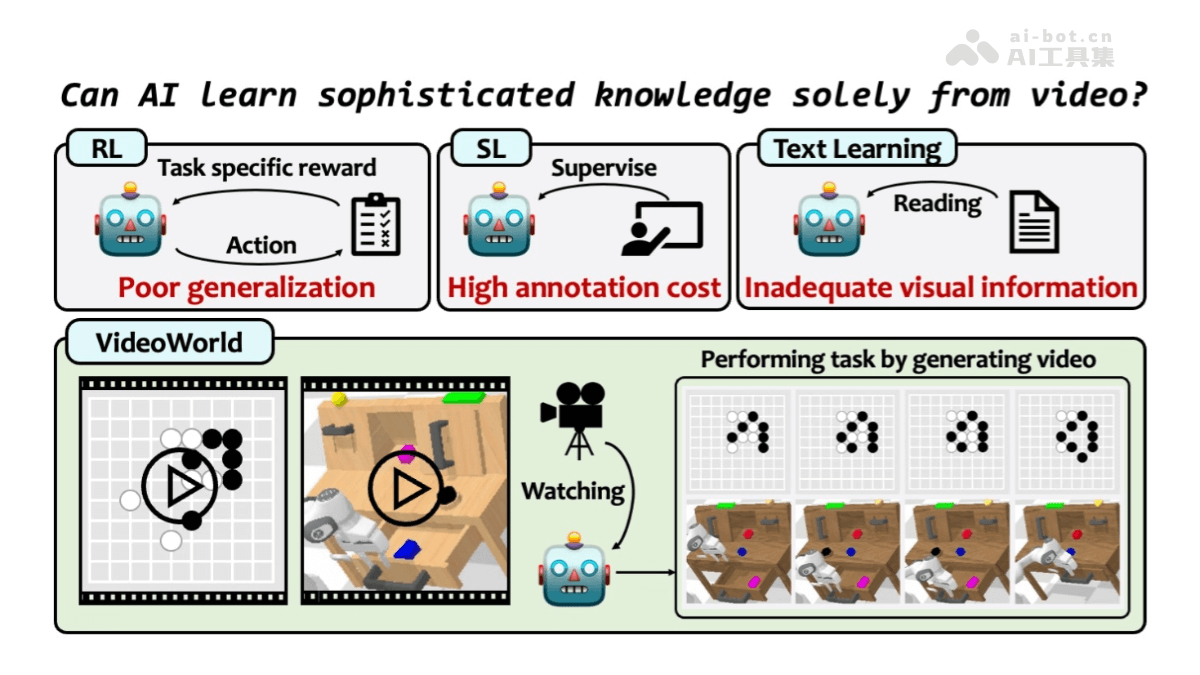
Main Features of VideoWorld
- Learning Complex Knowledge from Unlabeled Videos: VideoWorld can learn complex task knowledge solely from unlabeled video data, including rules, reasoning, and planning capabilities, without relying on language instructions or labeled data.
- Autoregressive Video Generation: Using the VQ-VAE and autoregressive Transformer architecture, VideoWorld can generate high-quality video frames, and infer task-related actions from the generated video frames.
- Long-Term Reasoning and Planning: In Go tasks, VideoWorld can perform long-term planning, select the best move positions, and defeat high-level opponents (such as KataGo-5d). In robot tasks, VideoWorld can plan complex action sequences and complete a variety of robot control tasks.
- Cross-Environment Generalization Capability: VideoWorld can transfer learned knowledge across different tasks and environments, demonstrating good generalization capability.
- Compact Visual Information Representation: LDM compresses lengthy visual information into compact latent codes, reducing information redundancy and improving learning efficiency. This compact representation enables the model to process complex visual dynamics more efficiently and supports long-term reasoning and decision-making.
- Autonomous Learning Without Reinforcement Learning: VideoWorld does not rely on traditional reinforcement learning methods (such as search algorithms or reward mechanisms), but instead autonomously learns complex tasks through pure visual input.
- Efficient Knowledge Learning and Reasoning: VideoWorld achieved a professional 5-dan level (Elo 2317) in Go tasks using only 300 million parameters, demonstrating its efficient knowledge learning capability. In robot tasks, VideoWorld's task success rate is close to that of the oracle model, demonstrating efficient reasoning and decision-making capabilities.
- Deep Understanding of Visual Information: VideoWorld can understand complex visual information through generated video frames and latent codes, supporting task-driven reasoning and decision-making.
- Support for Multiple Task Types: VideoWorld is not only applicable to Go and robot control tasks, but also has the potential to extend to other complex tasks, such as autonomous driving, intelligent surveillance, and other fields.
Technical Principles of VideoWorld
- VQ-VAE (Vector Quantized Variational Autoencoder): Used to encode video frames into discrete token sequences. VQ-VAE maps continuous image features to a discrete codebook through vector quantization, generating discrete representations.
- Autoregressive Transformer: Performs next-token prediction based on discrete token sequences. The Transformer architecture uses an autoregressive mechanism to predict the next frame based on previous frames, thereby generating coherent video sequences.
- Latent Dynamics Model (LDM): Introduces LDM, compressing multi-step visual changes into compact latent codes, improving the efficiency and effectiveness of knowledge learning. LDM can capture short-term and long-term dynamics in videos, supporting complex reasoning and planning tasks.
- Mapping of video generation to task operations: Building on generated video frames, VideoWorld further maps the generated video frames to specific task operations through an Inverse Dynamics Model (IDM). IDM is an independently trained module, typically composed of a multilayer perceptron (MLP), that can predict the corresponding action based on the current frame and the generated next frame.
- Data-driven knowledge learning: VideoWorld learns through large-scale unlabeled video data, reducing dependence on manually labeled data and lowering the cost of data preparation.
VideoWorld project address
- Project official website:https://maverickren.github.io/VideoWorld
- GitHub repository:https://github.com/bytedance/VideoWorld
- arXiv technical paper:https://arxiv.org/pdf/2501.09781
VideoWorld application scenarios
- Autonomous driving: Through video input from onboard cameras, VideoWorld can learn the dynamic changes of the road environment and recognize traffic signs, pedestrians, and obstacles.
- Intelligent surveillance: By observing surveillance videos, VideoWorld can learn patterns of normal and abnormal behavior and detect abnormal events in real time.
- Fault detection: By observing videos of the production process, VideoWorld can learn patterns of normal and abnormal states and detect faults in real time.
- Game AI: Requires a model that can generate reasonable operations based on the game environment and compete against players or other AIs. By observing game videos, VideoWorld can learn game rules and environment dynamics.
- Fault detection: By observing videos of the production process, VideoWorld can learn patterns of normal and abnormal states and detect faults in real time.