
What is VideoVAE+
VideoVAE+ (VideoVAE Plus) is an advanced cross-modal Video Variational Autoencoder (Video VAE) launched by a team from the Hong Kong University of Science and Technology. By introducing a new spatiotemporally decoupled compression mechanism and text guidance, it achieves efficient compression and precise reconstruction of videos with large motion, while maintaining good temporal consistency and motion recovery. VideoVAE+ comprehensively surpasses the latest models in video reconstruction quality, including NVIDIA's Cosmos Tokenizer and others. The model supports high-fidelity reconstruction and cross-modal reconstruction, setting a new benchmark in video reconstruction tasks.
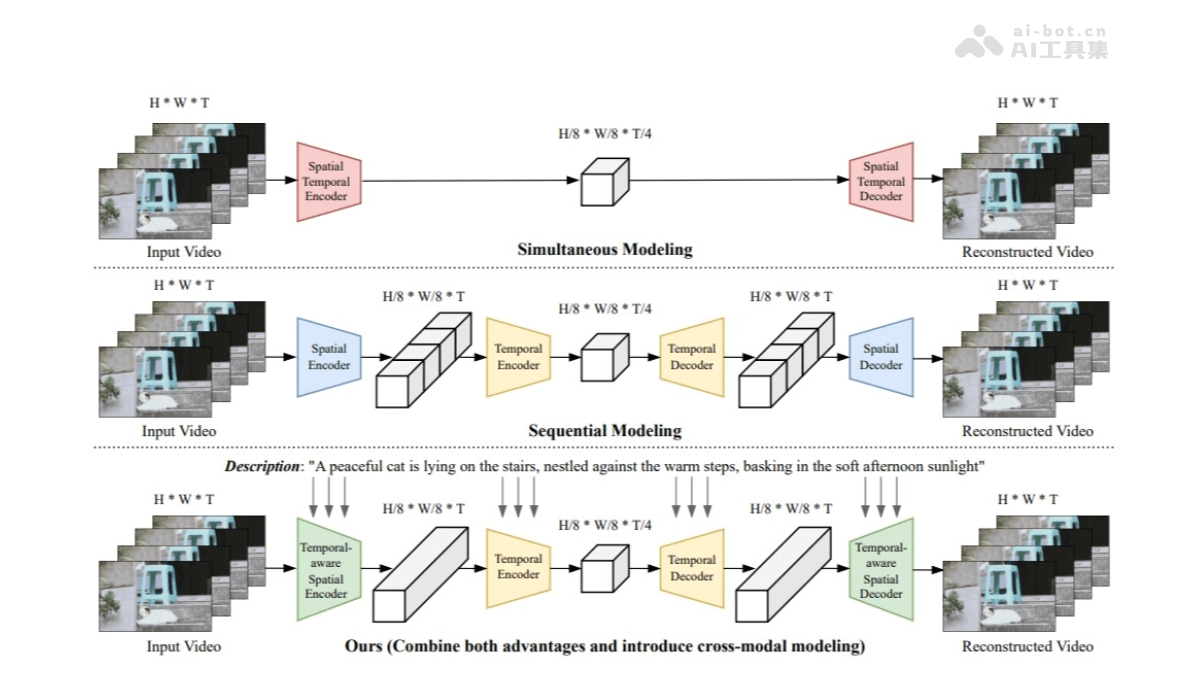
Main Features of VideoVAE+
- High-Fidelity Reconstruction: VideoVAE+ can achieve excellent image and video reconstruction quality, maintaining high clarity and detail even in video scenes with large motion.
- Cross-Modal Reconstruction: The model can guide the video reconstruction process based on text information, improving the ability to preserve video details and temporal stability.
Technical Principles of VideoVAE+
- Spatiotemporally Decoupled Compression Mechanism: VideoVAE+ proposes a temporal-aware spatial compression method that effectively separates spatial and temporal information processing, avoiding motion artifacts caused by spatiotemporal coupling.
- Lightweight Motion Compression Model: A model specifically designed for temporal compression, efficiently capturing motion dynamics in videos.
- Text Information Fusion: Utilizes text information from text-to-video datasets as guidance to improve the ability to preserve video details and temporal stability.
- Joint Training on Images and Videos: Through joint training on image and video data, the model's reconstruction performance and adaptability across multiple tasks are enhanced.
- Intelligent Feature Patching: Splits the visual feature maps of videos into small patches and processes them as tokens. Different layers adopt multiple sizes (8×8, 4×4, 2×2, 1×1), ensuring detailed tracking of features at each layer.
- Cross-Modal Attention Mechanism: For the first time in a Video VAE task, text information is introduced as semantic guidance, allowing visual tokens (as Query) and text embeddings (as Key and Value) to compute cross-modal attention, improving detail reconstruction quality.
- Powerful Text Embedder: Adopts the advanced Flan-T5 model to convert text into semantic vectors, providing a solid semantic foundation for video generation.
VideoVAE+ Project Address
- Github Repository:https://github.com/VideoVerses/VideoVAEPlus
- arXiv Technical Paper:https://arxiv.org/pdf/2412.17805
Application Scenarios of VideoVAE+
- Video Compression: VideoVAE+ achieves efficient video compression by mapping videos to a latent space while maintaining high video quality.
- Video Reconstruction: VideoVAE+ performs excellently in video reconstruction, accurately reconstructing original video information and providing a foundation for generating high-quality videos.
- Online Education: In the field of online education, VideoVAE+'s video generation capability can be used to create teaching videos with virtual teachers, enhancing students' learning interest and engagement.
- Film and Television Post-Production: VideoVAE+'s latent space interpolation and attention mechanism bring revolutionary changes to special effects production. Through interpolation operations in the latent space, transition videos can be generated between two different videos, achieving smooth video transformation effects.
- Video Streaming: VideoVAE+'s efficient compression and high-quality reconstruction capabilities bring a better viewing experience to video streaming platforms. With VideoVAE+, video loading speeds are improved and buffering rates are reduced.