
What is VideoRefer
VideoRefer is jointly launched by Zhejiang University and Alibaba DAMO Academy, specifically designed for perception and reasoning of objects in videos. Based on the spatio-temporal understanding capabilities of enhanced Video Large Language Models (Video LLMs), it enables the model to perform fine-grained perception and reasoning on any object in a video. VideoRefer is implemented based on three core components: the VideoRefer-700K dataset, providing large-scale, high-quality object-level video instruction data; the VideoRefer model, equipped with a versatile spatio-temporal object encoder that supports both single-frame and multi-frame inputs, enabling precise perception, reasoning, and retrieval of any object in a video; and the VideoRefer-Bench benchmark, used to comprehensively evaluate the model's performance in video referring tasks and advance the development of fine-grained video understanding technology.
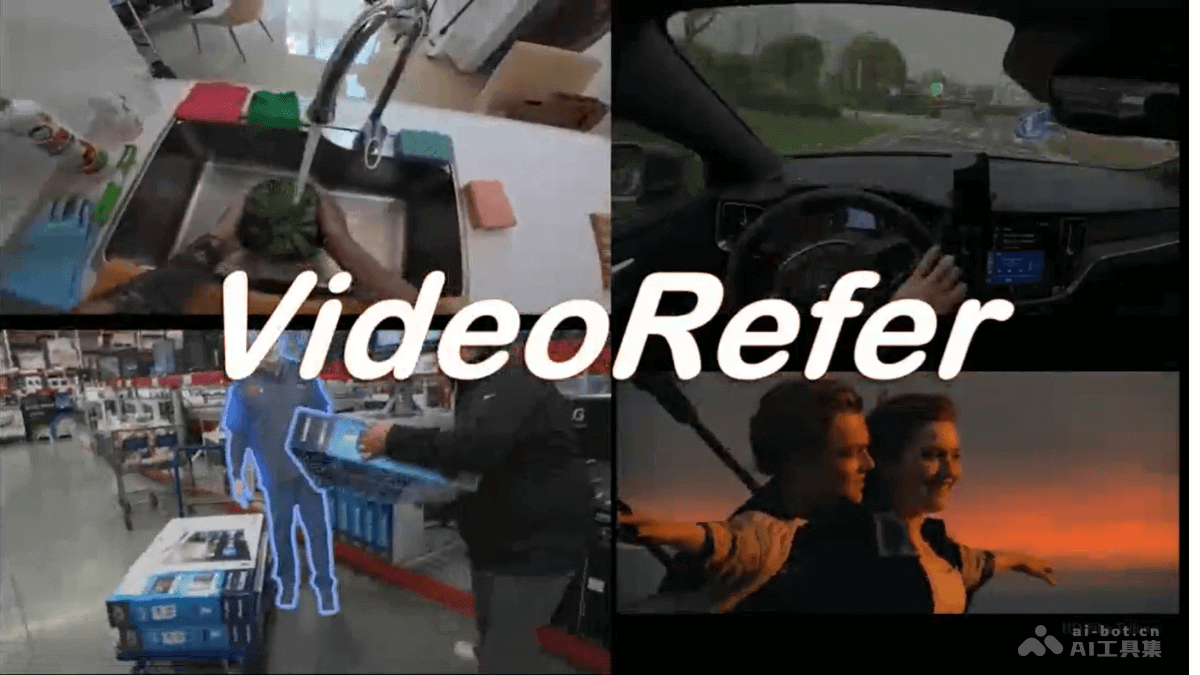
Main Features of VideoRefer
- Fine-grained Video Object Understanding: Accurately perceive and understand any object in a video, capturing detailed information such as the object's spatial position, appearance features, and motion state.
- Complex Relationship Analysis: Analyze complex relationships among multiple objects in a video, such as interactions and relative position changes, and understand the interactions and influences between objects.
- Reasoning and Prediction: Based on understanding of video content, perform reasoning and prediction, such as inferring an object's future behavior or state, and predicting the development trend of events, etc.
- Video Object Retrieval: According to user-specified objects or conditions, retrieve related objects or scene segments from videos, enabling precise video content retrieval.
- Multimodal Interaction: Support multimodal interaction with users, such as interacting with users based on text instructions, voice prompts, or image markers, understanding user needs and providing corresponding video understanding results.
Technical Principles of VideoRefer
- Multi-Agent Data Engine: Launch a multi-agent data engine that uses multiple expert models (such as video understanding models, segmentation models, etc.) to work collaboratively to automatically generate high-quality object-level video instruction data, including detailed descriptions, short descriptions, and multi-turn question-answer pairs, etc., providing sufficient and diverse data support for model training.
- Spatio-Temporal Object Encoder: Design a versatile spatio-temporal object encoder, including a spatial token extractor and an adaptive temporal token merging module. The spatial token extractor is used to extract precise region features of objects from a single frame. The temporal token merging module, in multi-frame mode, merges based on calculating the similarity of object features between adjacent frames, capturing the continuity and changes of objects along the temporal dimension and generating rich object-level representations.
- Fusion and Decoding: Fuse the video's global scene-level features, object-level features, and language instructions into a unified input sequence, send it to a pre-trained Large Language Model (LLM) for decoding, and generate fine-grained semantic understanding results of video content, such as text information including object descriptions, relationship analysis, and reasoning predictions.
- Comprehensive Evaluation Benchmark: Build the VideoRefer-Bench evaluation benchmark, including two sub-benchmarks: description generation and multiple-choice question answering. It comprehensively evaluates the model's performance in video referring tasks from multiple dimensions (such as subject correspondence, appearance description, temporal description, hallucination detection, etc.), ensuring the effectiveness and reliability of the model in fine-grained video understanding.
VideoRefer Project Address
- Project Official Website:https://damo-nlp-sg.github.io/VideoRefer/
- GitHub repository:https://github.com/DAMO-NLP-SG/VideoRefer
- HuggingFace model library:https://huggingface.co/DAMO-NLP-SG/VideoRefer
- arXiv technical paper:https://arxiv.org/pdf/2501.00599
Application scenarios of VideoRefer
- Video editing: Help editors quickly find specific shots or scenes, improving editing efficiency.
- Education: Based on students' learning progress, recommend suitable video clips to support efficient learning.
- Security monitoring: Identify abnormal behavior in surveillance video in real time and issue timely alerts to ensure safety.
- Interactive robots: Control smart home devices based on video instructions to enable convenient home operations.
- E-commerce: Analyze product videos and inspect product quality to ensure that listed products meet standards.