
What is VideoPrism
VideoPrism is a general-purpose video encoder developed by the Google Research team, designed to handle multiple video understanding tasks through a single pre-trained model. This model can extract rich semantic representations from videos, enabling it to achieve high performance and accuracy across different video understanding tasks, such as video classification, localization, retrieval, captioning, and question answering.
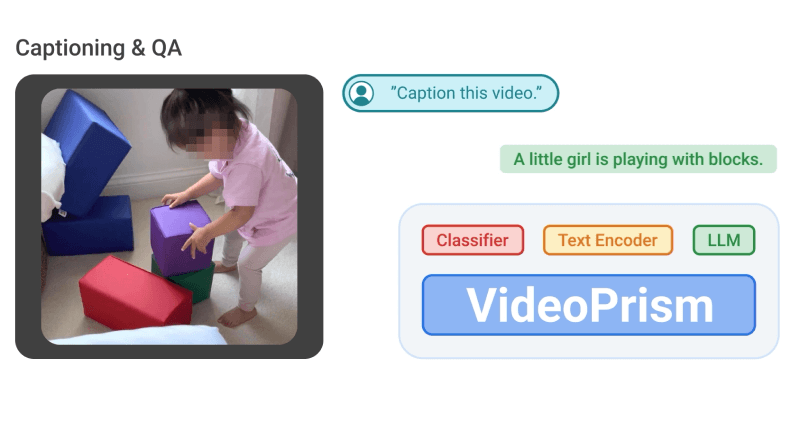
The core design philosophy of VideoPrism lies in its innovations in pre-training data and modeling strategies. It is pre-trained on a large-scale heterogeneous video-text dataset and adopts a two-stage training method (video-text contrastive learning and masked video modeling).
Arxiv research paper:https://arxiv.org/abs/2402.13217
Official project introduction:https://blog.research.google/2024/02/videoprism-foundational-visual-encoder.html
Features of VideoPrism
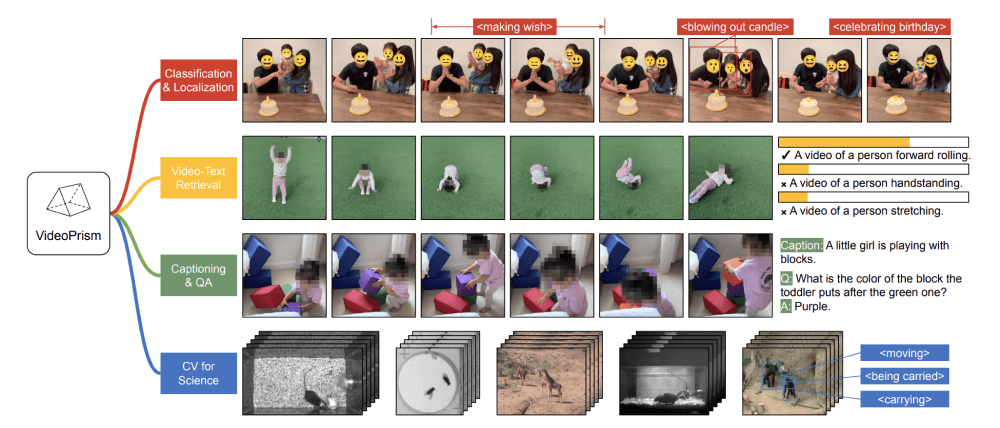
- Video Classification:VideoPrism can classify video content and identify the main activities or events in a video. For example, it can classify videos into different categories, such as sports, cooking, gaming, and more.
- Video Localization:In video localization tasks, VideoPrism can identify the start and end time points of specific actions or events in a video, which is very important for understanding the temporal information of video content.
- Video Retrieval:VideoPrism can perform video-text retrieval, that is, finding relevant video clips based on text descriptions. This is helpful for application scenarios such as content recommendation and video database search.
- Video Captioning:This model can generate descriptive text for videos, helping users quickly understand video content. It is also commonly used for video content management and indexing.
- Video Question Answering:VideoPrism can handle question answering tasks about video content, such as answering questions about events that occur in a video, which requires the model to have an in-depth understanding of the video content.
- Scientific Vision:In the field of scientific research, VideoPrism can be applied to animal behavior analysis, ecological research, and more, helping researchers extract useful information from video data.
- Multimodal Learning:By combining with large language models (such as PaLM), VideoPrism can establish connections between video and language to perform more complex tasks, such as detailed description and explanation of video content.
Technical Principles of VideoPrism
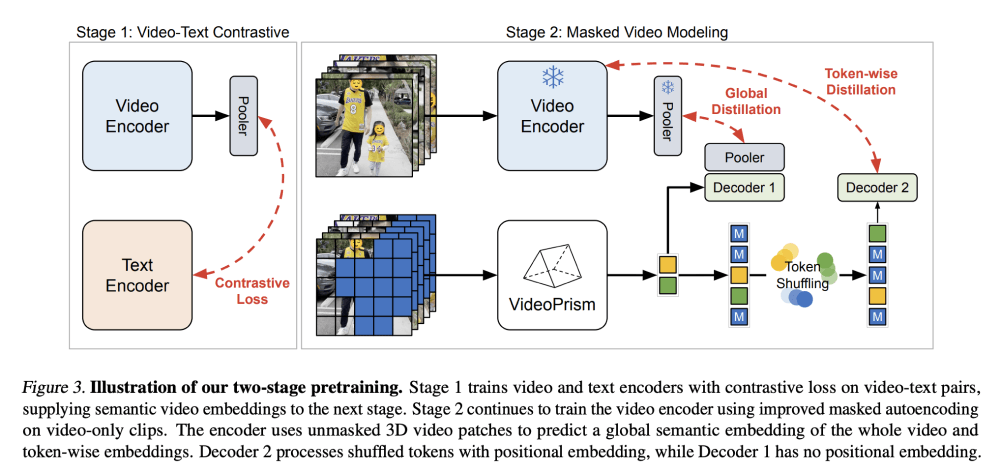
- Pre-training:VideoPrism is first pre-trained on a large-scale heterogeneous video-text dataset,allowing the model to learn rich video representations that can capture the semantic information of video content. This dataset contains36 million high-quality video-title pairs and582 million video clips with noisy parallel text(such as ASR transcription text).
- Video-Text Contrastive Learning:In the first stage of pre-training, VideoPrism aligns video and text representations through contrastive learning. The model attempts to find the correspondence between video content and related text descriptions, thereby learning high-quality features that can describe video content.
- Masked Video Modeling:In the second stage of pretraining, VideoPrism employs masked video modeling to further improve its understanding of video content. This process involves randomly masking a portion of the video (for example, certain frames or clips), and then having the model predict the content of these masked parts, thereby helping the model learn more detailed and comprehensive video representations.
- Global and Local Distillation:In the second stage, VideoPrism also performs global and local distillation, which involves extracting global video representations from the first-stage model and combining them with local details. This distillation process enables the model to better understand the global structure and local dynamics of the video while preserving semantic information.
- Token Shuffling:To improve the model's understanding of video content, VideoPrism introduces a Token Shuffling strategy in the second stage of pretraining. This requires the model to ignore the order of input samples when predicting masked parts, thereby forcing the model to focus more on the video content itself.
- Downstream Task Adaptation:After pretraining is completed, VideoPrism can handle various downstream video understanding tasks through simple adaptation. This usually involves adding specific task heads (for example: classifiers, localizers, or retrievers) on top of the model's output, without the need to fine-tune the main body of the model.