
What is VideoPoet
VideoPoet is an AI video generation solution based on a large model developed by Google's research team. It supports synthesizing high-quality video content from text, image, or video inputs and generates matching audio. The core advantage of VideoPoet lies in its multimodal large model design, which can process and convert different types of input signals. Without the need for specific datasets or diffusion models, it can achieve video output in various styles and motions, and supports generating videos up to 10 seconds long.
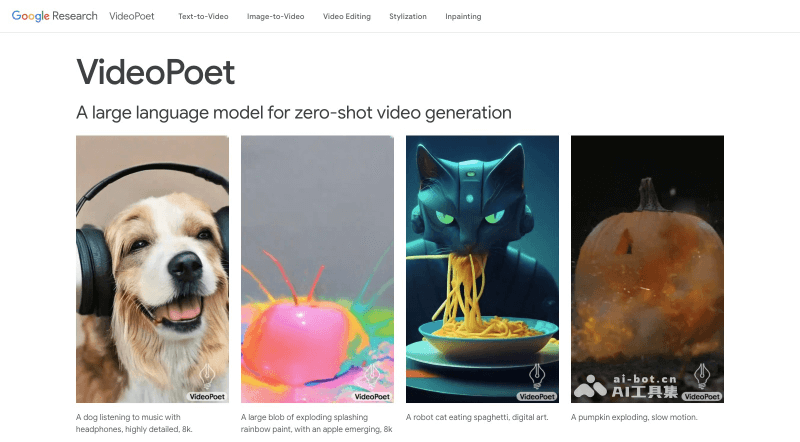
VideoPoet official website entry
- Official project homepage:http://sites.research.google/videopoet/
- Arxiv research paper:https://arxiv.org/pdf/2312.14125.pdf
Main features of VideoPoet
- Text-to-video conversion: VideoPoet can generate corresponding video content based on text descriptions. Users can input a description, and the model will then generate a video clip that matches the description.
- Image-to-video animation: In addition to text, VideoPoet can also generate animations based on static images. For example, users can upload an image, and the model will convert it into a dynamic video.
- Video stylization: VideoPoet can change the style of existing videos, such as converting a video into oil painting style, cartoon style, or other art forms.
- Video editing and extension: The model supports editing videos, such as changing the motion of objects in the video or adding new elements. In addition, it can also extend video content to generate longer video clips.
- Video-to-audio conversion: VideoPoet can also generate audio from video, meaning it can add sound effects or music to silent videos.
- Multimodal learning: VideoPoet supports cross-modal learning, enabling learning and conversion among video, image, audio, and text to achieve more complex creative tasks.
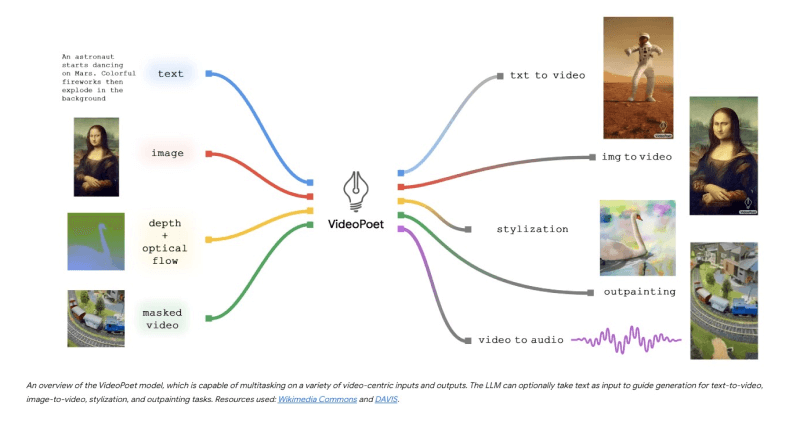
Technical principles of VideoPoet
- Multimodal input processing: VideoPoet can receive and process different types of input signals, such as images, video frames, text, and audio waveforms. These inputs are converted into discrete tokens by specific tokenizers and then processed by the model.
- Decoder architecture: VideoPoet adopts a decoder-only Transformer architecture. This architecture is commonly used for natural language processing (NLP) tasks, but in VideoPoet it is extended to video generation tasks. The decoder can predict an output sequence based on an input token sequence, which in video generation means being able to generate continuous video frames.
- Pretraining and task adaptation: VideoPoet's training is divided into two stages. In the pretraining stage, the model is trained within an autoregressive transformer framework through multiple multimodal generation objectives. This provides the model with a strong foundation that can adapt to various video generation tasks. In the task adaptation stage, the pretrained model can be further fine-tuned to improve the generation quality for specific tasks or perform new tasks.
- Multimodal vocabulary: To handle different types of input, VideoPoet builds a unified multimodal vocabulary. This vocabulary contains tokens for images, videos, and audio, enabling the model to understand and generate cross-modal content.
- Autoregressive generation: VideoPoet employs an autoregressive approach when generating videos, which means the model takes into account information from all previous frames when generating each frame. This approach helps maintain the coherence and consistency of the video content.
- Super-Resolution Module: To improve the resolution and quality of video output, VideoPoet introduces a dedicated spatial super-resolution (SR) transformer module. This module works on top of the language model's output, improves computational efficiency through a local window attention mechanism, and generates higher-resolution videos.
- Zero-Shot Video Generation: VideoPoet demonstrates the ability to handle new text, image, or video inputs without having seen the distribution of the specific input data, which is called zero-shot video generation. This indicates that the model has strong generalization ability.
- Task Chaining: Because VideoPoet learned multiple tasks during the pretraining stage, it can chain these tasks together to perform new tasks that were not explicitly taught during training, such as video editing and stylization.