
What is VideoMaker
VideoMaker is an innovative project jointly developed by Zhejiang University, Tencent, and Huawei Noah's Ark Lab, a zero-shot customized video generation framework based on video diffusion models (VDM). Unlike traditional methods, VideoMaker can directly extract and inject subject features from reference images without additional models, enabling one-click generation of personalized video content. The framework performs fine-grained feature extraction based on the intrinsic capabilities of VDM and achieves feature injection through spatial self-attention mechanisms, ensuring the diversity of video generation and subject consistency. While maintaining video diversity, VideoMaker ensures a high degree of alignment with the subject features in the reference images, bringing great convenience and flexibility to personalized video creation.
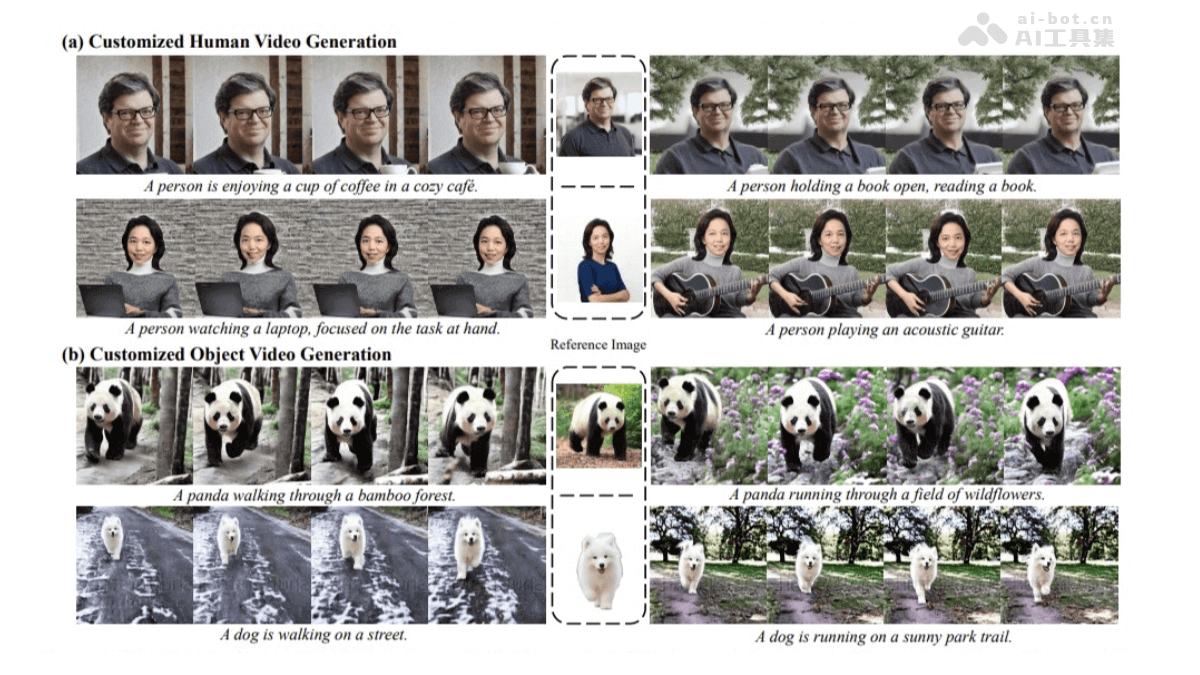
Main features of VideoMaker
- Fine-grained feature extraction: VideoMaker can directly leverage the intrinsic capabilities of video diffusion models (VDM) to extract richly detailed subject features from provided reference images.
- Feature injection: Through the spatial self-attention mechanism of VDM, VideoMaker can effectively inject the extracted subject features into each frame of the video during video generation, ensuring that the video content remains highly consistent with the reference images.
- Video content generation: While maintaining consistency with the subject appearance in the reference images, VideoMaker can also ensure the diversity and dynamism of the generated video, avoiding monotonous and repetitive content.
- No additional training required: VideoMaker does not require complex retraining or parameter tuning of VDM; only simple fine-tuning is needed to activate the model's intrinsic power and achieve customized video generation.
- High fidelity: Videos generated by VideoMaker can maintain high fidelity, accurately presenting the appearance and dynamic features of either people or objects in the video.
Technical principles of VideoMaker
- Video diffusion models (VDM): VDM is the core of VideoMaker, learning the distribution of video data through progressive denoising to generate videos.
- Feature extraction: VideoMaker directly inputs reference images into VDM and uses VDM's pre-trained knowledge for fine-grained feature extraction; these features are highly aligned with VDM's knowledge system.
- Spatial self-attention mechanism: VideoMaker achieves feature injection by modifying the spatial self-attention computation in VDM. This mechanism allows the model to perform bidirectional interaction between subject features and generated content when generating each frame of the video, ensuring accurate presentation of subject features.
- Guidance information recognition loss: To distinguish reference information from generated content during training, VideoMaker designs a loss function that helps the model more accurately recognize and process reference information.
- Training and inference paradigm: During the training phase, VideoMaker effectively injects subject information by fine-tuning the spatial self-attention layers and motion block parameters of VDM. During inference, the outputs corresponding to the reference information are directly discarded to ensure that the generated video is not disturbed by noise.
Project address of VideoMaker
- Project official website:https://wutao-cs.github.io/VideoMaker/
- arXiv technical paper:https://arxiv.org/pdf/2412.19645
Application scenarios of VideoMaker
- Film and television production: In the pre-production of films or TV series, VideoMaker can be used to generate specific scenes and actions, helping directors and producers preview and plan.
- Virtual idols: Generate diverse video content for virtual idols to enhance their interaction with fans and influence.
- Product Demonstration: Enterprises can use VideoMaker to demonstrate the effects of products in different environments, such as the effects of furniture in different decoration styles, and the performance of cars under different road conditions.
- Customized Advertising: Customize personalized advertising videos according to the target customer group to improve the appeal and marketing effectiveness of the advertisement.
- Instructional Videos: Teachers can create vivid instructional videos, such as demonstrations of physics and mechanics principles, displays of chemical experiment phenomena, and reenactments of historical events, to enhance the learning experience.
- Animation Game Design: Game designers can quickly generate preliminary character animation videos by inputting character sketches and action design concept art, and evaluate the smoothness of character movements and visual effects.