
What is VideoLLaMA3
VideoLLaMA3 is an open-source frontier multimodal foundation model from Alibaba, focused on image and video understanding. Based on the Qwen 2.5 architecture, it combines advanced visual encoders (such as SigLip) with powerful language generation capabilities, can efficiently process long video sequences, and supports multilingual video content analysis and visual question answering tasks. The model has strong multimodal fusion capabilities, supports video and image inputs, generates natural language descriptions, and is suitable for multiple scenarios such as video content analysis, visual question answering, and multimodal applications. VideoLLaMA3 offers multiple pretrained versions (such as 2B and 7B parameter scales), is optimized for large-scale data, and has efficient spatiotemporal modeling capabilities and cross-language understanding capabilities.
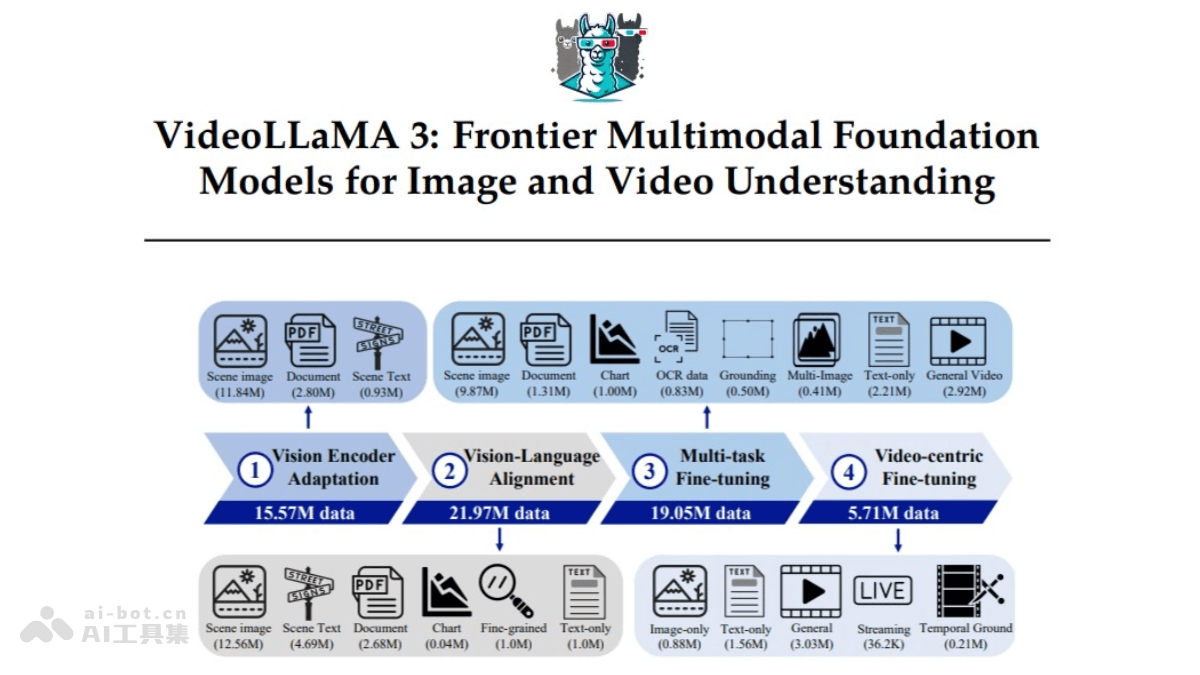
Main features of VideoLLaMA3
- Multimodal input and language generation: Supports multimodal input of video and images, can generate natural language descriptions, and helps users quickly understand visual content.
- Video content analysis: Users can upload videos, and the model will provide detailed natural language descriptions, suitable for quickly extracting core video information.
- Visual question answering: By combining questions with video or image input, the model can generate accurate answers, suitable for complex visual question answering tasks.
- Multilingual support: Has cross-language video understanding capabilities and supports multilingual generation.
- Efficient spatiotemporal modeling: Optimized spatiotemporal modeling capabilities enable it to process long video sequences, suitable for complex video understanding tasks.
- Multimodal fusion: Combines video and text data for content generation or classification tasks, improving the model's performance in multimodal applications.
- Flexible deployment methods: Supports local deployment and cloud inference, adapting to different usage scenarios.
Technical principles of VideoLLaMA3
- Vision-centric training paradigm: The core of VideoLLaMA3 lies in high-quality image-text data, not large-scale video-text data. Its training is divided into four stages:
- Visual alignment stage: Warms up the visual encoder and projector to prepare for subsequent training.
- Vision-language pretraining stage: Uses large-scale image-text data (such as scene images, documents, charts) and plain text data to jointly tune the visual encoder, projector, and language model.
- Multi-task fine-tuning stage: Combines image-text data for downstream task optimization and introduces video-text data to establish a foundation for video understanding.
- Video-centric fine-tuning stage: Further improves the model's performance in video understanding tasks.
- Vision-centric framework design: The visual encoder is optimized to generate a corresponding number of visual tokens based on image size, rather than a fixed number of tokens, better capturing fine-grained details in images. For video input, the model improves the precision and compactness of representations by reducing the number of visual tokens.
- Multimodal fusion based on the Qwen 2.5 architecture: VideoLLaMA3 is based on the Qwen 2.5 architecture and combines advanced visual encoders (such as SigLip) with powerful language generation capabilities, enabling efficient handling of complex visual and language tasks.
VideoLLaMA3 project address
- GitHub repository:https://github.com/DAMO-NLP-SG/VideoLLaMA3
- HuggingFace Model Library:https://huggingface.co/papers/2501.13106
- arXiv Technical Paper:https://arxiv.org/pdf/2501.13106
Application Scenarios of VideoLLaMA3
- Video Content Analysis: VideoLLaMA3 can deeply understand and analyze long video content, capturing subtle movements and long-term memory in videos. It can automatically detect abnormal behavior in videos or generate detailed video descriptions, helping users quickly understand the core content of videos.
- Video Question Answering System: In video question answering (VideoQA) tasks, users can ask questions about video content, and VideoLLaMA3 can generate accurate answers.
- Video Subtitle Generation: Based on its streaming subtitle generation capability, VideoLLaMA3 can automatically generate real-time subtitles for videos.
- Multilingual Support: VideoLLaMA3 supports multilingual generation and can handle cross-lingual video understanding tasks. It has broad application potential in internationalized video content analysis and multilingual education scenarios.