
What is VideoJAM
VideoJAM is introduced by Meta and is used to enhancevideo generationmodels' motion coherence framework. By introducing a joint appearance-motion representation, it enables the model to simultaneously learn to predict the pixel and motion information of videos during the training stage, and during the inference stage uses the model's own motion predictions as dynamic guidance signals to generate more coherent motion. VideoJAM adds motion prediction to the training objective and adopts the Inner-Guidance mechanism during inference, significantly improving motion coherence in video generation while maintaining visual quality. VideoJAM is general-purpose and can be applied to any video generation model without modifying the training data or scaling up the model, surpassing existing state-of-the-art models on multiple benchmarks and providing new ideas for the development of video generation technology.
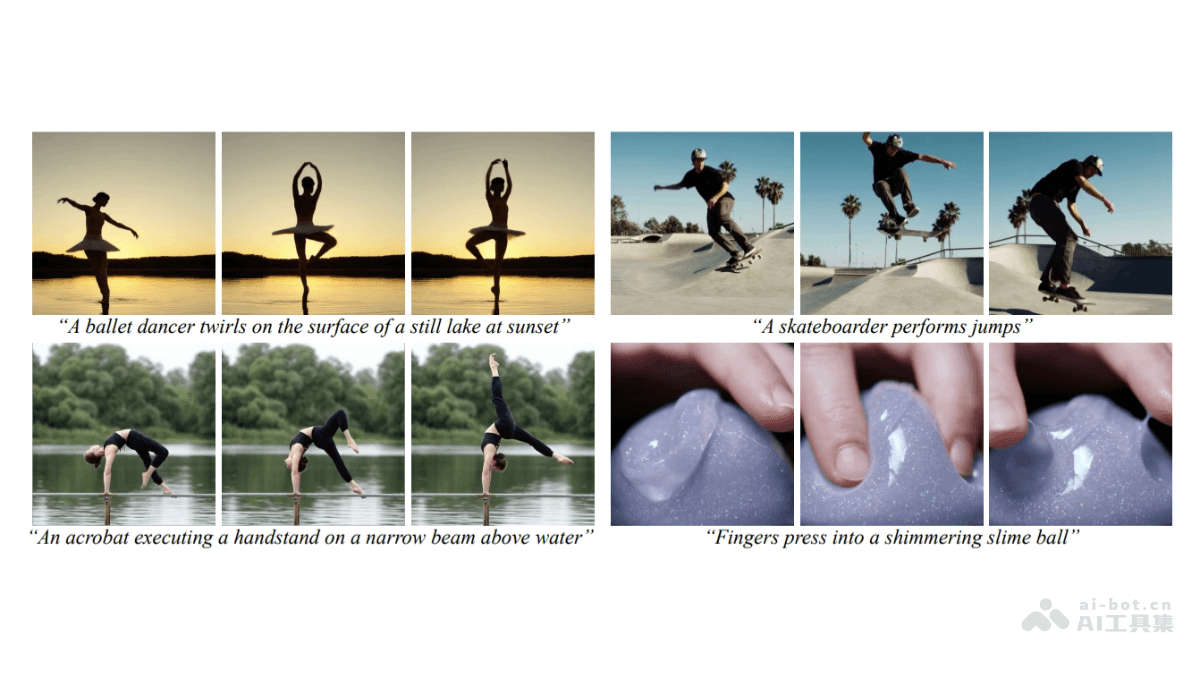
Main Features of VideoJAM
- Improved motion coherence: Based on jointly learning appearance and motion, it generates more natural and more coherent motion, reducing distortion and physical errors in video generation.
- Improved visual quality: While improving motion coherence, it optimizes the overall visual quality of generated videos, making them look more realistic.
- General-purpose: VideoJAM can be applied to any video generation model without modifying the training data or model scale, and has broad applicability.
- Dynamic guidance mechanism: During the inference stage, the model's own motion predictions are used as dynamic guidance signals to ensure that the generated videos are more reasonable and coherent in motion.
Technical Principles of VideoJAM
- Joint appearance-motion representation:
- Training stage: During training, VideoJAM not only predicts the pixels (appearance) of videos but also predicts the motion information of videos (such as optical flow). To this end, it adds a linear layer at the model's input to merge the video and motion information into a joint representation, and adds another linear layer at the output to extract motion predictions from the joint representation. The objective function is also modified to simultaneously optimize the prediction of appearance and motion.
- Motion representation: VideoJAM uses optical flow as the motion representation, converting optical flow into RGB video so that the model can process motion information.
- Dynamic guidance mechanism (Inner-Guidance): When generating videos, VideoJAM uses the model's own continuously evolving motion predictions as dynamic guidance signals. Based on modifying the sampling distribution, it guides the generation process toward coherent motion. This mechanism ensures that the generated videos are more reasonable and natural in motion.
- General-purpose and adaptable: VideoJAM's design is very general-purpose; it only requires adding two linear layers to an existing video generation model and making minor modifications to the objective function. It does not require additional training data or expansion of model scale, and can be easily applied to various video generation models.
VideoJAM Project Address
- Project website:https://hila-chefer.github.io/videojam
- Technical paper:https://hila-chefer.github.io/videojam-paper.github.io/VideoJAM_arxiv.pdf
Application Scenarios of VideoJAM
- Entertainment and film production: Generate creative videos, animations, and special effects, improving production efficiency and visual effects, suitable for advertising, science fiction, or action videos, etc.
- Game development: Generate character actions and special effects animations in games, optimize game performance, and also enable rapid prototyping during game testing and development.
- Education and training: Generate simulated training videos in military, aviation, medical and other fields to help trainees familiarize themselves with operating procedures; it can also be used in online education to create vivid instructional videos.
- Advertising and Marketing: Create attractive advertising videos and product demonstration videos for social media, television advertising, etc., to enhance brand influence and product presentation effectiveness.
- Social Media and Content Creation: Help users quickly generate interesting, high-quality video content, meet creators' diverse needs, and enhance social media interactivity.