
What is VideoGigaGAN
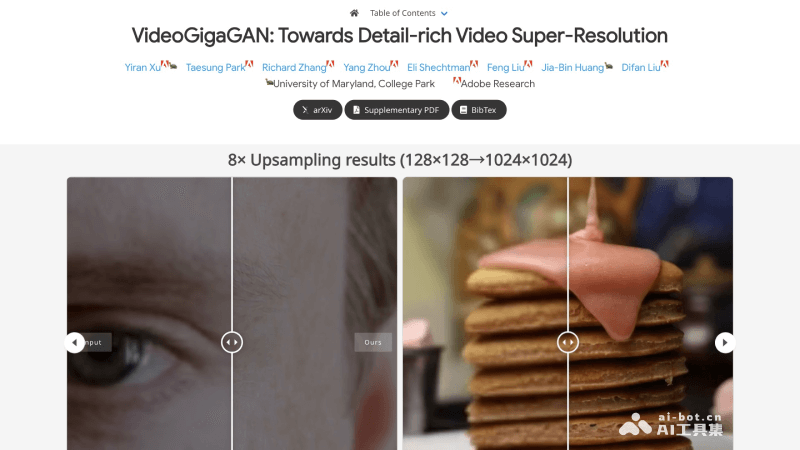
VideoGigaGAN is a novel generative video super-resolution (VSR) model proposed by researchers from Adobe and the University of Maryland. It can upscale video resolution by up to 8x, enlarging blurry videos into high-definition videos with rich details and temporal coherence. The model is based on the large-scale image upsampler GigaGAN and, through innovative technical means such as flow-guided feature propagation, anti-aliasing processing, and high-frequency shuttle, solves the blurriness and flickering issues in traditional VSR methods, significantly improving temporal consistency and high-frequency detail performance after video upsampling.
VideoGigaGAN Features
- Efficient Video Super-Resolution: VideoGigaGAN can convert standard or low-resolution video content into high-resolution format, significantly improving video clarity and watchability.
- Detail Enhancement and Preservation: While improving resolution, the model focuses on preserving high-frequency video details, such as fine textures and sharp edges, avoiding the blurriness and distortion common in traditional upscaling methods.
- Inter-Frame Coherence Optimization: Through advanced technical means, VideoGigaGAN ensures smooth and natural transitions between consecutive frames in a video, effectively avoiding temporal flickering and inconsistency issues and providing a coherent viewing experience.
- Fast Rendering Capability: The model has fast processing capability and can complete video super-resolution processing in a short time, making it suitable for application scenarios that require rapid conversion or real-time processing.
- High-Magnification Video Upscaling: It supports video upscaling ratios of up to 8x, providing strong technical support for professional applications that require significantly improved video resolution, such as video editing and visual effects production.
- Comprehensive Video Quality Improvement: In addition to improving resolution, VideoGigaGAN also improves the overall image quality of videos, including color, contrast, and detail levels, making video content more vivid and realistic.
- Generate Highly Realistic Videos: Utilizing a powerful generative adversarial network architecture, VideoGigaGAN can generate high-resolution videos close to natural filming effects, meeting the needs of high-end video production.
VideoGigaGAN Official Website Entry
- Official Project Homepage:https://videogigagan.github.io/
- arXiv Research Paper:https://arxiv.org/abs/2404.12388
VideoGigaGAN Technical Principles
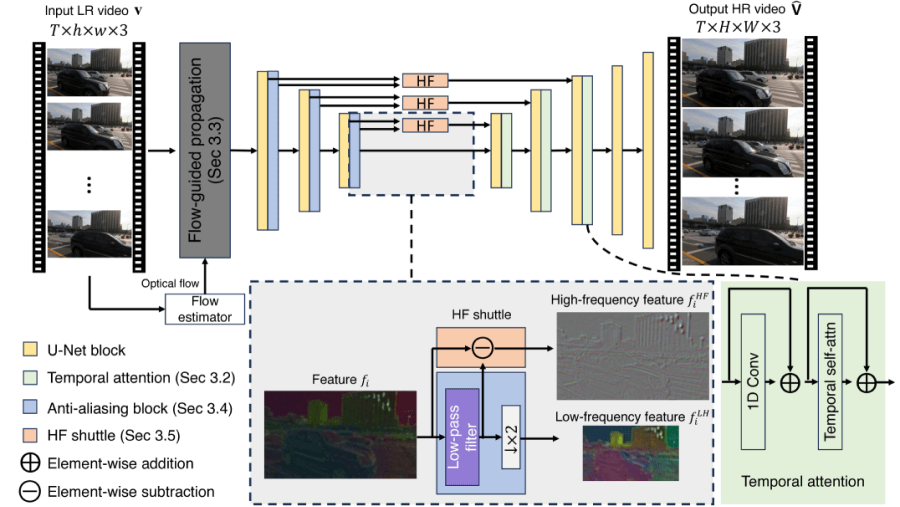
- Base Architecture: VideoGigaGAN is built onGigaGANimage upsampler. GigaGAN is a large-scale generative adversarial network (GAN) capable of high-quality image upsampling.
- Temporal Module Extension: To apply GigaGAN to video processing, the researchers extended the 2D image module to a 3D temporal module by adding temporal convolution layers and temporal self-attention layers in the decoder to process video sequences.
- Flow-Guided Feature Propagation: To improve temporal consistency between video frames, VideoGigaGAN adopts a flow-guided feature propagation module. This module uses a bidirectional recurrent neural network (RNN) and an image de-warping layer to align and propagate features based on optical flow information.
- Anti-Aliasing Processing: To reduce temporal flickering in high-frequency detail regions, VideoGigaGAN uses anti-aliasing blocks (BlurPool) in the encoder's downsampling layers instead of traditional strided convolution to reduce aliasing effects.
- High-Frequency Feature Shuttle (HF Shuttle): To compensate for high-frequency details that may be lost during the upsampling process, VideoGigaGAN transmits high-frequency features directly to the decoder layers through skip connections.
- Loss Functions: During training, VideoGigaGAN uses a variety of loss functions, including the standard GAN loss, R1 regularization, LPIPS loss, and Charbonnier loss, to optimize model performance.
- Training and Inference: VideoGigaGAN jointly optimizes the flow-guided feature propagation module and the extended GigaGAN model during training. During inference, the flow-guided module is first used to generate frame features, and then the features are fed into the GigaGAN blocks for upsampling.
- Datasets and Evaluation: Standard VSR datasets such as REDS and Vimeo-90K are used for training and testing, and the model's upsampling quality is evaluated through metrics such as PSNR, SSIM, and LPIPS.
Application Scenarios of VideoGigaGAN
- Video Quality Enhancement: For old movies, home videos, or any low-resolution video material, VideoGigaGAN can increase their resolution, improve image quality, and make them more suitable for modern playback devices.
- Video Security Monitoring: In the field of security monitoring, VideoGigaGAN can help improve the clarity of videos, thereby better identifying and analyzing objects or events in the video.
- Video Editing and Post-Production: In video editing and post-production, VideoGigaGAN can be used to increase the resolution of original videos to meet the requirements of high-quality output.
- Video Transmission and Storage: When bandwidth is limited, reducing the transmission resolution of videos can reduce the amount of data transmitted. VideoGigaGAN can upsample the video to high resolution at the receiving end to improve the viewing experience.
- Video Security and Authentication: In scenarios where the authenticity of video content needs to be verified, VideoGigaGAN can help restore video details and assist in determining the authenticity of the content.