
What is VideoAnydoor
VideoAnydoor is a zero-shot video object insertion framework jointly launched by the University of Hong Kong, Alibaba Group DAMO Academy, Hupan Lab, and Huazhong University of Science and Technology. It can insert specific objects into videos with high fidelity and precise motion control. VideoAnydoor is based on a text-to-video diffusion model, using an ID extractor to inject global identity information and box sequences to guide overall motion. The core of the framework is the pixel deformer module. VideoAnydoor accepts reference images with keypoints and trajectories as input, deforms pixel details according to the trajectories, and fuses them with the diffusion U-Net to preserve details, supporting fine-grained motion control. VideoAnydoor combines training strategies for videos and static images, and introduces a reweighted reconstruction loss to improve insertion quality.
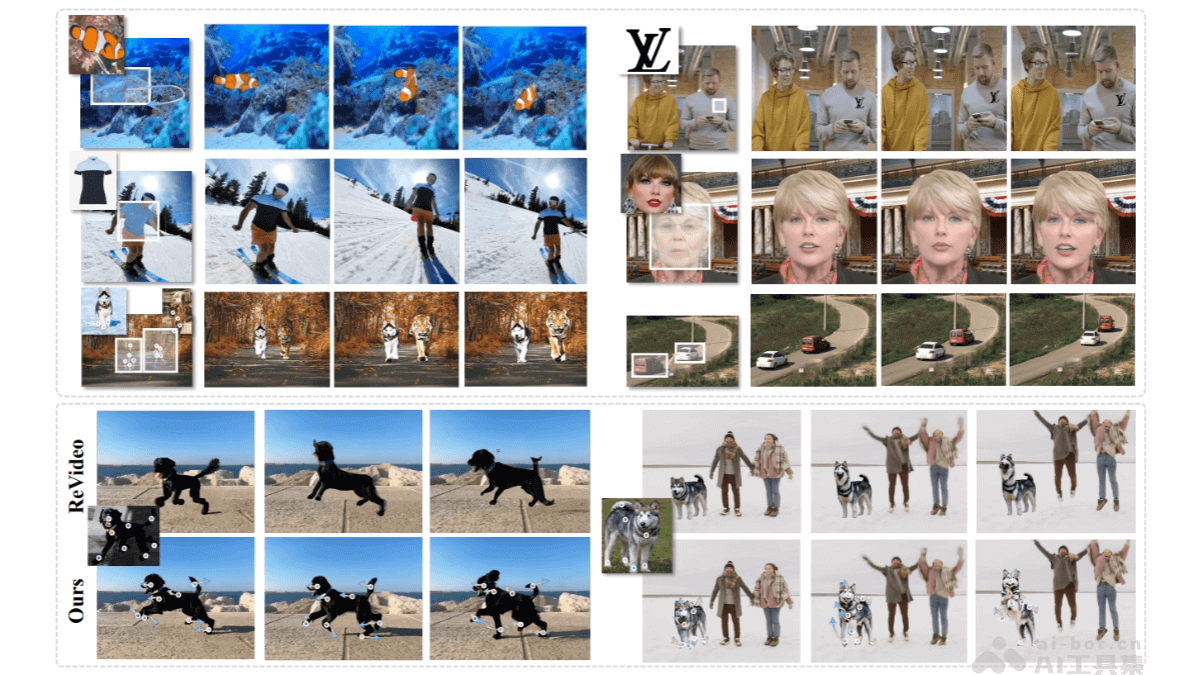
Main Features of VideoAnydoor
- High-fidelity video object insertion: Insert specified objects into target videos with high fidelity, preserving fine appearance details of the objects.
- Precise motion control: Support users in precisely controlling the motion of inserted objects based on box sequences or point trajectories, achieving natural integration with the video background.
- Multi-region editing: Support simultaneous editing of multiple regions in a video, such as inserting multiple objects or performing different editing operations in different regions.
- Diverse application support: Seamlessly support a variety of downstream applications, including video virtual try-on, video face swapping, multi-region editing, etc., without the need for task-specific fine-tuning.
Technical Principles of VideoAnydoor
- Based on text-to-video diffusion models: Based on text-to-video diffusion models, using a combination of random noise, object masks, and masked videos as input to generate video content that matches the text description.
- ID extractor: Extract compact and discriminative ID tokens from background-free reference images, inject them into the diffusion model, preserve the global identity information of the object, and ensure the identity consistency of the inserted object in the video.
- Pixel deformer module: Accept reference images with arbitrary keypoints and corresponding keypoint trajectories as input, deform pixel details according to the trajectories, achieve precise motion control of the object, fuse the deformed features with the diffusion U-Net, and improve detail preservation capability.
- Training strategy optimization: Combine training strategies for videos and static images, enhance insertion quality based on a reweighted reconstruction loss, and use high-quality image data augmentation for video training to compensate for the scarcity of high-quality video data.
Project Address of VideoAnydoor
- Project official website:videoanydoor.github.io
- arXiv technical paper:https://arxiv.org/pdf/2501.01427
Application Scenarios of VideoAnydoor
- Film and television special effects production: In science fiction films, insert virtual alien creatures or futuristic technological equipment into real-shot scenes, naturally integrating with the environment, enhancing the film's visual impact and the audience's sense of immersion.
- Virtual try-on advertising: Create advertisements for newly launched sneakers, insert the model's virtual image into various sports scenes, such as basketball courts, football fields, etc., to demonstrate the comfort and performance of the sneakers under different sports conditions, attracting sports enthusiasts' attention and purchases.
- Virtual tourism experience: Create virtual tourism videos for popular island tourism destinations by inserting tourists' avatars into island scenes such as beaches and diving, allowing tourists to experience the beautiful scenery and relaxed atmosphere of the islands from home, and stimulating tourists' interest in travel.
- Education and Training
- Virtual Experiments and Teaching: In chemistry experiment teaching, insert virtual chemical reaction processes into instructional videos to help students understand chemical principles and experimental phenomena more intuitively, improving learning outcomes.
- Social Media and Content Creation
- Personalized Video Creation: When users share their travel experiences on social media, they insert their own photos or video clips into videos of famous attractions around the world, creating unique travel videos and increasing interactivity and fun.