
What is VideoAgent
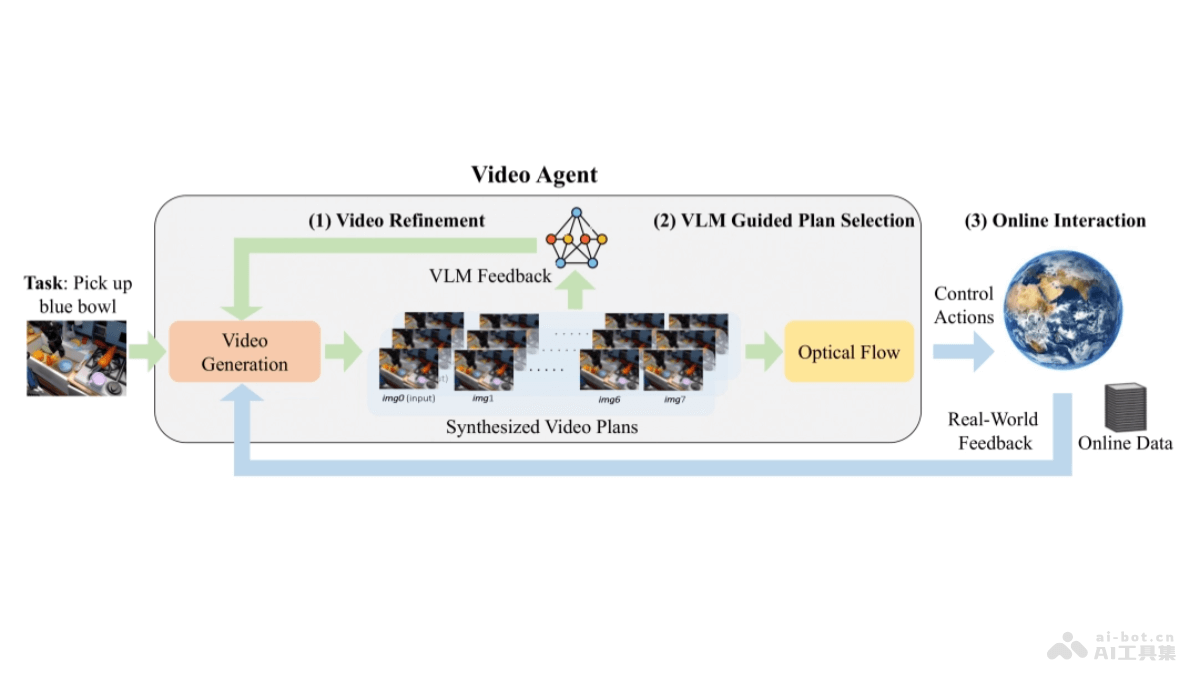
VideoAgent is a self-improving video generation system jointly launched by researchers from Stanford University, the University of Waterloo, DeepMind, and other institutions. It generates video plans based on image observations and language instructions, and converts them into robot control actions. VideoAgent refines video plans based on the self-conditioning consistency method, using feedback from a pretrained vision-language model (VLM) for iterative optimization. During execution, VideoAgent collects environmental data to further improve the quality of video generation, effectively reducing hallucinated content in videos and increasing task success rates. The system performs excellently in simulated environments, can improve real robot videos, and provides new possibilities for applying video generation technology in the real world.
Main features of VideoAgent
- Video plan generation: Based on given image observations and language instructions, generates video plans used to control robotic systems.
- Self-improvement: Based on external feedback, such as feedback from a pretrained vision-language model (VLM) and real-world execution feedback, iteratively improves the generated video plans.
- Video refinement: Uses the self-conditioning consistency method to optimize low-quality video samples into high-quality videos.
- Online execution and data collection: Executes video plans in real environments and collects additional data to further fine-tune the video generation model.
- Task success evaluation: Evaluates whether tasks are successfully completed and improves video generation strategies based on execution feedback.
Technical principles of VideoAgent
- Self-conditioning consistency: A heuristic method used in video diffusion models to iteratively refine low-quality video samples into high-quality videos. It uses self-generated samples to guide video generation, preserving the real parts of the video and optimizing the hallucinated parts.
- VLM-guided video generation: During inference, VideoAgent uses a pretrained VLM to select the best refined video plan. The VLM evaluates the coherence of the video, compliance with physical laws, and task completion, and provides feedback.
- Online fine-tuning: When executing video strategies in real environments, VideoAgent collects successful trajectory data and uses the trajectory data to further fine-tune the video generation model, improving the success rate of future tasks.
- Feedback integration: VideoAgent integrates AI feedback from the VLM and real-world execution feedback, and uses the feedback to guide the training and improvement of the video generation model.
- Reinforcement learning: In interaction with the environment, VideoAgent optimizes strategies based on reinforcement learning techniques, improving the quality of video generation and the success rate of task execution.
Project address of VideoAgent
- GitHub repository:https://github.com/Video-as-Agent/VideoAgent
- arXiv technical paper:https://arxiv.org/pdf/2410.10076
Application scenarios of VideoAgent
- Robot control: VideoAgent is used to generate video plans that control robots in executing complex tasks, such as grasping, placing, and assembling, improving the application efficiency of robots in fields such as industrial automation and service robots.
- Simulation and training: In simulated environments, VideoAgent serves as a tool for training robot strategies, using videos generated for various tasks to train and test robot behavior without the need for physical operations in the real world.
- Education and research: VideoAgent is used in the education field to generate instructional videos that demonstrate how robots or automated systems perform specific tasks, helping students better understand the relevant concepts.
- Game Development: In game design, VideoAgent is used to generate behavior patterns for non-player characters (NPCs), creating richer and more dynamic game environments.
- Film and Animation Production: VideoAgent assists animators and filmmakers by generating video sketches and animation sequences, accelerating the creative process and reducing production costs.