
What is Video-XL
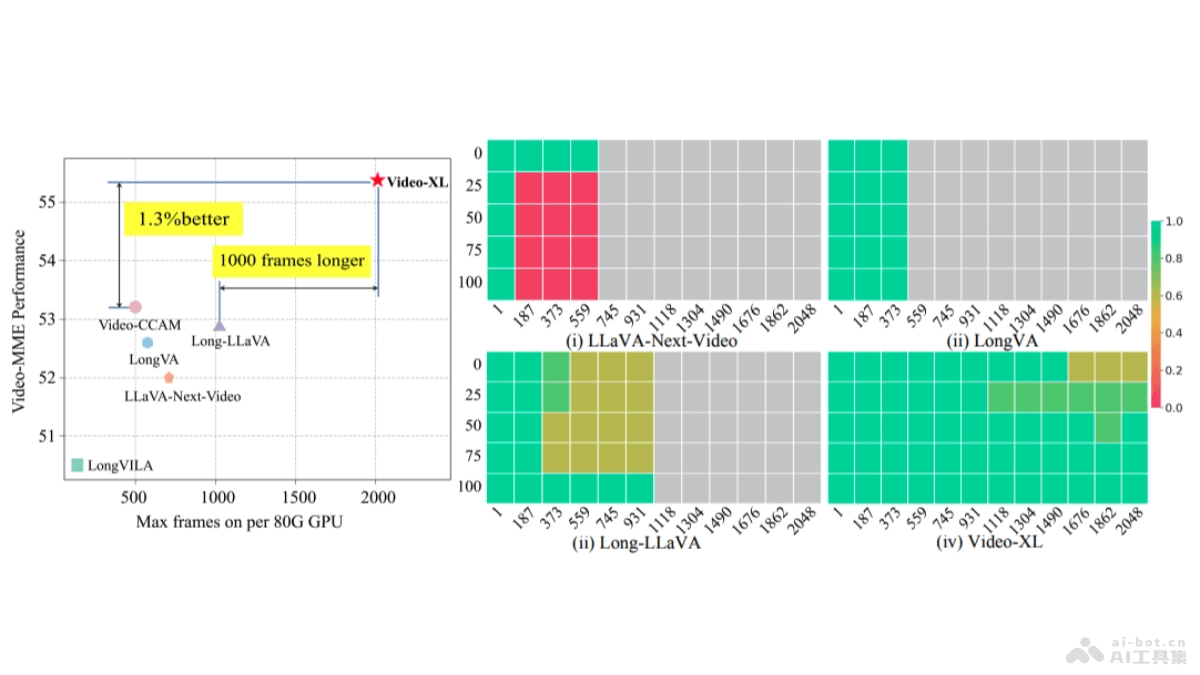
Video-XL is an ultra-long visual understanding model designed for hour-level video understanding, jointly launched by the Beijing Academy of Artificial Intelligence (BAAI) together with researchers from Shanghai Jiao Tong University, Renmin University of China, the Chinese Academy of Sciences, Beijing University of Posts and Telecommunications, and Peking University. Based on visual context latent summarization technology, it compresses visual information into a compact form, improving processing efficiency and reducing information loss. It performs excellently in multiple long video understanding benchmarks; for example, on VNBench, its accuracy is nearly 10% higher than the best existing methods, and when processing 2048 frames of video on a single 80GB GPU, its accuracy is close to 95%. Video-XL demonstrates the ability to strike a balance between efficiency and effectiveness, and has potential in long-video-specific tasks such as movie summarization, surveillance anomaly detection, and advertisement placement recognition.
Main Features of Video-XL
- Hour-Level Video Understanding: Video-XL can process very long videos, achieving hour-level video content understanding.
- Visual Compression: Based on visual context latent summarization technology, it compresses large amounts of visual information into a more compact form to adapt to the model's processing capacity.
- Efficient Computation: While maintaining high accuracy, it reduces computational resource consumption, and can process a large number of video frames on a single GPU.
- Multimodal Data Processing: Processes multiple data types including single images, multiple images, and videos.
- Long-Video-Specific Task Processing: Suitable for long-video-related specific tasks such as movie summarization, surveillance anomaly detection, and advertisement placement recognition.
Technical Principles of Video-XL
- Visual Context Latent Summarization: Introduces visual summarization tokens (VSTs) to compress the activations of the original visual context (such as keys and values in self-attention modules) into a highly compact representation.
- Chunked Processing: Splits the visual token sequence into chunks of equal size, inserts VSTs into each chunk, and uses the LLM to progressively compress the visual signal.
- Autoregressive Method: In the process of encoding each chunk, in addition to using an extra projection matrix, Video-XL reuses all modules to transform the VST hidden states, compressing the information of the visual signal into the VST activations.
- Unified Visual Encoding Scheme: Uniformly encodes single images, multiple images, and videos into the same space, handling different multimodal data.
- Long Video Dataset (VICO): Develops a new long video dataset, specifically used to handle longer videos and dynamic visual contexts, enhancing the model's long video understanding capability.
Video-XL Project Address
- GitHub Repository:https://github.com/VectorSpaceLab/Video-XL
- HuggingFace Model Library:https://huggingface.co/sy1998/Video_XL
- arXiv Technical Paper:https://arxiv.org/pdf/2409.14485
Application Scenarios of Video-XL
- Movie and Video Content Summarization: Video-XL can understand and summarize long video content, such as the main plot and events of a movie or TV series, providing users with a concise overview.
- Video Surveillance Analysis: In the field of security surveillance, it is used for abnormal behavior detection, identifying abnormal events or unusual activities in surveillance videos.
- Advertising Placement and Analysis: Video-XL helps analyze the effectiveness of advertisement placement in video content, understand the relevance between advertisements and video content, and the audience's reaction to advertisements.
- Education and Training Videos: In the field of education, Video-XL is used to understand and summarize long teaching videos, helping students quickly grasp the key points of the course.
- Video content retrieval: Video-XL is used for content retrieval in video databases, helping users quickly find key segments or related information in videos.