
What is Video-LLaVA2
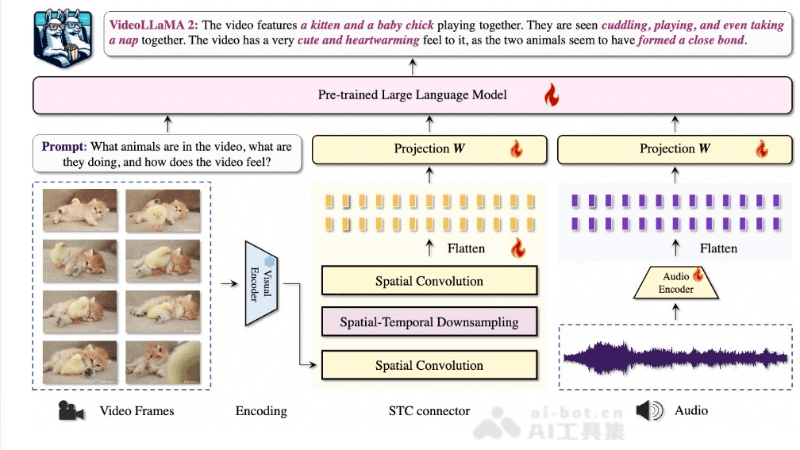
Video-LLaVA2 is an open-source multimodal intelligent understanding system launched by the ChatLaw research group at Peking University. Through an innovative Spatiotemporal Convolution (STC) connector and audio branch, it enhances video and audio understanding capabilities. The model performs excellently in multiple benchmarks such as video question answering and caption generation, comparable to some proprietary models, while also demonstrating superior multimodal understanding capabilities in audio and audio-visual question answering tasks.
Main Features of Video-LLaVA2
- Video Understanding: Accurately identifies visual patterns in videos and understands scenarios that change over time.
- Audio Understanding: Integrates an audio branch to process and analyze audio signals in videos, providing richer contextual information.
- Multimodal Interaction: Combines visual and auditory information to provide a more comprehensive ability to understand and analyze video content.
- Video Question Answering: Performs excellently in multiple video question answering tasks and can accurately answer questions about video content.
- Video Caption Generation: Can generate descriptive captions for videos, capturing key information and details of the video.
- Spatiotemporal Modeling: Through the STC connector, the model can better capture spatiotemporal dynamics and local details in videos.
Technical Principles of Video-LLaVA2
- Dual-Branch Framework: The model adopts a dual-branch framework with a vision-language branch and an audio-language branch, each independently processing video and audio data, and then performing cross-modal interaction through the language model.
- Spatiotemporal Convolution Connector (STC Connector): A customized module used to capture complex spatiotemporal dynamics in video data. Compared with traditional Q-former, the STC connector more effectively preserves local spatial and temporal details without producing a large number of video tokens.
- Vision Encoder: Selects image-level CLIP (ViT-L/14) as the vision backend, compatible with arbitrary frame sampling strategies, providing a flexible frame-to-video feature aggregation solution.
- Audio Encoder: Advanced audio encoders such as BEATs convert audio signals into fbank spectrograms and capture detailed audio features and temporal dynamics.
Project Address of Video-LLaVA2
- GitHub Repository:https://github.com/DAMO-NLP-SG/VideoLLaMA2?tab=readme-ov-file
- arXiv Technical Paper:https://arxiv.org/pdf/2406.07476
- Online Experience Link:https://huggingface.co/spaces/lixin4ever/VideoLLaMA2
How to Use Video-LLaVA2
- Environment Preparation: Ensure that the necessary software and libraries are installed in the computing environment, including Python, PyTorch, CUDA (if using GPU acceleration), and the dependency packages for the Video-LLaVA2 model.
- Obtain the Model: Download or clone the model's code repository from the official GitHub repository of Video-LLaVA2.
- Data Preparation: According to the application scenario, prepare video and/or audio data. The data should be in a format that the model can process, for example, video files may need to be converted into frame sequences.
- Model Loading: Use the code provided by Video-LLaVA2 to load the pre-trained model weights. This involves loading the vision and audio encoders, as well as the language model.
- Data Processing: Input video frames and audio signals into the model for processing. Video frames need preprocessing, such as resizing, normalization, etc., to match the model's input requirements.
- Model Inference: Use the model to perform inference on input data. For video understanding tasks, this includes video question answering, video captioning, and so on.
Application Scenarios of Video-LLaVA2
- Video Content Analysis: Automatically analyze video content and extract key information for content summarization, topic identification, and so on.
- Video Captioning: Automatically generate subtitles or descriptions for videos to improve video accessibility.
- Video Question Answering System: Build an intelligent system capable of answering questions about video content, suitable for fields such as education and entertainment.
- Video Search and Retrieval: Provide more accurate video search and retrieval services by understanding video content.
- Video Surveillance Analysis: In the field of security surveillance, automatically detect important events or abnormal behavior in videos.
- Autonomous Driving: Assist in understanding road conditions and improve the perception and decision-making capabilities of autonomous driving systems.