
What is VibeVoice
VibeVoice is a new text-to-speech (TTS) model introduced by Microsoft that can generate expressive, long-form, multi-speaker conversational audio, such as podcasts. The latest open-source VibeVoice-Realtime-0.5B model, with only 500 million parameters, achieves true real-time streaming speech synthesis with a first-packet latency of only about 300 milliseconds. Its core feature is "thinking while speaking," enabling it to start speaking while text is being generated, just like a real person, supporting pauses, tone changes, and natural conversational flow. Through innovative continuous speech tokenization technology and a next-generation token diffusion framework, combined with a large language model (LLM), the model efficiently processes long audio sequences while maintaining high fidelity. VibeVoice can synthesize speech up to 90 minutes long and support up to 4 different speakers, breaking through the limitations of traditional TTS systems and offering new possibilities for natural conversation and emotional expression.
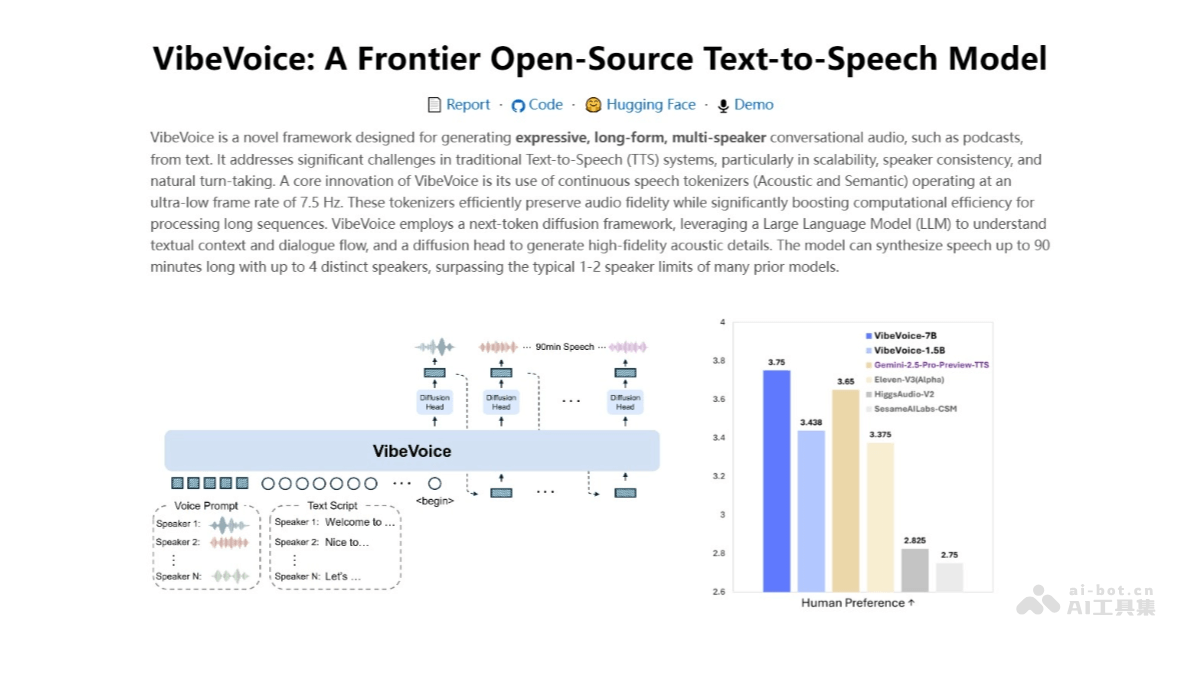
VibeVoice's Main Features
- Multi-Speaker Support: Can generate conversational audio with up to 4 different speakers, suitable for scenarios such as podcasts and audiobooks.
- Long-Form Dialogue: Supports generating continuous speech up to 90 minutes long, breaking through the length limitations of traditional TTS systems.
- Expressive Speech: Generates speech with emotion and intonation based on text content, making conversations more natural and vivid.
- Cross-Language Support: Supports speech synthesis in multiple languages and can handle cross-language conversational scenarios.
- High-Fidelity Audio: The generated speech is of high quality and close to natural human speech, providing a better user experience.
- Real-Time Interaction: Can generate speech in real time, supporting dynamic dialogue and interactive applications.
VibeVoice's Technical Principles
- Continuous Speech Tokenization: Uses continuous speech tokenization technology to decompose audio signals into semantic and acoustic tokens. The tokens operate at a very low frame rate (such as 7.5 Hz), improving computational efficiency while preserving the high fidelity of the audio. The Semantic Tokenizer is responsible for processing text content and extracting semantic information; the Acoustic Tokenizer is responsible for generating specific audio details.
- Next-Generation Token Diffusion Framework: A generation framework based on diffusion models, combined with a large language model (LLM) to understand text context and dialogue flow. The diffusion model gradually refines the generated audio tokens to ultimately generate high-quality speech signals.
- Multi-Speaker Consistency: Through specific Speaker Embeddings technology, it ensures that the voice characteristics of different speakers remain consistent in long-form conversations. The model supports multi-speaker speech synthesis and can naturally handle switches between speakers and dialogue flow.
- High-Fidelity Audio Generation: Uses advanced vocoder technology to convert generated tokens into high-quality audio signals. By optimizing the vocoder's parameters, it ensures that the generated speech is close to natural human speech in sound quality.
VibeVoice's Project Address
- Project Website:https://microsoft.github.io/VibeVoice/
- GitHub Repository:https://github.com/microsoft/VibeVoice
- HuggingFace Model Library:https://huggingface.co/collections/microsoft/vibevoice-68a2ef24a875c44be47b034f
- Technical Paper:https://github.com/microsoft/VibeVoice/blob/main/report/TechnicalReport.pdf
VibeVoice's Application Scenarios
- Podcast Production: Supports generating conversational audio with up to 4 different speakers and continuous speech up to 90 minutes long, making it very suitable for producing multi-host podcast programs and making podcast content richer and more diverse.
- Audiobooks: Generate emotional and intonated speech to make audiobooks more vivid and engaging, enhancing the listening experience for audiences.
- Virtual assistants: The generated speech is natural and fluent, suitable for voice interaction in virtual assistants, providing users with more humanized services and enhancing the user experience.
- Education and training: Suitable for simulating teaching scenarios such as classroom discussions. The emotional expression feature makes interactive teaching materials more vivid and improves learning outcomes.
- Entertainment and gaming: Generate expressive speech for virtual characters, enhancing the immersion of games and interactive entertainment applications, giving players a more realistic experience.